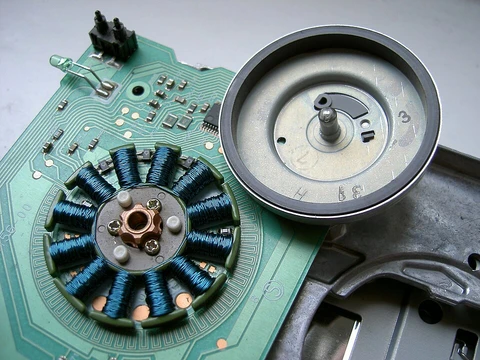
Permanent magnet motor
Electric motor using permanent magnets for field excitation.

A permanent magnet motor is an electric motor that relies on permanent magnets to create its magnetic field, paired with a wound armature. The magnets may be fixed or spinning, and can be placed inside or outside the armature in a radial flux design, or stacked with the armature in an axial flux layout. A common example is the type with stationary magnets surrounding a brushed armature, often found in toy slot cars.
These motors are used in electric vehicles like the Chevrolet Bolt and Volt, as well as the rear-wheel drive of the Tesla Model 3. Newer dual-motor Teslas combine a permanent magnet motor in the rear with a traditional induction motor up front. For certain high-efficiency uses, such as EVs, permanent magnet motors outperform induction motors or those with field windings. Tesla’s chief motor designer noted that permanent magnet machines benefit from pre-excitation by the magnets, giving them an efficiency edge, while induction machines offer perfect flux regulation. He explained that the Model 3 uses a permanent magnet motor because it best met the cost, range, and performance targets—a trade-off between motor cost, battery cost, and range that will determine future technology choices.
There are two main types: permanent magnet DC motors (run on direct current) and permanent-magnet synchronous motors (run on alternating current). They also split into surface permanent magnet (SPM) motors, with magnets on the rotor’s outside, and internal permanent magnet (IPM) motors, with magnets embedded inside the rotor. Internal magnets improve structural strength and reduce back EMF, and the holes cut for them create high-reluctance areas, letting carmakers combine benefits of reluctance motors with those of permanent magnets.
Back electromotive force (EMF), or counter-electromotive force, is the voltage generated by the relative motion between stator windings and the rotor’s magnetic field. The rotor’s shape determines the waveform. This effect also occurs in induction motors, but in those, the rotor’s fields weaken as speed increases. In a permanent magnet motor, the constant field from the magnets induces a voltage on the stator that rises linearly with speed, opposing the input voltage and creating a system loss.
The magnets in these motors come from several materials, chosen based on needed magnetic strength and cost.
- Curie temperature ndfeb
- approximately 320 °C
- Curie temperature smco
- exceeding 700 °C
- Curie temperature alnico
- nearly 800 °C
- Curie temperature ceramic
- around 450 °C
- Neodymium demand supply gap 2017
- about 10%
- Nominal composition ndfeb
- Nd14Fe78B8 (at%)
Lore & Background
Permanent magnet motors consist of two main types: surface permanent magnet (SPM) motors, which place magnets on the outside of the rotor, and internal permanent magnet (IPM) motors, which place magnets inside the rotor. Benefits of internal magnets include structural integrity and reducing back EMF, and the holes cut for magnets create areas of high reluctance, allowing some benefits of reluctance motors. Back electromotive force (EMF) occurs from relative motion between stator windings and the rotor's magnetic field; in a permanent magnet motor, the constant field induces voltage linearly with speed, which is a loss to the system.
Four primary permanent magnetic materials are used: neodymium iron boron (NdFeB), samarium cobalt (SmCo), aluminium nickel cobalt (Alnico), and strontium carbonate-iron oxide (ceramic magnet). NdFeB is the strongest, with a Curie temperature of about 320 °C, but is vulnerable to corrosion and expensive due to rare earth content. SmCo has higher coercivity and better corrosion resistance, with a Curie temperature exceeding 700 °C, but is even more expensive. Alnico is a non-rare earth material with high-temperature stability and a Curie temperature near 800 °C, but is weaker and susceptible to demagnetization. Ceramic magnets are weaker than SmCo or NdFeB but stronger than Alnico, with lower cost and good corrosion resistance, though poorer temperature stability.
Environmental and supply concerns include radioactive waste from rare earth production (TENORM), and China's 2010 restriction of neodymium shipments to Japan and subsequent export quotas, lifted in 2015. Global demand for neodymium outstripped production by about 10% in 2017. Research into non-rare earth materials is ongoing, including iron-cobalt-molybdenum alloys, nanostructured cobalt-platinum alloys, and meteoric-type ordered iron-nickel alloys.
Reader's Guide
The permanent magnet motor is significant for its efficiency benefits in high-efficiency applications, particularly electric vehicles. As noted in the article, Tesla's chief motor designer stated that permanent magnet machines have the benefit of pre-excitation from the magnets, providing an efficiency benefit, while induction machines have perfect flux regulation. For the Tesla Model 3, the permanent magnet machine better solved the cost minimization function and was optimal for range and performance targets. The trade-off between motor cost, range, and battery cost determines which technology will be used in the future. Recent dual-motor Tesla models use a combination of a permanent magnet motor at the back and a traditional induction motor at the front. The choice of permanent magnet material—NdFeB, SmCo, Alnico, or ceramic—depends on factors such as magnetic strength, cost, temperature stability, and corrosion resistance, with rare earth materials facing supply and environmental challenges. The development of non-rare earth materials is an active research area to address these concerns.
Did You Know?
- Permanent magnet motors are used in the Chevrolet Bolt and Volt, and the rear wheel drive of the Tesla Model 3.
- NdFeB magnets have a Curie temperature of approximately 320 °C and are the strongest permanent magnet material used industrially.
- SmCo magnets have a Curie temperature exceeding 700 °C and higher coercivity than NdFeB, but contain a higher fraction of rare earth metals.
More in Electric Motors, Part 2 1-24
Spotted an error? Know more?
Reader corrections go straight into our review queue. Suggest an edit · How this site is sourced