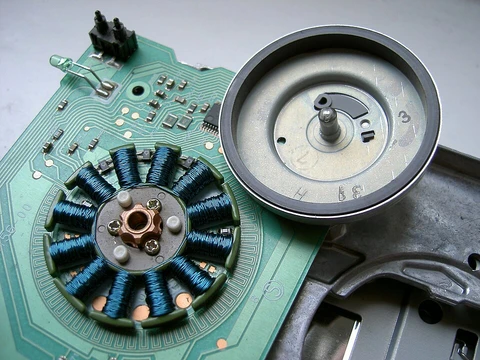
Mouse mill motor
Early electric motor with governed speed, used in telegraphy.

The mouse mill motor, also known as the Revolving Armature Engine, is an early form of electric motor invented by Paul-Gustave Froment in 1844. It has similarities to both the synchronous motor and the contemporary stepper motor. Its name derives from the rotor's resemblance to a small treadmill, though usual sizes were more to the scale of a hamster than a mouse. The motor was notable for being simple to construct and for its speed being easily governed, leading to later use in driving automatic recorders in telegraphy.
- Inventor
- Paul-Gustave Froment
- Year of invention
- 1844
- Alternative name
- Revolving Armature Engine
- Common maker
- Daniel Davis of Boston
- Rotor bars
- six or eight (commonly)
- Electromagnet count
- one, two, or four
Lore & Background
The motor was invented by French electrical engineer Paul-Gustave Froment in 1844. It has some similarity to Ritchie's earlier motor of 1833, but Ritchie's rotor used only the two ends of a single bar, giving uneven torque. Several similar motors existed at the time but suffered from drawbacks such as depending on weakly magnetised materials, requiring rotating coils with unsolved brushgear problems, or being reciprocating machines with uneven rotation. Froment's motor was the first that offered useful rotation and the capacity to do mechanical work, not merely to be a demonstration or indicator.
The motor consists of a freely rotating rotor made of a light brass wheel with soft iron bars mounted around its rim, surrounded by one, two, or four electromagnets. Each magnet has a cam-operated switch. Operation relies on simple magnetic attraction: as a bar approaches a magnet, the current switches on and pulls the bar; as it gets closer, the current switches off, allowing the bar to continue past. The bars are spaced symmetrically for balance, while coils are spaced unevenly for more even torque. The motor always rotates in the same direction, as reversing would require changing the phasing of cams and switches.
Speed is controlled by a centrifugal governor. When overspeed is detected, the governor interrupts the cam linkage, reducing the time the switches are activated and slowing the motor. Because the governor gradually adjusts contact times rather than shutting off power altogether, the motor could be governed very precisely. For motors with multiple electromagnets, the motor is usually self-starting; the simpler single-magnet form may require a flick to start from some positions.
Reader's Guide
The mouse mill motor's significance lies in being the first early electric motor to offer useful rotation and the capacity to do mechanical work, overcoming limitations of earlier designs that depended on weakly magnetised materials, rotating coils with brushgear problems, or reciprocating mechanisms. Its simple construction and precise governing capability made it practical for driving automatic recorders in telegraphy, specifically powering the paper feed mechanism for Kelvin's and Muirhead's syphon recorders. In Muirhead's design, a vibrating pen avoided ink sticking; in Kelvin's, a hollow glass pen used electrostatic charge from an influence machine also driven by the motor. Larger similar machines later recorded Morse code telegraphy. However, the mechanically-governed mouse mill motor was not synchronous; for telegraph machines depending on precise timing to signal letters, a synchronous motor such as that developed by Paul Le Cour was used. The motor's legacy includes its role as a bridge between demonstration devices and practical work-performing motors, and its governing mechanism—which gradually adjusted contact times rather than shutting off power—allowed unusually precise speed control.
Did You Know?
- Many early mouse mill motors were made by scientific instrument maker Daniel Davis of Boston, who sold them as the 'Revolving Armature Engine'.
- The motor always rotates in the same direction; there is no record of motors being built for easy reversing.
- The motor was used decades after its invention to power paper feed mechanisms for Kelvin's and Muirhead's syphon recorders in telegraphy.
More in Electric Motors, Part 2 1-24
Spotted an error? Know more?
Reader corrections go straight into our review queue. Suggest an edit · How this site is sourced