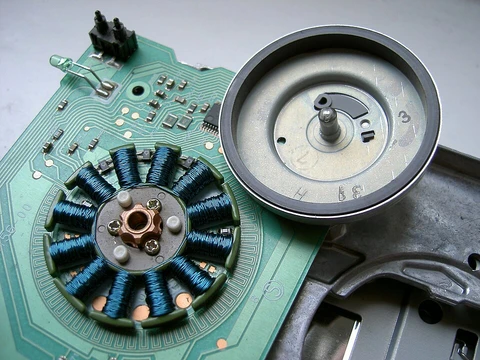
Motor drive
A system controlling motor speed, adjustable or variable.

A motor drive is an electrical system built around a motor. When a motor drive can operate at several distinct speeds, it is called an adjustable-speed motor drive; if its speed can be changed smoothly across a range without steps, it is a variable-speed motor drive. Even when the motor generates electricity instead of using it, the system may still be called a motor drive, though it could also be termed a generator drive. More broadly, the word "drive" refers to any equipment that controls the speed of machinery.
The electronic part that regulates motor speed is known as a variable-frequency drive (VFD) or variable-speed drive (VSD). Many industrial processes, like assembly lines, need different speeds for different products. Adjusting a pump or fan's speed to match flow requirements can save energy compared to other flow-control methods.
If a drive offers several preset speed ranges, it is usually called adjustable speed. If the output speed can be varied continuously over a range, it is typically called variable speed. These drives can be purely mechanical (called variators), electromechanical, hydraulic, or electronic. Sometimes "motor drive" is used interchangeably with VFD or VSD because it controls a motor.
Electric motors running on AC can operate at fixed speeds determined by the number of stator pole pairs and the supply frequency. Some AC motors are designed for pole changing—rewiring the stator to change the number of poles, giving two or sometimes three speeds. For instance, a motor with eight physical pole pairs can be connected to run as either four or eight pole pairs, yielding 1800 RPM and 900 RPM at 60 Hz. If speed changes are infrequent, the motor can be rewired manually, or magnetic contactors can switch between speeds as needed. More than three speeds are not economical. The number of fixed speeds is limited by cost as pole pairs increase. For many different speeds or continuous variation, other methods are needed.
DC motors can change speed by adjusting the shunt field current or by varying the voltage applied to the armature. An adjustable-speed motor drive may consist of an electric motor and a controller that adjusts its operating speed. It can also be a constant-speed motor paired with a continuously adjustable mechanical speed changer.
- Fixed speed example 60hz
- 1800 RPM and 900 RPM for eight physical pole pairs connected as four or eight pole pairs
- Airflow energy example
- For 50% airflow, variable-speed motor consumes about 20% input power; fixed-speed motor consumes about 85% input power at half flow
- Primary reasons for use
- Process control and energy conservation
Lore & Background
Before electric motors were invented, mechanical speed changers were used to control the mechanical power provided by water wheels and steam engines. When electric motors came into use, means of controlling their speed were developed almost immediately. Today, various types of mechanical drives, hydraulic drives and electric drives compete with one another in the industrial drives market. Mechanical drives include variable-pitch pulley and belt drives and traction drives that transmit power through metal rollers. Hydraulic adjustable-speed drives include hydrostatic drives (using a hydraulic pump and motor), hydrodynamic drives (fluid couplings), and hydroviscous drives (discs pressed together with an oil film). Electric adjustable-speed drives include power electronics-based variable-frequency drives, which are rapidly making older technologies redundant. AC motors can be run in fixed-speed operation determined by the number of stator pole pairs and the frequency of the alternating current supply; pole changing allows two or sometimes three speeds. Direct-current motors allow speed changes by adjusting shunt field current or armature voltage.
Reader's Guide
Adjustable-speed drives are notable for process control and energy conservation. Historically developed for process control, energy conservation has emerged as an equally important objective. For fans and pumps serving varying loads, using a damper or valve to reduce flow introduces energy loss through pressure drop; a variable-speed drive adjusts supply to match demand without extra loss. Following the affinity laws, for 50% airflow a variable-speed motor consumes about 20% of input power, while a fixed-speed motor still consumes about 85% at half flow. Adjustable-speed drives can also provide smoother operation, as in a sewage lift station where continuous speed adjustment matches outflow to average inflow, avoiding the surges and stresses of cycling fixed-speed pumps on and off. Power electronics-based variable-frequency drives are rapidly making older technologies redundant. The term 'motor drive' sometimes gets interchanged with VFD or VSD.
Did You Know?
- An adjustable-speed motor drive might consist of an electric motor and controller, or a constant-speed motor with a continuously adjustable mechanical speed-changing device.
- AC motors can be made for pole changing operation, reconnecting the stator winding to vary the number of poles so that two, sometimes three, speeds are obtained.
- Hydrodynamic drives use oil to transmit torque between an impeller on the constant-speed input shaft and a rotor on the adjustable-speed output shaft.
Frequently Asked Questions
Who is Motor drive?
A motor drive is an electrical system built around a motor whose job is to govern how fast the connected machinery runs. In the broadest sense, the word "drive" simply names any piece of equipment that controls the speed of machinery.
What are Motor drive's powers/role?
A motor drive regulates speed in two principal ways: an adjustable-speed drive locks the motor into several distinct speeds, while a variable-speed drive lets the speed shift smoothly across a continuous range. The electronic component that actually performs this regulation is the variable-frequency drive.
Why is Motor drive important?
The energy payoff is striking — at just 50 % airflow, a variable-speed motor draws roughly 20 % of its input power, whereas a fixed-speed motor still burns about 85 % at that same half-flow point. This gap is the primary reason drives are central to modern energy-efficient design.
What's the difference between Motor drive and Generator drive?
Even when the motor is producing electricity rather than consuming it, the surrounding control system can still be called a motor drive, though it may also be referred to as a generator drive. The terminology overlaps because the underlying speed-control architecture is essentially identical in both directions.
More in Electric Motors, Part 2 1-24
Spotted an error? Know more?
Reader corrections go straight into our review queue. Suggest an edit · How this site is sourced