Pip (counting)
Small symbols used for counting on cards, dice, and dominoes.

Pips are small, countable marks used on items like dominoes, dice, and playing cards. On playing cards, pips are the symbols on the front that show the card's suit and rank. A standard 52-card deck has four suits (spades, hearts, clubs, diamonds), each with thirteen cards. Three of these are face cards (jack, queen, king), while the other ten are pip cards, numbered one through ten (though the one is usually called an ace and often ranks highest). Each pip card has a small index in the top-left and bottom-right corners (or all four corners in Europe, for left-handed players) showing its value, and the center displays pips matching the suit. The number of pips equals the card's number, and their layout is consistent across decks. Pip cards are also called numeral cards, number cards, spot cards, or spotters. In point-trick games, card points are sometimes called pips, as cards often score their pip value (or an equivalent for court cards, like a king being worth 13). Many French-suited packs based on the English pattern have a special Ace of spades with a large pip or image and manufacturer details, originally for stamp duty. Similar treatment applies to the Ace of clubs in the Paris pattern, the Ace of diamonds in the Russian pattern, the Ace of hearts in Germany, or the deuce of hearts for German-suited cards. For Latin-suited cards, the ace of coins is used. Historically, German pips differ from those in France and England, with the latter dating back to at least the 1300s.
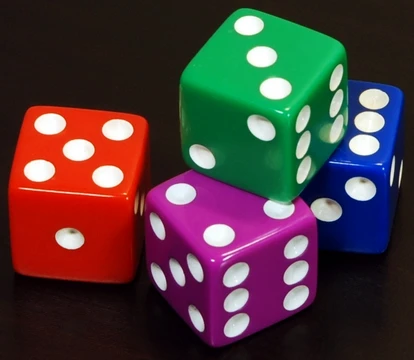
On dice, pips are small dots on each face, arranged in patterns for numbers one through the number of faces. On a standard six-sided die, opposite faces add up to seven. Pips are usually black on white or yellow dice, and white on other colors, though colored pips on white or yellow dice exist. Asian dice often have a large red pip for the one face, while the 1964 game Kismet uses black pips for 1 and 6, red for 2 and 5, and green for 3 and 4.
Domino pips work similarly to dice. Each half of a domino tile can have from zero up to 18 pips, depending on the set. A standard double-six set ranges from blank to six pips per half. Larger sets like double-nine or double-twelve extend this range for more players.
- field
- Gaming and counting
- known_for
- Small symbols used for counting on playing cards, dice, and dominoes
- variants
- Pip cards, spot cards, spotters, numerals
Lore & Background
In playing cards, pips are small symbols on the front side that determine the suit and rank. A standard 52-card deck has four suits of thirteen cards each: spades, hearts, clubs, and diamonds. Each suit contains three face cards (jack, queen, king) and ten pip cards numbered from one to ten, with the 'one' almost always changed to 'ace'. Each pip card has an encoding in the top left-hand corner and lower right-hand corner, while in Europe it is more common to have corner indices on all four corners. The center of the card contains pips representing the suit, with the number of pips corresponding to the card's number, and the arrangement generally consistent from deck to deck.
Reader's Guide
Pips are a fundamental counting tool in games, appearing on playing cards, dice, and dominoes. On dice, pips are small dots arranged in patterns denoting numbers, with the sum of pips on opposing faces of a six-sided die traditionally adding up to seven. Dominoes use pips similar to dice, with each half of a tile having from no pips up to 18 in practice. Historically, German pips differ from those used in France and England, with the latter dating from at least the fourteenth century CE. Many French-suited packs derived from the English pattern contain a variation on the pip style for the Ace of spades, often with an especially large pip or representative image, originally to display stamp duty. In point-trick games where cards score their value in pips, card points are sometimes referred to as pips. The term 'pip cards' originally came from 'peep' and are also known as numerals, number cards, spot cards, or spotters.
Did You Know?
- In playing cards, the 'one' pip card is almost always changed to 'ace' and often is the highest card in many games.
- For a common six-sided die, the sum of the pips on opposing faces traditionally adds up to seven.
- In Europe, it is more common to have corner indices on all four corners of playing cards, allowing left-handed players to fan their cards more comfortably.
- Many French-suited packs contain a variation on the pip style for the Ace of spades, originally to display stamp duty.
More in Dice 1-21
Spotted an error? Know more?
This is a living reference — every entry is fact-audited, and reader corrections feed straight into our audit queue. Suggest an edit · See this site's audit record