Dice notation
Standard notation for rolling polyhedral dice in games.

Dice notation is a system used to represent combinations of dice in wargames and tabletop role-playing games through simple algebra-like notation such as d8+2. It was already in use in wargaming communities before Dungeons & Dragons, and became a standard method for specifying die rolls.
- introduced_by
- Unknown (predates 1975; used in wargaming communities)
- first_publication
- Unknown (predates Alarums & Excursions, 1975)
- adopted_by
- Gary Gygax in early Dungeons & Dragons products (before Advanced Dungeons & Dragons, 1977–1979)
Lore & Background
Dice notation originated in the early days of tabletop role-playing games. Miniatures wargamers began using dice in the shape of Platonic solids in the late 1960s and early 1970s. Dungeons & Dragons, first published in 1974, initially had no standardized way to call for polyhedral die rolls, sometimes using verbal instructions or ambiguous ranges. For example, the spell sticks to snakes instructed 'roll two eight-sided dice,' while a random encounter might list a range like '30–300' orcs without specifying the method.
Dice notation was already in use in wargaming communities before 1975, and it appeared in the fanzine Alarums & Excursions that year, but it was not introduced there. Gary Gygax had already used the notation in earlier D&D products before the first edition of Advanced Dungeons & Dragons (1977–1979). The close association between D&D fandom and standard dice notation is reflected in the name of the Open Game version of the D&D rules: the 'd20 System.'
Reader's Guide
Dice notation's significance lies in its role as a universal shorthand for describing random outcomes in tabletop games. The basic form nds (e.g., 3d6) specifies the number of dice (n) and the number of faces per die (s), with the letter 'd' standing for die or dice. Modifiers can be added (e.g., 1d20−10), and expressions can be chained (e.g., 2d6+1d8). The notation also accommodates dropping the lowest or highest result (e.g., 4d6−L), which skews probability curves. Variations include multipliers (e.g., 1d6×5), percentile dice (d% using two ten-sided dice), and selective results (e.g., 4d6dh1dl1 for dropping highest and lowest). The system's flexibility and clarity made it essential for game design and player communication, influencing countless role-playing games and wargames. Its legacy endures in the d20 System and in the widespread use of polyhedral dice across the hobby.
Did You Know?
- The letter 'd' in dice notation is most commonly lower-case, but some forms use upper-case D, and non-English texts sometimes use the equivalent first letter of the local word for 'dice'.
- A notable exception to uniform numbering is the d10, which is labeled from 0 to 9, though the 0 can also be read as a 10.
- Rolling three or more dice gives a probability distribution that is approximately Gaussian, in accordance with the central limit theorem.
- Before the widespread use of ten-sided dice, twenty-sided dice were sometimes manufactured with two copies of each digit 0 to 9 for use as percentile dice, but ten-sided dice were introduced earlier, in the late 1970s (e
Ancient Origins and Archaeological Evidence
Dice predate written history, and their exact birthplace remains a mystery. Scholars believe they evolved from the practice of casting the talus bones of hoofed animals, a fortune-telling ritual colloquially called knucklebones. Some of the earliest evidence points to Native Americans of the Great Plains, who may have been rolling dice as far back as 12,000 years ago, around 10,000 BCE. In the ancient world, the Egyptian game of senet, played from before 3000 BCE through the second century CE, used flat two-sided throwsticks that functioned as a primitive form of dice. Among the oldest physical dice ever found are those excavated at the Burnt City in south-eastern Iran, dating between 2800 and 2500 BCE, discovered alongside a backgammon-like game set. Bone dice from Skara Brae in Scotland span 3100 to 2400 BCE, while terracotta dice pulled from graves at Mohenjo-daro in the Indus Valley civilization date to 2500 to 1900 BCE. Remarkably, at least one Mohenjo-daro die already featured the modern convention of opposite sides summing to seven.
Cultural Transmission Across Civilizations
The story of dice is inseparable from the broader story of human play and technology. In ancient India, games involving dice appear in sacred texts including the Rigveda, Atharvaveda, and Mahabharata, as well as in Buddhist lists of games. In Greece, the skill-based game of knucklebones evolved into a form where four sides of the bones were assigned different values, closely mirroring modern dice. Roman culture embraced dicing with such fervor that the act received its own Latin phrase, aleam ludere, even though gambling was technically illegal. Romans used two distinct sizes: large four-sided tali marked with one, three, four, and six pips, and smaller six-sided tesserae. The tradition traveled eastward, where in China it spawned dominoes and, by the Tang dynasty, playing cards, a shift that paralleled the technological move from rolled manuscripts to block-printed books. In Japan, dice fueled the popular game sugoroku, with two variants: ban-sugoroku, a backgammon-like game from the Heian period, and e-sugoroku, a racing game. Meanwhile, twenty-sided dice trace back to Ptolemaic Egypt in the second century BCE, showing that non-cubic forms were already in circulation millennia ago.
Construction, Design, and Manufacturing
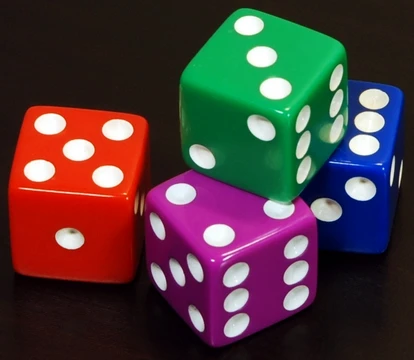
The physical design of a standard die follows conventions that have persisted for thousands of years. The most common form is a small cube, typically 1.6 centimeters across, with six faces marked by patterns of round dots called pips representing the numbers one through six. A defining rule is that opposite faces must sum to seven, which forces the one, two, and three faces to meet at a single vertex. Depending on whether those three faces run clockwise or counterclockwise around that vertex, the die is classified as right-handed or left-handed. Western dice are normally right-handed, while Chinese dice tend to be left-handed. Asian-style dice share similar pip layouts but place the dots closer to the center of each face, vary pip sizes, and color the one and four sides red, a red four that may trace back to Indian origins. In manufacturing, dice fall into two broad categories: precision dice, used in casinos, which are larger, translucent, and feature flush markings with sharp edges; and non-precision dice, sold with board games, which are smaller, opaque, and have recessed markings with rounded corners. Non-precision dice are typically produced by plastic injection molding, often from polymethyl methacrylate, with pips integrated directly into the mold.
Terminology, Slang, and Gambling Culture
The language surrounding dice carries layers of etymology and subcultural slang. The English word die descends from Old French dé, which in turn comes from the Latin datum, meaning something which is given or played. A set of older terms for the faces, ace, deuce, trey, cater, cinque, and sice, are now largely obsolete in everyday speech, though some professional gamblers still use them. Ace itself derives from the Latin as, meaning a unit, while the remaining five names come from Old French. When two dice are rolled together, specific outcomes have acquired colorful slang. A roll of one pip on each die is called snake eyes, a term the Online Etymology Dictionary traces to 1919. A double six is known in the United States as boxcars or midnight, a name drawn from the visual resemblance of two rows of six pips to a pair of boxcars on a freight train. Many additional rolls carry their own names within the game of craps, reflecting the deep cultural embedding of dice in gambling traditions.
Frequently Asked Questions
What is dice notation?
Dice notation is a compact, algebra-like shorthand that lets players and designers specify die rolls and their modifiers in a single string, such as 2d6+3. It tells you how many dice to roll, how many faces each has, and what flat number to add to the total. It became the universal way to describe rolls across wargames and tabletop RPGs.
Who invented dice notation?
No single individual is credited with creating it; the shorthand grew organically inside wargaming communities before 1975. Its earliest published uses predate even Alarums & Excursions (1975), so the origin remains unattributed.
How did dice notation get into Dungeons & Dragons?
Gary Gygax borrowed the existing wargaming shorthand for his early D&D rulebooks, well before Advanced Dungeons & Dragons appeared in 1977–1979. By printing it throughout the core books, D&D locked the notation in as the default way players communicate die mechanics.
What exactly does a notation like d8+2 mean?
The 'd' stands for die, the number after it is the face count (an eight-sided die here), and '+2' is a flat modifier added to whatever comes up. You roll one d8, then add two to the result to get your final number.
Why is dice notation important to the tabletop hobby?
It gives every designer, referee, and player a shared, unambiguous language for describing probability and modifiers without long prose. Because it predates the modern RPG era and was carried forward by D&D, it remains the standard shorthand across virtually every polyhedral-dice game today.
More in Dice 1-21
Spotted an error? Know more?
This is a living reference — every entry is fact-audited, and reader corrections feed straight into our audit queue. Suggest an edit · See this site's audit record