Fuzzy dice
Plush dice hung from rearview mirrors, rooted in WWII pilot tradition.

Fuzzy dice—also called fluffy dice, soft dice, or stuffed dice—are a car decoration made of two oversized plush cubes, usually six-sided, that dangle from the rearview mirror. The first fuzzy dice from the 1950s were white and about 3 inches (8 cm) wide. Today, they are available in many colors and sizes.
The tradition likely started with American fighter pilots in World War II. Before a sortie, they would hang dice above their cockpit instruments, showing seven pips, as a good-luck charm. Some think the dice symbolized the high risk of the missions, given the heavy losses pilots faced—though actual loss rates varied widely by theater and time period. After the war, many former airmen kept the practice going.
In the 1950s, fuzzy dice became one of the first products sold specifically for hanging from a rearview mirror. According to the *Encyclopedia of American Social History*, young adults in that decade were drawn to cars "customized for speed, painted with vivid colors, stripes, and flames, tuck-and-roll interiors, fuzzy dice suspended from the mirror, rock-and-roll on the radio..." Another idea is that displaying the dice meant the driver was ready to "dice with death" in the risky, unregulated world of street racing.
However, research in the lowrider community found that even dedicated owners "did not attach any significance to the dice" hanging in their cars. Some places make it illegal to hang objects from rearview mirrors. A modern upgrade includes illuminated LED plastic dice that change colors.
- field
- Automotive decoration
- known_for
- Hanging from rearview mirrors as a symbol of luck or risk
- origin
- Believed to trace back to American fighter pilots during World War II
Lore & Background
The use of fuzzy dice is believed to be traced back to American fighter pilots during World War II. Pilots would hang the dice above their instruments, displaying seven pips, before a 'sortie' mission for good luck. It is also speculated that the dice represented the high degree of risk associated with fighter sorties, as pilot losses were significant—though actual loss rates varied by theater and time period. Upon returning after the war, many airmen continued the tradition.
In the 1950s, the fuzzy dice became one of the first items sold specifically to be hung from a rearview mirror. The Encyclopedia of American Social History notes that during the 1950s, young adults were drawn to cars that were 'customized for speed, painted with vivid colors, stripes, and flames, tuck-and-roll interiors, fuzzy dice suspended from the mirror, rock-and-roll on the radio...'.
Another explanation for hanging these in a car has been proposed that 'displaying the dice meant the driver was ready and willing to be dicing with death' in the dangerous and unregulated world of street racing. In some segments, such as the lowrider community, research indicated that even the most dedicated individuals 'did not attach any significance to the dice' that were hung from their car's rearview mirror.
Reader's Guide
Fuzzy dice emerged as a cultural artifact from World War II, where American fighter pilots hung dice above their instruments for luck before missions, symbolizing the high risk of being shot down. After the war, returning airmen continued the tradition, and by the 1950s, fuzzy dice became one of the first items sold specifically for rearview mirrors. They were adopted by youth culture as part of customizing cars for speed and style, alongside vivid paint, flames, and rock-and-roll. The dice also carried a connotation of 'dicing with death' in street racing, though a 1993 study found no correlation between their use and reckless driving. In some communities, like lowriders, the dice held no particular significance. Their legacy persists as a nostalgic automotive decoration, with modern variations including illuminated LED plastic dice. In some jurisdictions, suspending objects from rearview mirrors is illegal, reflecting ongoing tension between tradition and safety regulations.
Did You Know?
- The original fuzzy dice used in the 1950s were white and approximately 3 inches (8 cm) across.
- Fuzzy dice are believed to trace back to American fighter pilots during World War II, who hung dice above their instruments for good luck before missions.
- While some claim that fuzzy dice are linked to reckless driving, no widely-known, reputable study has confirmed a direct correlation between their use and driving behavior.
Ancient Origins & Archaeological Record
Dice predate any written record of human civilization, and no single origin story has been firmly established. Scholars generally trace their development to the ancient practice of casting the talus bones of hoofed animals—colloquially called knucklebones—for divination. Some researchers speculate that Indigenous peoples of the North American Great Plains were already casting dice-shaped objects as far back as twelve thousand years ago, around 10,000 BCE. In Egypt, the board game senet, played from before 3000 BCE through the second century CE, relied on flat, two-sided throwsticks that indicated how many squares a player advanced. Among the most remarkable archaeological finds are bone dice from the village of Skara Brae in Scotland, dated between 3100 and 2400 BCE, and terracotta dice recovered from burial sites at Mohenjo-daro in the Indus Valley, spanning 2500 to 1900 BCE. At least one Mohenjo-daro specimen already followed the convention of opposite faces summing to seven, a rule still standard on modern cubes. A backgammon-like game set containing what may be the oldest known dice was excavated at the Burnt City in southeastern Iran, estimated at 2800 to 2500 BCE.
Cultural Diffusion & Game Evolution
Dice games appear in some of the oldest literary traditions. The ancient Indian Rigveda, Atharvaveda, and Mahabharata all reference games involving dice, as does the Buddhist games list. In ancient Greece, knucklebones was a game of skill, and a later derivative assigned different values to the four sides of the bones, closely mirroring modern dice. Roman culture embraced dicing—known as aleam ludere—despite gambling being technically illegal. Romans used two distinct sizes: tali, large four-sided dice bearing one, three, four, and six pips, and tesserae, smaller cubes numbered one through six. Polyhedral dice were not limited to six faces; twenty-sided examples date to the second century CE, and Ptolemaic Egypt produced them as early as the second century BCE. In China, dice served as the direct ancestor of both dominoes and playing cards. The shift from dice to cards occurred around the Tang dynasty (618–907 CE), a period that also saw the technological transition from rolled manuscripts to block-printed books. In Japan, the popular game sugoroku came in two forms: ban-sugoroku, a backgammon-like contest dating to the Heian period (794–1185 CE), and e-sugoroku, a racing variant.
Construction & Design Conventions
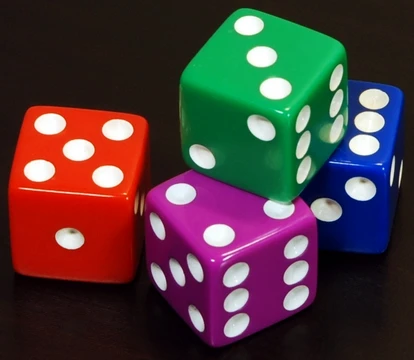
Standard dice are small cubes, typically 1.6 centimeters across, with faces marked by patterns of round dots called pips. A defining geometric rule is that opposite faces always sum to seven, which forces the one, two, and three faces to meet at a single vertex. The rotational order of those three faces determines handedness: if they run counterclockwise the die is right-handed, and if clockwise it is left-handed. Western dice are normally right-handed, while Chinese dice are normally left-handed. Asian-style dice share similar pip layouts but place the dots closer to the face center, vary pip sizes, and color the one and four faces red—a red four possibly of Indian origin. In manufacturing, dice fall into two broad categories. Precision dice, used in casinos, are larger, translucent, feature flush markings, and have sharp corners and edges. Non-precision dice, sold with board games, are smaller, opaque, carry recessed markings, and have rounded edges. Non-precision dice are produced by plastic injection molding, typically from polymethyl methacrylate, with the pips formed directly into the mold. Pigments can render them opaque, transparent, or speckled.
Language & Slang
The English word die descends from Old French dé, which in turn comes from the Latin datum, meaning something that is given or played. A set of older terms—ace, deuce, trey, cater, cinque, and sice—once named the six faces in order. Ace derives from the Latin as, a unit, while the remaining five are Old French numerals for two through six. Although these labels are largely obsolete in everyday speech, professional gamblers still employ them to call out specific sides. When two dice are rolled together, particular combinations carry colorful slang. Snake eyes, a roll of one pip on each die, has been documented in English since at least 1919. Boxcars, also called midnight, refers to a double six; the name evokes the visual resemblance of two rows of six pips to a pair of boxcars on a freight train. The game of craps has generated an extensive vocabulary of named rolls, and these terms have seeped into broader colloquial English, giving the humble cube a surprisingly rich linguistic afterlife.
Frequently Asked Questions
What exactly are fuzzy dice?
Fuzzy dice are a pair of large, soft, cube-shaped ornaments—usually with six faces—that dangle from a vehicle's rearview mirror. They go by several other names, including fluffy dice, soft dice, and stuffed dice.
How did the fuzzy dice tradition begin?
The practice is generally traced to U.S. fighter pilots in World War II, who would clip a set of dice above their instrument panel before each flight as a talisman for survival. Some also link the imagery to the extreme danger pilots faced, given the high casualty rates of those missions.
What did the very first fuzzy dice look like?
The earliest versions, which appeared in the 1950s, were plain white cubes measuring about three inches (roughly 8 cm) on a side. Today they come in virtually any color or size you can imagine.
Why do drivers still hang fuzzy dice in their cars?
They serve as a lighthearted good-luck charm for the road while also paying quiet homage to the original wartime custom of acknowledging risk before a dangerous journey.
Are fuzzy dice purely decorative, or do they carry deeper meaning?
Beyond being a fun car accessory, they inherit a symbolic weight from the WWII pilot tradition—representing both a wish for a safe outcome and an acknowledgment of the hazards inherent in any trip.
More in Dice 1-21
Spotted an error? Know more?
This is a living reference — every entry is fact-audited, and reader corrections feed straight into our audit queue. Suggest an edit · See this site's audit record