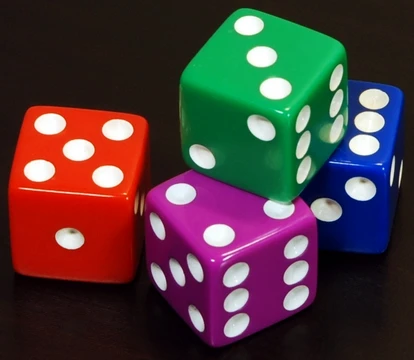
Intransitive dice
Dice sets where A beats B, B beats C, but C beats A.

Intransitive dice are sets of dice where the relation 'rolls a higher number more than half the time' is not transitive. This means that while die A may beat die B, and die B may beat die C, die A does not necessarily beat die C; in fact, die C may beat die A. Such sets challenge intuitive expectations about probability and are used to create games biased in favor of the second player.
- field
- Probability, Game theory
- known_for
- Intransitive (nontransitive) dice sets that violate transitivity in probability
Lore & Background
A set of dice is intransitive if it contains more than two dice with the property that each die rolls higher than the next more than half the time, but the first does not roll higher than the last more than half the time. For example, a set of three dice—A (2,2,4,4,9,9), B (1,1,6,6,8,8), and C (3,3,5,5,7,7)—has the property that A beats B, B beats C, and C beats A, each with probability 5/9. This set also has the stronger property that for each die, there is another that beats it more than half the time.
Efron's dice are a set of four intransitive dice invented by Bradley Efron. The dice A (4,4,4,4,0,0), B (3,3,3,3,3,3), C (6,6,2,2,2,2), and D (5,5,5,1,1,1) have the property that each die is beaten by the previous die in the list with wraparound, with probability 2/3. C beats A with probability 5/9, and B and D have equal chances of beating the other.
Miwin's dice are a set of nontransitive dice invented in 1975 by physicist Michael Winkelmann. They consist of three dice with faces bearing numbers from one to nine; opposite faces sum to nine, ten or eleven. In one set, die III (1,2,5,6,7,9), die IV (1,3,4,5,8,9), and die V (2,3,4,6,7,8) have the property that III beats IV, IV beats V, and V beats III, each with probability 17/36.
Reader's Guide
Intransitive dice are significant because they illustrate a counterintuitive property of probability: that a non-transitive relation can exist in a seemingly simple random process. This has implications for game theory, decision theory, and the design of games. In a game where the first player chooses a die and the second player chooses from the remaining dice, intransitive dice give the second player an advantage, as they can always pick a die that beats the first player's die more than half the time. This contrasts with transitive dice, where the first player can always find a die that is not beaten by any other more than half the time. The concept extends to weighted dice, where the maximum probability that each die beats the next in a cycle is approximately 0.62 (1 over the golden ratio). Efron's dice and Miwin's dice are notable examples that have been used to study optimal strategies and random number generation. Miwin's dice, in particular, allow generating numbers within a given range with equal likelihood, such as numbers 1 through 9 or 0 through 80, by rolling one or two dice chosen at random. The legacy of intransitive dice lies in their ability to challenge naive intuitions about probability and to provide practical tools for game design and statistical education.
Did You Know?
- A set of three dice (A: 2,2,4,4,9,9; B: 1,1,6,6,8,8; C: 3,3,5,5,7,7) is intransitive, with each die beating the next with probability 5/9.
- Efron's dice are a set of four intransitive dice where each die is beaten by the previous die in the list with wraparound, with probability 2/3.
- Miwin's dice were invented in 1975 by physicist Michael Winkelmann and consist of three dice with faces bearing numbers from one to nine.
- For standard intransitive dice, the maximum probability that each die beats the next in a cycle is 5/9 ≈ 0.555, a well-known result in the study of nontransitive dice.
The Core Idea: Fair Order of Play
Go First Dice represent a fascinating mathematical puzzle: designing a set of dice where every participant has an identical probability of rolling the highest, second-highest, and so on when all dice are thrown simultaneously. The primary practical purpose is straightforward — settling who moves first in a board game or similar multi-player activity without bias. A critical design constraint ensures that every face value across the entire set is unique, which eliminates the possibility of ties entirely. This distinguishes Go First Dice from ordinary dice sets, where duplicate numbers are common and ties require re-rolls or arbitrary tiebreakers. The elegance of the concept lies in transforming what seems like a simple roll to see who goes first into a deep combinatorial challenge, where the arrangement of numbers on each face must satisfy strict probabilistic symmetry across all players.
Three Levels of Fairness
The mathematical framework for Go First Dice organizes fairness into three progressively stronger conditions. The weakest, called go-first-fair, requires only that each player has an equal probability of producing the top roll. A step up, place-fair demands that when all results are ranked from highest to lowest, every player is equally likely to land in any given position. The strongest condition, permutation-fair, guarantees that every conceivable ordering of the players occurs with identical probability, and it automatically implies place-fairness as well. Beyond these three tiers, designers also seek a subset property: any smaller group of dice extracted from the full set should itself satisfy the same fairness criteria, so the dice remain useful when fewer players join a session. This layered structure means a single set must simultaneously satisfy multiple constraints, making the combinatorial search space considerably more restrictive than it might first appear.
Milestones in Discovery
The search for concrete Go First Dice configurations has produced several landmark results. For three players, Robert Ford identified an optimal permutation-fair arrangement on three six-sided dice back in 2010, and alternative optimal solutions using mismatched dice have also been documented. The four-player case saw Ford find an optimal permutation-fair set on four twelve-sided dice that same year, while Eric Harshbarger later contributed alternative optimal mismatched-dice configurations. The five-player scenario proved far more resistant: James Grime and Brian Pollock produced a non-permutation-fair solution on five sixty-sided dice, and in 2023 Eric Harshbarger discovered a permutation-fair mixed set comprising one 36-sided, two 48-sided, one 54-sided, and one 20-sided die. That same year, Paul Meyer achieved a permutation-fair solution using five uniform sixty-sided dice. Notably, some of the mixed dice in Harshbarger's set cannot correspond to regular polyhedra, since their geometry would lack more than one rotation axis of order greater than two.
Optimization and Open Questions
Beyond merely finding a valid set, researchers pursue various optimization targets. One can minimize the least common multiple of the dice sizes, reduce the total number of sides across all dice, or minimize the number of sides on the largest individual die. For configurations where all dice share the same number of sides, these criteria are presented directly, but alternative approaches deliberately mix dice of different sizes to hit one of these optimization goals. Importantly, optimal results in each of these categories have been rigorously proven by exhaustive search for sets of up to four dice, giving those cases a settled status. The five-player case, however, remains partially open: while several candidates exist, none has yet been confirmed as truly optimal across all measures. This gap between the solved smaller cases and the unresolved five-dice problem keeps the field active, inviting further computational and theoretical exploration.
Frequently Asked Questions
What are intransitive dice?
Intransitive dice are specially designed sets where the 'beats' relationship cycles instead of ranking: die A wins against B more than half the time, B wins against C, yet C still wins against A. They break the intuitive assumption that a better-than relation must be transitive.
How do intransitive dice actually work?
Each die carries a different arrangement of face values so that, across many rolls, one die statistically outperforms the next in the chain. The distributions are tuned so that the 'higher number more than half the time' probability loops back on itself rather than producing a simple linear ranking.
Why are intransitive dice important in probability and game theory?
They provide a concrete, tangible counterexample showing that probabilistic dominance does not behave like ordinary 'greater than' comparisons. This makes them a staple teaching tool for illustrating how conditional probability and set design can subvert everyday intuition.
Can intransitive dice be used in actual games?
Yes—they are commonly built into two-player games where the second player picks a die after the first, guaranteeing a statistical edge. The advantage is purely probabilistic over many rounds, so any single roll can still go either way.
Do intransitive dice only come in sets of three?
No; while the classic A-beats-B, B-beats-C, C-beats-A cycle uses three dice, larger sets of four or more can form longer nontransitive loops. The underlying principle is the same: the pairwise win-probability graph contains a directed cycle rather than a total order.
More in Dice 1-21
Spotted an error? Know more?
This is a living reference — every entry is fact-audited, and reader corrections feed straight into our audit queue. Suggest an edit · See this site's audit record