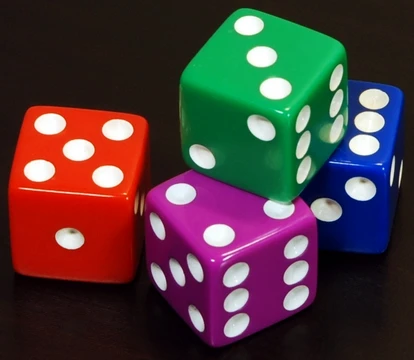
De arte aleae
Lost Roman book on dice by Emperor Claudius.

De arte aleae (Latin: [deː ˈartɛ ˈaːlɛ.ae̯]; On the Art of Dice) was a book by Claudius, the fourth Roman emperor, and is now lost. Its subject was how to play dice, as its title implies. The only surviving reference to this work appears in the Roman historian Suetonius, who, in book five, chapter 33 of *De vita Caesarum*, listed Claudius’s vices and noted that he was an avid dice player who also wrote a book on the game. The title *De arte aleae* is largely conjectural, derived from Suetonius’s phrase “on the art of [dice].” Over time, textual historians adopted this name; for example, in 1761, librarian Heinrich Jonathan Clodius called it “the Book on the Art of Dice” in his *Primae Lineae Bibliothecae Lusoriae*, directly citing Suetonius. What the book actually contained remains unknown, though scholar R. G. Austin suggested it may have covered a newer version of the game.
- author
- Claudius, fourth Roman emperor
- title
- De arte aleae
- field
- Game instruction / Dice
- known_for
- Lost book on the art of dice
- status
- Lost work, known only from Suetonius
Lore & Background
In book five, chapter 33 of the work De vita Caesarum by Roman historian Suetonius (c. AD 69–122), the author discusses many of Roman Emperor Claudius's vices. The final one considered was the leader's love of dice. Suetonius notes, '[Claudius] played dice most avidly, on the art of which he also wrote a book' (Aleam studiosissime lusit, de cuius arte librum quoque emisit). Mention of this work is only to be found in Suetonius's work.
The title De arte aleae seems to be mostly speculative, and based merely on the assertion by Suetonius that the book was 'on the art of [dice]'. As a result, in textual history, the book became simply known as De arte aleae; for instance, in 1761, the librarian Heinrich Jonathan Clodius, in his reference work Primae Lineae Bibliothecae Lusoriae (Bibliographic Outline of Recreation) calls it 'the Book on the Art of Dice' (Lib[er] de Arte Aleae) and directly references Suetonius in naming it as such. While it seems reasonable to conclude that the book concerned dice, exactly what was included in the book is a mystery, as the work has been lost. Austin notes that it is very possible that the work may have dealt with a newer form of the game.
Reader's Guide
De arte aleae holds significance primarily as a lost work attributed to a Roman emperor, illustrating the personal interests of Claudius beyond his political and administrative roles. Its existence is known solely through a single passage in Suetonius's De vita Caesarum, making it a rare example of a text that survives only in reference. The speculative title, coined centuries later by librarian Heinrich Jonathan Clodius, reflects the uncertainty surrounding the book's actual name and content. Scholars like R. G. Austin have suggested that the work may have described a newer form of dice play, but no further details are available. The legacy of De arte aleae lies in its status as a ghost in the historical record—a book that likely existed but has left no physical trace, preserved only as a footnote in the biography of its author. It serves as a reminder of the many ancient texts lost to time, and of the reliance on secondary sources for knowledge of Roman culture and leisure activities.
Did You Know?
- The only mention of De arte aleae is in Suetonius's De vita Caesarum.
- The title De arte aleae is speculative, based on Suetonius's phrase 'on the art of [dice]'.
- In 1761, librarian Heinrich Jonathan Clodius referred to it as 'the Book on the Art of Dice'.
- R. G. Austin suggested the work may have dealt with a newer form of the game.
The Emperor's Forgotten Manuscript
De arte aleae, which translates to "On the Art of Dice," stands as one of the most tantalizing lost works of the ancient world. Its author was none other than Claudius, the fourth emperor of Rome, who apparently possessed a genuine passion for the dice game that went beyond mere recreation. The very existence of this text tells us something remarkable: a sitting head of state took the time to compose a treatise on how to play a parlor game. The work has not survived to the present day, meaning no modern reader can open its pages or examine its arguments. What remains is only the knowledge that it once existed, that it was composed, and that it was published or circulated in some form. The book's subject matter, as the title indicates, was the art and technique of playing dice, though the precise scope of its contents—whether it covered strategy, probability, rules, or cultural commentary—has been lost to time along with the physical text itself.
Suetonius: The Only Witness
The entire knowledge of De arte aleae rests on a single passage in the De vita Caesarum, the biographical history composed by Suetonius, who lived roughly between AD 69 and 122. In book five, chapter thirty-three, Suetonius catalogues the various vices and personal failings of Claudius. Among the list of shortcomings he attributes to the emperor, the final entry concerns the ruler's intense devotion to dice. Suetonius records that Claudius played the game with great avidity and, notably, that he also produced a written work on the subject. This brief observation is the sole surviving reference to the book in the entire ancient literary record. No other author, no other historian, no other source from antiquity mentions the text. The weight of our entire knowledge about this work therefore depends on one sentence in one chapter of one biographical collection, making it an extraordinarily fragile thread connecting us to a lost imperial composition.
A Title Built on Inference
The very name De arte aleae is, by the admission of textual historians, largely a reconstruction rather than a confirmed original title. The designation rests almost entirely on Suetonius's phrasing that Claudius wrote a book "on the art of" dice. From that single descriptive clause, later scholars and cataloguers extrapolated a formal Latin title. A clear example of this practice appears in 1761, when the librarian Heinrich Jonathan Clodius, in his reference work Primae Lineae Bibliothecae Lusoriae, a bibliographic outline of recreation, listed the work as "the Book on the Art of Dice" and explicitly cited Suetonius as his source for the naming. This demonstrates how a casual biographical remark could calcify into a formal title over centuries. The title became the standard identifier in textual history, even though no ancient source confirms that Claudius himself or his scribes ever used those exact words as a heading. The book is known to us essentially through the lens of one later author's summary.
What the Lost Pages Might Have Held
Because the physical text has perished, the exact contents of Claudius's dice treatise remain an open question for scholars. We know only the general subject—dice play—but the specific angle, depth, and structure of the work are unknown. Did it function as a rules manual, a strategic guide, a cultural essay, or something else entirely? The scholar R. G. Austin, writing in 1935 in the journal Greece & Rome, raised the possibility that the book may have addressed a newer or evolving form of the dice game rather than the traditional version familiar to earlier Romans. This observation opens a fascinating gap: if Claudius was documenting a variant or innovation, then the lost text may have preserved knowledge of a game form that has otherwise vanished from the historical record. The broader field of Roman board game research, as advanced by scholars like Alexander J. de Voogt in the 1990s, continues to grapple with questions of game evolution and transmission, making the absence of this one imperial text a persistent lacuna in our understanding of how dice games developed across the Roman world.
Frequently Asked Questions
Who wrote De arte aleae?
The work is attributed to Claudius, the fourth emperor of Rome, who was described by Suetonius as a devoted dice player. Suetonius mentions the book while cataloging Claudius's personal habits and vices in his imperial biographies.
What was De arte aleae actually about?
It was an instructional text on how to play dice, functioning essentially as a game guide for Roman players. Because the book is lost, no surviving passage lets us confirm its exact structure or rules it covered.
How do we know De arte aleae even existed?
The only surviving reference is a single line in Suetonius's De vita Caesarum (Book 5, Chapter 33), where he notes Claudius wrote a work on dice. No manuscript, fragment, or quotation from the text has ever been found.
Why does De arte aleae matter to the history of dice?
It stands as the earliest known dedicated instructional text on dice as a game, making it a foundational reference point in the history of the pastime. Its total loss means no Roman-era dice guide survives in any form.
Is the title 'De arte aleae' actually confirmed by the author?
Not in any surviving source; the name is largely a scholarly reconstruction from Suetonius's phrase describing a work 'on the art of dice.' Textual historians formalized the Latin title over the centuries, but Claudius never inscribed it as a formal book title in any extant record.
More in Dice 1-21
Spotted an error? Know more?
This is a living reference — every entry is fact-audited, and reader corrections feed straight into our audit queue. Suggest an edit · See this site's audit record