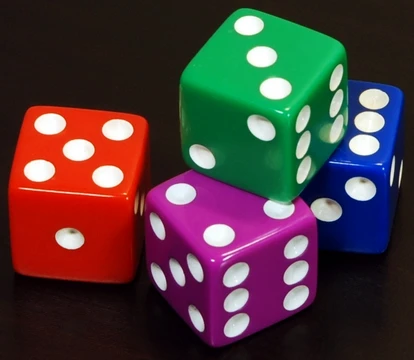
Four-sided die
Four-sided dice generate random numbers from 1 to 4.

Four-sided dice, abbreviated d4, are polyhedral dice used in tabletop role-playing games to generate random integers from 1 to 4. They have been employed since ancient times as tools for gambling and divination, and continue to appear in modern gaming systems.
- field
- Gaming equipment
- known_for
- Producing random integers 1–4 in tabletop role-playing games
- forms
- Regular tetrahedron, long dice with four isosceles triangle faces, long dice shaped like rectangular prisms
Lore & Background
Four-sided dice were among the gambling and divination tools used by early man, who carved them from nuts, wood, stone, ivory, and bone. Six-sided dice were invented later, but four-sided dice continued to be popular in Russia. In Ancient Rome, knucklebones (astragali) were called tali and had four usable sides, while six-sided cubic dice were tesserae. In India and Tibet, three four-sided long dice were rolled sequentially as an oracle to produce one of 64 possible outcomes. The ancient Mesopotamian Royal Game of Ur uses four tetrahedral dice, typically made of clay or stone, with two corners marked and two unmarked.
Reader's Guide
Four-sided dice have persisted across cultures and millennia, from early carved examples to modern role-playing games. Their forms vary: the regular tetrahedron (a triangular pyramid with four equilateral triangle faces) is nicknamed a caltrop and has no topmost face when at rest; values may be indicated by numbers on three visible faces or by a single number on the downward face. Long dice with four isosceles triangle faces, called wedge dice, do not roll well and are usually thrown or shaken in a box. Another long-dice form, shaped like rectangular prisms, appears in the Scandinavian game daldøs; these dice are designed to avoid landing on end by their small size, instability, and rounded or peaked ends. In modern gaming, four-sided regular tetrahedral dice appear in Dungeons & Dragons, the Pathfinder Roleplaying Game, and the d20 System, which includes a d4 alongside dice with 6, 8, 10, 12, and 20 faces. Their continued use demonstrates the enduring utility of simple randomizers in both ancient divination and contemporary entertainment.
Did You Know?
- Four-sided dice were among the gambling and divination tools used by early man, carved from nuts, wood, stone, ivory, and bone.
- In Ancient Rome, knucklebones (astragali) were called tali and had four usable sides, while six-sided cubic dice were tesserae.
- The ancient Mesopotamian Royal Game of Ur uses four tetrahedral dice, typically made of clay or stone, with two corners marked and two unmarked.
- In India and Tibet, three four-sided long dice were rolled sequentially as an oracle to produce one of 64 possible outcomes.
Ancient Roots of the Four-Sided Throw
Dice predate written history, and their earliest forms likely grew out of fortune-telling practices using the talus bones of hoofed animals, a practice colloquially called knucklebones. In ancient Greece, knucklebones was a game of skill, and a later derivative assigned different values to the four sides of the bones, functioning much like a modern four-sided die. The Romans, despite outlawing gambling, were deeply devoted to dicing, a pastime they called aleam ludere. Their dice came in two sizes: the larger tali, which bore four sides marked with one, three, four, and six pips, and the smaller tesserae, which carried the familiar one-through-six numbering. Archaeological evidence stretches the story even further back. Flat two-sided throwsticks used in the Egyptian game of senet, played from before 3000 BCE, served a dice-like function. In south-eastern Iran, the Burnt City site yielded what may be the oldest known dice, dating to roughly 2800 to 2500 BCE, while bone dice from Skara Brae in Scotland span 3100 to 2400 BCE. These early throws, whether four-sided bones or flat sticks, established the fundamental idea that a small object tumbled through the air could deliver a chance outcome.
Shape Beyond the Cube
Most people picture a die as a small cube, but the category of dice extends well beyond six equal faces. The fundamental definition is a small, throwable object with marked sides that can rest in multiple positions, and that description accommodates a wide range of polyhedral and irregular shapes. A tetrahedral die, for instance, has four triangular faces, and when it comes to rest the value is read from the corner rather than the face that points upward. Similarly, odd-numbered long dice are read by the edge that lands on top. Beyond geometry, the markings themselves vary: faces may carry numerals or symbols rather than the traditional round pips, and the numbers can be carved out from the material rather than painted or printed on the surface. Loaded dice represent another variation, deliberately designed or altered so that certain outcomes appear more frequently than chance would predict, whether for cheating or for entertainment. The flexibility of form means that a four-sided die, a twenty-sided die, or a flat two-sided throwstick all share the same essential purpose: to generate a random value through the simple act of throwing and letting the object settle.
Language and Slang of the Roll
The vocabulary surrounding dice carries layers of linguistic history. The English word die traces back to Old French dé, which in turn derives from Latin datum, meaning something that is given or played. A set of older terms—ace, deuce, trey, cater, cinque, and sice—once named the six faces, with ace coming from Latin as for a unit and the rest rooted in Old French. Though largely obsolete in everyday speech, these labels persist among professional gamblers. When two dice are rolled together, specific combinations earn colorful slang: snake eyes for a pair of ones, a usage documented as early as 1919, and boxcars, also called midnight, for a pair of sixes, the name evoking the look of coupled freight cars. The Romans had their own term, aleam ludere, simply meaning to play at dice. In the Indian subcontinent, games involving dice appear in sacred and epic texts including the Rigveda, Atharvaveda, and Mahabharata, as well as in Buddhist lists of games. In Japan, the popular game sugoroku relied on dice, with two distinct variants: ban-sugoroku, a backgammon-like contest from the Heian period, and e-sugoroku, a racing game. Each culture built its own lexicon around the same basic act of throwing and reading a result.
From Mold to Table
The physical making and use of dice reveal a craft that balances precision with accessibility. In modern manufacturing, non-precision dice, sometimes called drugstore or candystore dice, are produced through plastic injection molding, typically from polymethyl methacrylate. The pips or numbers are integral to the mold itself, and pigments can be added to create opaque, transparent, or speckled finishes. These dice tend to be smaller, with rounded corners and recessed markings. At the other end, precision dice used in casinos are larger, translucent, and feature flush markings with sharp edges and corners, making them visually and tactibly distinct. When a die is actually thrown, whether from the hand or from a cup, tray, or tower, the face, corner, or edge that ends up uppermost determines the value. Although a perfectly controlled throw could theoretically be predicted, the act of tossing breaks the die's symmetry in practice, producing a genuinely random outcome. This principle applies whether the die is a standard cube, a tetrahedron, or any other polyhedral shape, and it is what makes the humble throw of a four-sided die as unpredictable as any other.
Frequently Asked Questions
What is a four-sided die (d4)?
A d4 is a polyhedral gaming die that produces a random integer between 1 and 4, serving as the smallest member of a standard tabletop RPG dice set.
What shapes can a d4 take?
While most people picture a regular tetrahedron, d4s also come in elongated forms with four isosceles triangle faces, or as rectangular prisms with four usable faces.
What is a d4 used for in games?
In tabletop role-playing games, the d4 generates a random number from 1 to 4 for rolls that require a small range of possible outcomes.
How old is the four-sided die?
Four-sided dice have been used for gambling and divination since ancient times, and they continue to appear in modern gaming systems today.
What category of equipment is a d4?
The d4 is classified as gaming equipment, specifically a polyhedral die known for producing random integers from 1 to 4.
More in Dice 1-21
Spotted an error? Know more?
This is a living reference — every entry is fact-audited, and reader corrections feed straight into our audit queue. Suggest an edit · See this site's audit record