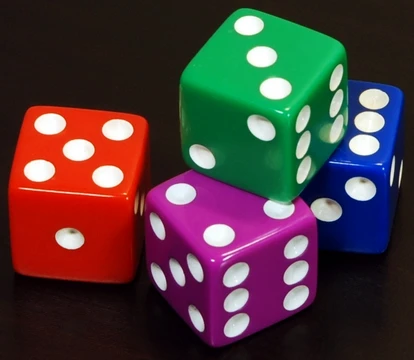
Astragalomancy
Divination by casting marked dice or knucklebones.

Astragalomancy—also called cubomancy or astragyromancy—is a method of fortune-telling that relies on dice engraved with letters or numbers. In earlier times, the "dice" were typically knucklebones or other small bones from four-legged animals. Archaeologists often find marked astragali, or talus bones, from sheep and goats at sites in the Mediterranean and Near East, especially those used for burials or religious rituals. The tradition of seeking divine insight by randomly tossing dice or bones goes back to times before written records.
In ancient Greece, practitioners rolled astragaloi—the cut and marked knucklebones of sheep, or bronze and wooden copies shaped the same way. These oblong dice had four sides, with two rounded sides that never landed flat. One broad side is flat (the 'belly'), the opposite broad side is convex (the 'back'), one narrow side is concave (the 'side'), and the opposite narrow side is flat (the 'other side'). The sides carried values of 1, 3, 4, and 6, with opposite sides adding up to seven. Because of their shape, some numbers came up more often than others. The results were checked against dice oracles carved on large stone pillars found across the Mediterranean. Each possible outcome was linked to a specific god; for instance, the highest possible total—often considered auspicious—was tied to a particular deity, though the known oracles do not assign a result of five ones to Zeus.
These Anatolian dice oracles follow a set pattern. They are written in the second person, addressing the inquirer directly. The reader’s question—either spoken aloud or kept silent—is presented to the oracle, which then replies. The answers could be encouraging, such as “You will find that for which you are consulting the oracle, and nothing will be bad,” or discouraging, like “The sun has gone down, and terrible night has come. Everything has become dark: interrupt the matter, about which you ask me.”
In Tibetan culture, dice divination appears in many forms, some tied to Buddhism and others not. The most common uses standard six-sided cubic dice marked with pips one through six. Another type, the Sanskrit pāśaka, is a four-sided rectangular die, known from manuscripts dating between the eighth and tenth centuries. Dice divination influenced Tibetan law, affecting dec
- field
- Divination
- known_for
- Use of marked dice (often knucklebones) for random casting to obtain divine guidance
- also_called
- Cubomancy, astragyromancy
- related_to
- Cleromancy, pessomancy (psephomancy)
Lore & Background
In Ancient Greece, astragalomancy was performed through the rolling of astragaloi—marked and cut-off knucklebones of sheep, or similarly shaped imitations in bronze or wood. These dice had four sides with values 1, 3, 4, and 6, with opposing sides adding up to seven. The results were compared to dice oracles, some excavated on large stone pillars throughout the Mediterranean. Each result had an attached divinity; for example, the highest possible total was associated with a specific god, but the known oracles do not assign a result of five ones to Zeus. The Anatolian dice oracles address the inquirer directly in the second person, not in first-person singular with a 'stranger.'
Reader's Guide
Astragalomancy represents a widespread and ancient method of seeking divine will through random casting, with evidence spanning from the Mediterranean to Tibet and South America. In Tibetan culture, dice divination traditions include both Buddhist and non-Buddhist forms, using either standard cubical six-sided dice or four-sided rectangular pāśaka dice. The Dalai Lama is reported as using the mo—balls of dough with paper choices—for important decisions. On the Silk Road, numerical trigram-based astragalomancy appears in Turkish, Tibetan, Sanskrit, and Sogdian texts from the sixth through tenth centuries. In South America, the huayru dice game is played at funerals with llama bones to divine the will of the deceased. The practice's persistence across cultures and millennia underscores its role as a tool for decision-making, legal resolution, and communication with the divine or the dead.
Did You Know?
- Marked astragali have been found near the altar of Aphrodite Ourania in Athens, Greece, suggesting astragalomancy was performed there after about 500 BCE.
- In Ancient Greece, astragaloi had four sides with values 1, 3, 4, and 6; opposing sides added up to seven.
- The Dalai Lama is reported as using the mo—balls of dough containing paper choices—to help make important decisions.
- The huayru dice game in South America is played with llama bones, believed to attract the soul of the deceased.
Archaeological Roots & Prehistoric Origins
Astragalomancy's physical evidence stretches deep into human history. The 'dice' at the heart of this practice were, for millennia, not manufactured cubes but the talus bones—knucklebones—of sheep and goats, marked with letters or numbers. Archaeologists have uncovered these inscribed astragali at funerary and religious sites across the Mediterranean and Near East, pointing to a ritual context far older than any surviving text. One particularly evocative find sits near the altar of Aphrodite Ourania in Athens, indicating that bone-casting divination was taking place in that sacred space by roughly 500 BCE. The practice's reach extends well beyond the classical world: the Metropolitan Museum of Art has exhibited bone 'dice' called hakata, used by the Shona people of Southern Africa, demonstrating that the impulse to seek divine guidance through random castings of small objects predates any single written tradition. In this sense, astragalomancy is less a localized custom than a near-universal human response to uncertainty, expressed through the simplest of materials.
The Greek Dice Oracles & Their Literary Voice
In the ancient Greek world, astragalomancy took a highly structured form. The astragaloi—whether real sheep knucklebones or imitations carved from bronze or wood—were oblong, four-sided objects with two rounded faces that could not land flat. The four usable sides carried the values one, three, four, and six, with opposing faces always summing to seven. Because of their irregular geometry, the probability of each outcome was unequal, making the 'lowest' roll of five ones statistically the rarest. Results were then cross-referenced against dice oracles inscribed on large stone pillars, many of which have been excavated across the Mediterranean. What makes these oracles remarkable is their literary voice: they speak in first-person singular, addressing the inquirer as a 'stranger' who has traveled from a foreign land with business to conduct. The god-narrator responds in kind, offering blessings like 'You will find that for which you are consulting the oracle' or warnings such as 'The sun has gone down, and terrible night has come. Everything has become dark: interrupt the matter.' Each outcome was also tied to a specific divinity; the five-ones roll, for instance, belonged to Zeus, whose oracle promised good counsel.
Tibetan Dice Divination & Its Legal Role
Tibetan culture developed its own rich tradition of dice-based divination, encompassing both Buddhist and non-Buddhist lineages. The earliest documented form employed pāśaka—four-sided rectangular dice marked with pips one through four on their long faces, typically measuring about seven by one by one centimeter. A single die was cast three times in succession, and the sequence of results produced one of sixty-four possible omens, recorded in manuscripts using geometric pip symbols. Each omen entry followed a fixed structure: the die-marks, a verse or the name of a divinity, a commentary, and a stated result. Beyond ritual, dice divination was woven into Tibetan law. A recently published manuscript pairs a divination manual with a legal text organized into eleven clauses of questions and answers, each case concluding with the question of whether the matter can be settled by sho, meaning 'dice.' Petitions typically ended with the phrase, 'Do we decide by means of sho or not—how do you command?' This interconnection suggests that randomness was not merely a spiritual tool but a recognized mechanism for adjudicating loans, interest, marital disputes, and even troop conscription.
Cleromancy, Sortition & the Broader Divinatory Family
Astragalomancy is most precisely understood as a branch of cleromancy, the broader category of divination that derives meaning from a random selection process. In its sortition form, numbers are inscribed on the dice, and those numbers are mapped to letters, thereby encoding the diviner's question into the casting itself. The diviner throws the dice, receives a random sequence, and then interprets that sequence according to rules anchored in a particular religious or philosophical system—Tibetan Buddhism's mo tradition being one well-documented example. A closely related practice, pessomancy (or psephomancy), substitutes colored or marked pebbles for numbered dice; the pebbles are either shaken out of a bag or drawn at random, and their colors or symbols are read for guidance on matters of health, communication, success, or travel. The Dalai Lama himself is reported to have used mo—balls of dough enclosing slips of paper bearing possible choices—to aid in significant decisions, while Tibetan lamas have long employed the same technique for everyday matters. Books written by various lamas codify the interpretations for such castings, showing that the practice was both widespread and systematically taught across generations.
Frequently Asked Questions
What is Astragalomancy?
Astragalomancy is a divination method in which a person casts small objects marked with letters or numbers and interprets the random result as divine guidance. The core idea is that the gods reveal their will through the unpredictable outcome of the toss.
What other names does Astragalomancy go by?
You will also encounter the terms cubomancy and astragyromancy, which refer to the same bone- or dice-casting tradition under slightly different etymological roots.
What objects were actually used in early Astragalomancy?
Rather than the six-sided cubes we picture today, practitioners typically cast knucklebones—specifically the talus bones of sheep and goats—engraved with symbols. Archaeologists have uncovered marked astragali at burial and ritual sites across the Mediterranean and Near East, confirming their widespread use.
How does Astragalomancy fit among other divination practices?
It is a specific branch of cleromancy, the umbrella term for any divination technique based on random casting. It is also closely related to pessomancy (or psephomancy), which involves tossing pebbles or small stones rather than bones.
How far back does the Astragalomancy tradition reach?
The practice of seeking divine insight through randomly cast bones or dice predates any written record, making it one of the oldest known forms of divination. Its physical traces—marked talus bones—have been found at sites spanning the ancient Mediterranean and Near East.
More in Dice 1-21
Spotted an error? Know more?
This is a living reference — every entry is fact-audited, and reader corrections feed straight into our audit queue. Suggest an edit · See this site's audit record