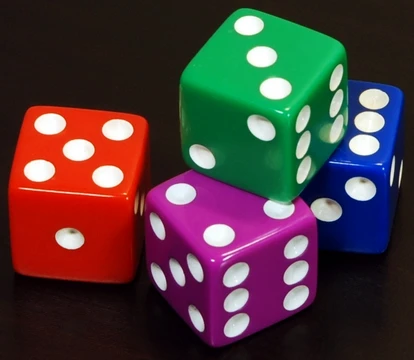
Go First Dice
Dice sets ensuring equal chance for each rank.

Go First Dice are a set of dice designed to fairly determine the order of play in games such as board games. When rolled together, each die has an equal chance of showing the highest number, the second highest number, and so on, and each side has a unique number to prevent ties.
- field
- Game design, combinatorics
- known_for
- Fair dice sets for determining play order
- notable_contributors
- Robert Ford, Eric Harshbarger, James Grime, Brian Pollock, Paul Meyer
Lore & Background
The concept of Go First Dice includes three levels of fairness: go-first-fair (equal chance of highest roll), place-fair (equal chance of each rank), and permutation-fair (every ordering equally probable). Sets may be optimized for smallest least common multiple, fewest total sides, or fewest sides on the largest die, with optimal results proven by exhaustion for up to 4 dice. For two players, two coins (2-sided dice) suffice. For three players, an optimal permutation-fair solution using three 6-sided dice was discovered by Eric Harshbarger, with alternative mismatched dice configurations. For four players, an optimal permutation-fair solution using four 12-sided dice was discovered by Eric Harshbarger, with alternative mismatched configurations by Eric Harshbarger. For five players, several candidates exist but none is known to be optimal; a not-permutation-fair solution for five 60-sided dice was found by James Grime and Brian Pollock, a permutation-fair mixed set by Eric Harshbarger in 2023, and a permutation-fair solution for a mixed set of five dice by Paul Meyer in 2023.
Reader's Guide
Go First Dice address a fundamental problem in multiplayer games: ensuring a fair random order of play without ties. Their significance lies in the mathematical rigor of their fairness properties, which go beyond simple equal chance of going first to guarantee equal probability for every possible ranking or permutation. The search for optimal sets—minimizing sides, total sides, or largest die—has driven combinatorial exploration, with proven optimal solutions for up to four dice. For five dice, the problem remains open, with multiple candidate sets but no proven optimum. The work of Robert Ford, Eric Harshbarger, James Grime, Brian Pollock, and Paul Meyer illustrates ongoing research. The legacy of Go First Dice is in providing a concrete, fair tool for game designers and a rich problem in discrete mathematics, connecting to topics like intransitive dice and permutation fairness.
Did You Know?
- For two players, two coins (2-sided dice) can be used as Go First Dice.
- An optimal permutation-fair solution for three 6-sided dice was discovered by Eric Harshbarger.
- A permutation-fair solution for a mixed set of five dice was found by Paul Meyer in 2023.
- No optimal set of five dice is known to exist.
The Core Idea: A Fair Roll for Any Number of Players
Go First Dice are a specialized set of dice designed to solve a deceptively simple problem: determining who goes first in a game without resorting to coin flips or arbitrary methods. The defining feature is that when the entire set is rolled simultaneously, every individual die carries an identical probability of landing on the top value, the second-highest value, the third-highest, and so on. Because each face value is unique across the whole set, ties are mathematically impossible, guaranteeing a clean, unambiguous ordering. This makes them particularly well-suited for board games and other tabletop scenarios where a fair, single-roll mechanism for establishing turn order is desired. Rather than relying on conventional dice where the distribution of who wins the roll can be uneven, Go First Dice redistribute the numbers across faces so that positional fairness is built into the labeling of the set itself.
Three Tiers of Fairness and the Subset Requirement
The mathematical framework behind Go First Dice organizes fairness into three progressively stronger tiers. The weakest, called go-first-fair, merely requires that each player has an equal shot at rolling the single highest number. The middle tier, place-fair, demands that when all rolls are ranked from first to last, every player has an equal probability of occupying any given rank. The strongest, permutation-fair, goes further: every possible ordering of the players must carry the same probability, which automatically satisfies place-fairness as well. Beyond these three levels, designers also pursue a practical desideratum: any subset of dice drawn from the set should retain the same fairness properties, so the same physical set can serve two, three, four, or five players without needing a separate kit. This subset requirement adds a layer of combinatorial complexity that makes finding valid configurations considerably harder than satisfying fairness for a fixed player count alone.
Solutions Across Player Counts: From Trivial to Frontier
The two-player case is essentially trivial, reducible to a pair of two-sided dice. The real intellectual challenge begins at three players, where Robert Ford identified an optimal, permutation-fair arrangement on three six-sided dice in 2010, with several alternative solutions using mismatched dice also known. For four players, Ford again provided the breakthrough in 2010, discovering an optimal permutation-fair set on four twelve-sided dice, while Eric Harshbarger contributed alternative optimal configurations using dice of differing sizes. The five-player case remains the most active frontier. James Grime and Brian Pollock produced a non-permutation-fair solution on five sixty-sided dice, and in 2023 Eric Harshbarger found a permutation-fair mixed set comprising one thirty-six-sided, two forty-eight-sided, one fifty-four-sided, and one twenty-sided die. That same year, Paul Meyer achieved a permutation-fair solution using five uniform sixty-sided dice. No five-dice set has yet been proven optimal.
Optimization Criteria, Geometric Limits, and Open Questions
Beyond merely finding a valid set, researchers pursue optimization across several competing criteria: minimizing the least common multiple of the dice sizes, reducing the total number of sides across the set, or keeping the largest individual die as small as possible. For up to four dice, optimal results in each of these categories have been established through exhaustive computational search, giving a firm baseline. The five-dice problem, however, resists such closure; multiple candidate sets exist, but none has been confirmed as the true optimum. An additional geometric constraint complicates physical realization: some of the dice required in mixed five-player sets would need more than one rotation axis of order greater than two, a property that regular polyhedra do not possess, meaning such dice cannot be manufactured as simple Platonic or Archimedean solids. The field also sits in a broader mathematical neighborhood, with connections to intransitive dice, where the non-intuitive ordering properties of specially labeled dice create further avenues for exploration.
Frequently Asked Questions
What are Go First Dice?
Go First Dice are a purpose-built set of dice that settle who takes the first turn in multi-player board games. Rather than producing ties like standard dice, they guarantee a clean, unambiguous ranking of every player in a single roll.
How do Go First Dice guarantee a fair outcome?
The numbers are assigned so that, when the full set is rolled, every individual die carries the same probability of finishing in first, second, third, or any other position. Because no two faces across the set share a value, two dice can never land on the same number, making re-rolls unnecessary.
Who are the key people associated with Go First Dice?
The design draws on contributions from Robert Ford, Eric Harshbarger, James Grime, Brian Pollock, and Paul Meyer. Their work connects combinatorial mathematics with practical tabletop game design.
Why do Go First Dice matter to board-game players?
They eliminate the tedious re-roll loop that standard dice create when two or more players tie for the top spot. A single throw instantly produces a unique ordering, saving time and giving every player an identical mathematical shot at any rank.
What area of mathematics underpins Go First Dice?
The core challenge lives in combinatorics: distributing a set of distinct numbers across multiple dice so that each die's probability profile is perfectly symmetric across all possible ranks. This makes the problem a neat bridge between pure counting theory and recreational game design.
More in Dice 1-21
Spotted an error? Know more?
This is a living reference — every entry is fact-audited, and reader corrections feed straight into our audit queue. Suggest an edit · See this site's audit record