Galaktoboureko
A custard and filo dessert popular in Greece and Turkey.

DanielPenfield · CC BY-SA 4.0
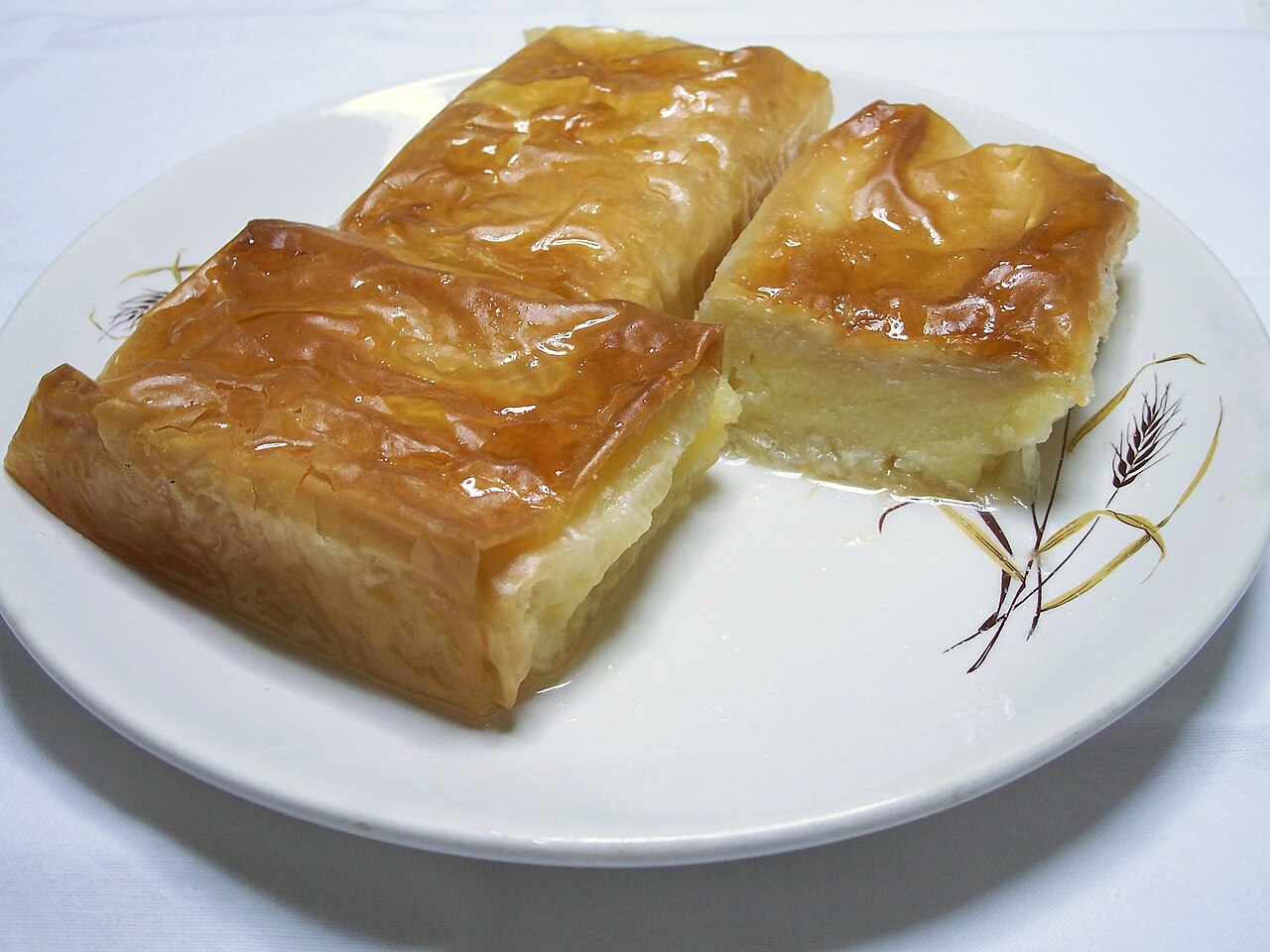
Galaktoboureko (γαλακτομπούρεκο in Greek, paponi in Laz, and laz böreği in Turkish) is a dessert enjoyed in Greece and the eastern Black Sea region of Turkey. It consists of custard between layers of filo dough, all topped with syrup. The custard is made from muhallebi or semolina pudding. In Albania, it may appear during Orthodox Easter, though the local favorite Qumështor—a filo-free custard—is more common. In Cyprus, it is known as galatopourekko.
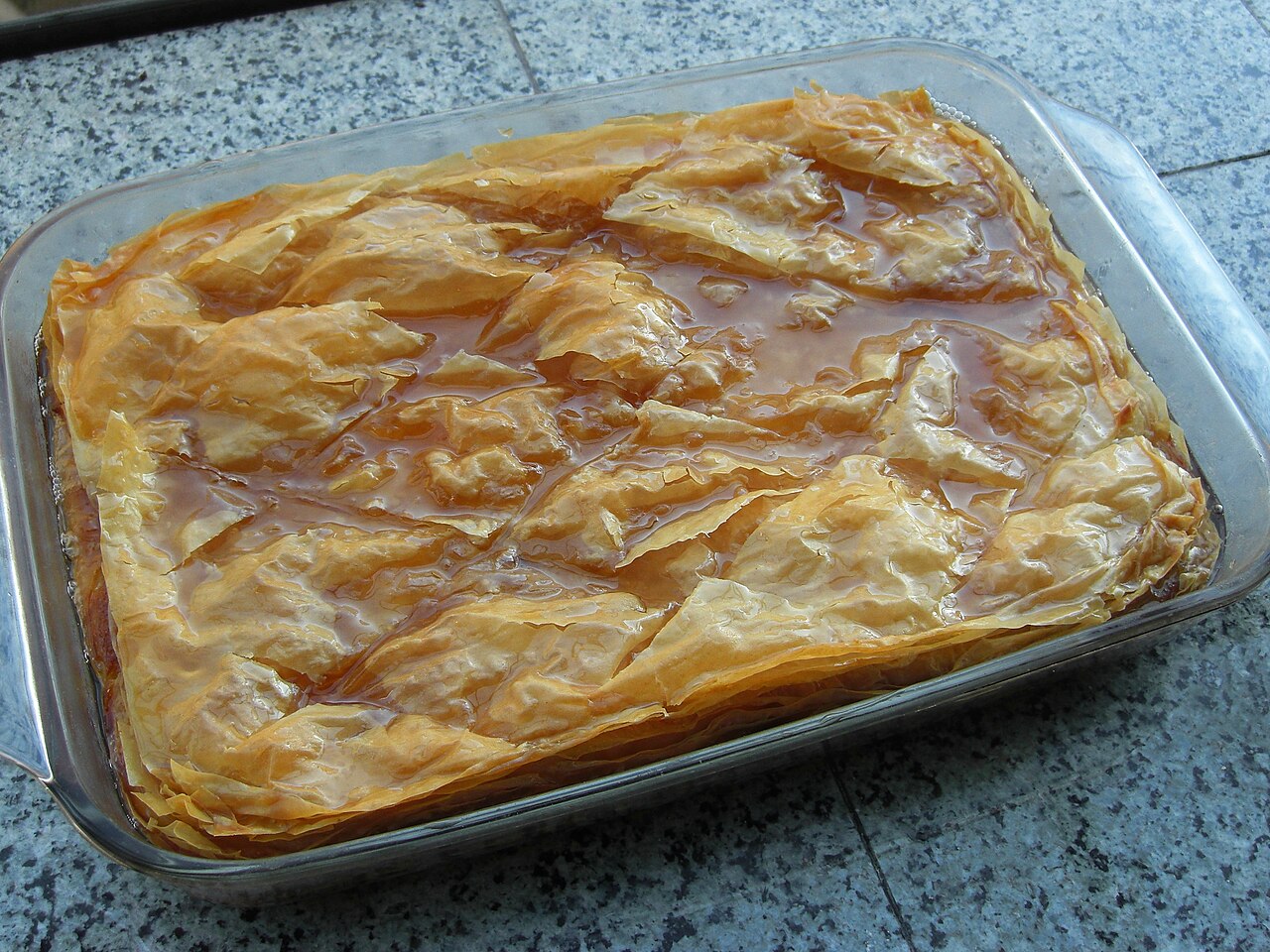
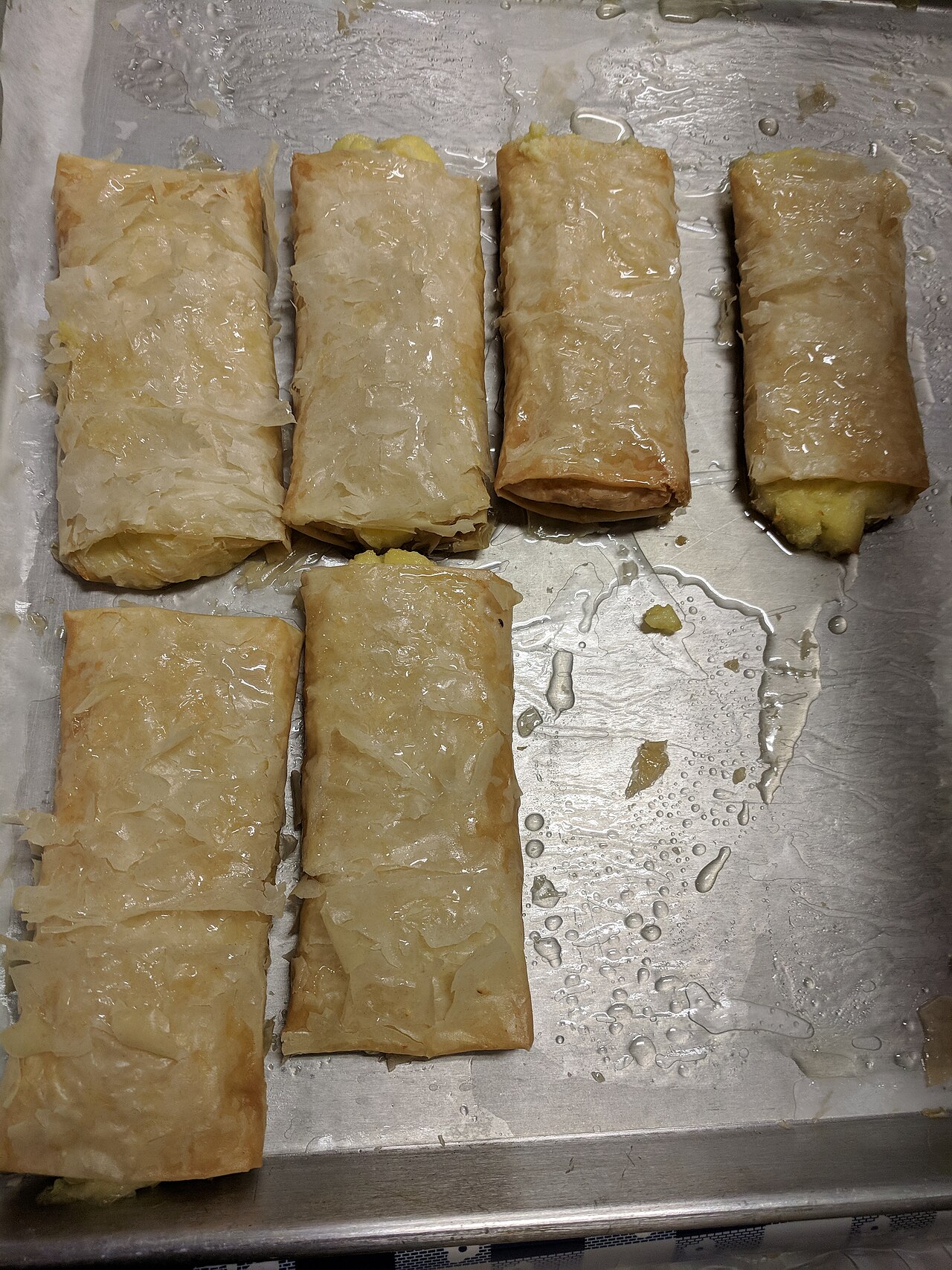
For preparation, galaktoboureko can be baked in a pan with filo layered above and below (twenty layers total) and cut into squares, or rolled into individual servings about 10 cm (4 in) long. A clear, sweet syrup is poured over or served alongside it. The semolina or milk-rice custard can be flavored with lemon, orange, or rose. Unlike mille-feuille, which it only vaguely resembles, the custard is baked together with the pastry rather than added later. The dessert is widespread across Greece, with regional variations; notable versions come from Athens and Thessaloniki. The Laz variant, paponi or laz böreği, uses a muhallebi pudding that includes cornmeal and ground black pepper instead of semolina. It is popular in the Rize and Artvin provinces of Turkey’s Black Sea region, among the Laz people, and its ingredients are thin filo, butter, muhallebi, black pepper, and simple syrup.
The earliest known references to this dessert date to the Ottoman era, reflecting the historical importance of milk and semolina in ancient Mediterranean cooking. Ancient Greek cuisine had a similar dish called plakous, made with honey, cheese, and wheat. Filo, an invention of ancient Greece, was adopted by the Ottomans during the Ottoman era. Tradition holds that galaktoboureko originated in the wealthy Greek areas of western Asia Minor, particularly Smyrna. The Turkish version was registered in 2020 as a geographical indication by the Turkish Patent and Trademark Office under the name "Hopa Laz Böreği."
- Field
- Culinary history
- Nationality
- Greek, Turkish, Laz
- Known for
- Custard and filo dessert with syrup
- Earliest reference
- Ottoman era
Lore & Background
Galaktoboureko may be made in a pan, with filo layered on top and underneath (20 layers in total) and cut into square portions, or rolled into individual servings (often approximately 10 cm (4 in) long). It is served or coated with a clear, sweet syrup. The semolina custard, or milk rice (muhallebi) may be flavored with lemon, orange, or rose. Unlike mille-feuille, which it only vaguely resembles, the custard is baked with the pastry, not added afterwards. It is popular across Greece, with regional and local variations in ingredients and preparation. Notable versions are associated with Athens and Thessaloniki.
Laz böreği/Paponi is made with a variation of the pudding called muhallebi with the inclusion of cornmeal and ground black pepper, instead of semolina custard. It is popular in the Rize and Artvin provinces in the Black Sea Region, among the Laz. Its ingredients are thin filo dough, butter, muhallebi, black pepper and simple syrup.
Reader's Guide
The earliest known references to this dessert date back to the Byzantine period, highlighting the historical importance of milk and semolina in ancient Mediterranean culinary traditions. Ancient Greek cuisine included a similar dish called plakous, made with honey, cheese, and wheat. Filo, a culinary invention originating in Ancient Greece was adopted by Ottomans during the Ottoman period. According to tradition, Galaktoboureko originated in the wealthy Greek areas of West Minor Asia and in particular Smyrna. The Turkish version of the dessert was registered in 2019 as a geographical indication by the Turkish Patent and Trademark Office under the name 'Hopa Laz Böreği'. Its legacy lies in its enduring popularity across multiple cultures and its reflection of shared culinary heritage in the eastern Mediterranean and Black Sea regions.
Did You Know?
- Galaktoboureko is made with a type of pudding called muhallebi or semolina custard.
- In Albania, it is sometimes prepared during Orthodox Easter, though Qumështor is traditionally preferred.
- The Turkish version was registered as a geographical indication in 2020 under the name 'Hopa Laz Böreği'.
A Dessert with Many Names
Galaktoboureko is known by different names across the regions where it is enjoyed. In Greece it bears its Greek name, in Cyprus it surfaces as galatopourekko, and among the Laz communities of Turkey's eastern Black Sea coast it is called paponi or laz böreği. In Albania, a comparable custard dessert is sometimes prepared around Orthodox Easter, though the local tradition leans toward Qumështor, a milk-based preparation that contains no filo dough at all. This spread of names and adaptations shows a dessert that has moved and morphed across the eastern Mediterranean and Black Sea world. The underlying structure stays familiar—thin pastry sheets wrapping a milk-based filling, drenched in sweet syrup—yet the precise ingredients and methods shift from one community to the next. Each regional iteration becomes a small expression of local identity layered over a shared culinary heritage.
Technique and the Baked-Custard Distinction
Galaktoboureko can be assembled in two principal ways. In one method, the custard is spread in a pan with filo layered both above and below—twenty sheets in total—and the finished block is sliced into square portions. In the other, the filling is rolled between pastry into individual servings roughly ten centimeters long. Both approaches are finished with a clear, sweet syrup poured over the surface. The filling itself is a semolina custard, sometimes called muhallebi, or a milk-rice pudding, and it may be scented with lemon, orange, or rose. A key technical distinction separates galaktoboureko from the French mille-feuille, which it only loosely resembles: here the custard is baked together with the pastry rather than added after baking. Across Greece, regional and local variations in ingredients and preparation are common, with particularly noted versions tied to Athens and Thessaloniki.
Ancient Roots and the Byzantine Thread
The earliest documented references to galaktoboureko reach back to the Byzantine period, underscoring how deeply milk and semolina were embedded in ancient Mediterranean cooking. Ancient Greek cuisine already featured a comparable dish called plakous, constructed from honey, cheese, and wheat, suggesting that the impulse to layer sweet, grain-based ingredients predates the modern dessert by centuries. Filo pastry, a culinary innovation that originated in Ancient Greece, was later adopted by the Ottomans during their long rule, weaving the technique into a broader imperial food culture. By tradition, galaktoboureko itself took shape in the affluent Greek neighborhoods of western Anatolia, particularly in and around Smyrna, where Greek, Ottoman, and local influences converged. This layered history—Greek invention, Byzantine refinement, Ottoman adoption, and Anatolian localization—gives the dessert a depth that extends far beyond any single recipe.
The Laz Böreği and Geographical Identity
In the Rize and Artvin provinces along Turkey's Black Sea coast, the dessert takes a distinctly local form known as laz böreği or paponi. Here the familiar muhallebi is reworked with cornmeal and a pinch of ground black pepper in place of the standard semolina custard, producing a filling that tastes markedly different from its Greek counterpart. The remaining ingredients—thin filo dough, butter, and a simple syrup—stay consistent, but the cornmeal-and-pepper combination gives the Laz version a savory-sweet complexity that sets it apart. In 2019, the Turkish Patent and Trademark Office formally registered this regional variant under the name "Hopa Laz Böreği" as a geographical indication, a legal step that anchors the recipe to a specific place and community. This registration reflects a broader pattern in which a single dessert, shared across multiple cultures, becomes a marker of local pride and identity when tied to a particular landscape and people.
Gallery
Frequently Asked Questions
What is Galaktoboureko?
It is a sweet dessert built around a creamy custard filling sandwiched between thin sheets of filo pastry and finished with a pour of syrup. In Cyprus, people call it "galatopourekko."
What are the main ingredients in Galaktoboureko?
The filling is a custard made from either muhallebi or semolina pudding, wrapped in layers of filo dough, and the whole thing is drenched in a sweet syrup after baking.
Where does Galaktoboureko come from?
Its earliest references date back to the Ottoman era, and it has since become a staple across Greece, the eastern Black Sea coast of Turkey, and Cyprus.
How is Galaktoboureko typically prepared?
Bakers can layer roughly twenty sheets of filo above and below the custard in a pan and cut the result into squares, or they can roll the filling into a log shape before baking.
Is Galaktoboureko eaten outside of Cyprus?
Absolutely; it is a well-known treat in Greece and Turkey, and a custard-based cousin of the dish sometimes appears in Albania around Orthodox Easter, though the local filo-free favorite Qumështor is more common there.
More in Cypriot cuisine 1-24
Spotted an error? Know more?
Reader corrections go straight into our review queue. Suggest an edit · How this site is sourced