Space Alert
A real-time cooperative board game about space survival.

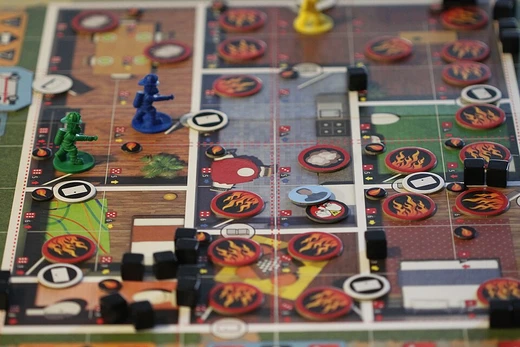
Space Alert, a cooperative board game designed by Vlaada Chvátil, was released in 2008. Players take on the roles of space explorers surveying the galaxy, with their performance judged on teamwork and their ability to handle unexpected problems. Unlike many board games, Space Alert requires players to make decisions and play cards in real time. The game received a special prize for "New Game Worlds" at the 2009 Spiel des Jahres awards.
Gameplay is divided into two phases: an action round and a resolution round. The action round lasts ten minutes, during which a computer announces threats, and players play cards to respond. Cards allow movement around the ship or actions like firing lasers or supplying energy to reactors. After the action round, the resolution round begins, where players resolve their actions and see if they survived the threats. Points are then calculated based on how many threats were handled and how much damage the ship took.
The crew consists of a Captain, a First Mate, a Chief of Security, a Communications Officer, and a Science Officer. The Captain announces the progression of turns, the Chief of Security announces internal threats, and the Communications Officer announces external threats. The First Mate and Science Officer have their own specialized duties.
The action round follows an audio track included in the game, which narrates events like enemy activity, incoming data, data transfers, and the end of each phase. Incoming data lets players draw cards, and data transfers allow them to exchange cards. Enemy activity details both external and internal threats.
Threats are either external or internal. External threats appear outside the ship and are usually dealt with using lasers or missiles. Internal threats appear inside the ship. All threats are categorized as serious or common; serious threats, if not handled, typically cause substantial damage.
The expansion pack, Space Alert: the New Frontier, was released in 2010. It adds new threats, including more difficult "red" threats, a "double actions" game mode, player specializations, and an experience system. Players can use all these additions together or pick and choose for a given mission.
Quick Facts
- Title
- Space Alert
- Designer
- Vlaada Chvátil
- Publisher
- Czech Games Edition / Heidelberger Spieleverlag / Quined White Goblin Games / Red Glove / Rio Grande Games
- Players
- 1 to 5
- Ages
- 12 and up
- Playing Time
- 30 minutes
Facts from the source article.
Lore & Background
Space Alert was created by Vlaada Chvátil in 2008. The game is separated into two rounds: the action round and the resolution round. The action round consists of 10 minutes of gameplay during which the computer announces threats, and players play cards allowing them to move around the ship or take actions such as firing a laser or supplying energy to a reactor. After the action round, players complete the resolution round, resolving their actions and determining whether they survived the threats, then calculating points based on threats handled and ship damage.
Reader's Guide
Space Alert is significant for its real-time cooperative gameplay, a departure from turn-based board games. It received a special prize for 'New Game Worlds' in the 2009 Spiel des Jahres awards, highlighting its innovative design. The game's structure—an action round with a timed audio track and a resolution round—creates tension and teamwork. Its expansion, Space Alert: the New Frontier (2010), adds new threats, a double actions mode, player specializations, and an experience system. The game also appeared in pop culture, with its box visible in The Big Bang Theory episode 11x10. Space Alert won several awards, including the 2009 Golden Geek Award for Best Innovative Board Game and the 2008 Dice Tower Gaming Award for Most Innovative Game. Its legacy lies in pioneering real-time cooperative board gaming, influencing later designs.
More in Cooperative board games 1-24
Spotted an error? Know more?
Reader corrections go straight into our review queue. Suggest an edit · How this site is sourced