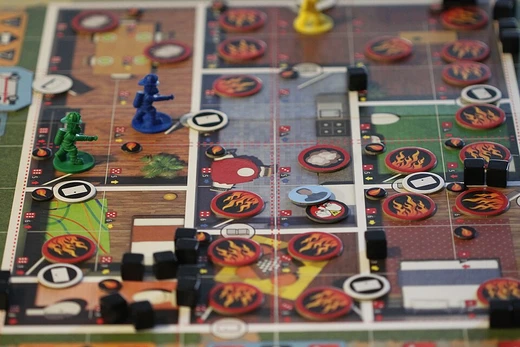
Burgle Bros
Cooperative heist board game series by Tim Fowers.

Burgle Bros is a series of cooperative board games about pulling off heists. Designed and self-published by Tim Fowers, each game supports up to four players. Everyone picks a character, then moves through the game’s spaces—called tiles—to use items, open safes, and get away with stolen goods. Guards patrol each floor, moving toward random destinations and trying to catch the players. The group wins if all players escape with their loot; if the team runs out of stealth tokens, everyone loses immediately.
Every tile has a unique effect when entered. Some are alarms that, if not handled correctly, make a guard head straight for the player. Others, like vents or lavatories, give a one-time boost. Tiles are placed randomly, and all but one are hidden at the start, only revealed when a player steps onto them.
The first game, *Burgle Bros*, came out in 2015. Players try to crack three safes inside a three-story office building. Each floor has sixteen tiles, one guard, and walls that are set up randomly. Players start on the first floor with just one tile visible, then explore, trigger alarms, dodge guards, and find the safes, which are opened by rolling dice. Inside each safe is a loot card that adds extra limits, making the game harder. For example, a Painting restricts movement through vents; Chihuahuas or Persian Cats may set off alarms at the start of a turn; Gold Bars require a player to use both hands (cannot carry other items). Event cards are drawn when a player doesn’t use all their actions, and they bring both good and bad effects, adding risk. A digital version of *Burgle Bros* is available on Steam.
*Burgle Bros 2: Casino Capers*, the 2021 sequel, takes place in a two-story luxury casino. It adds dynamic guests and more complex safe cracking. Unlike the first game, which is set up the same way each time, this one is a legacy game: each mission affects the next. The box itself transforms into a two-layer game board.
The third game, *Burgle Bros 3: Future Flip*, is scheduled for release in 2025, after a successful Kickstarter campaign in April 2024.
Quick Facts
- Title
- Burgle Bros
- Creator
- Tim Fowers
- Publisher
- Fowers Games
- Latest Release Version
- Burgle Bros 3: Future Flip
Facts from the source article.
Lore & Background
The first game, Burgle Bros, was published in 2015. Players attempt to crack three safes in a three-story office building, each floor containing sixteen tiles, one guard, and randomly set-up walls. Players start on the first floor with only one tile revealed, exploring tiles, triggering alarms, and avoiding guards. Safes are opened by rolling dice and contain loot cards that add gameplay limits, such as Painting (restricting movement through vents), Chihuahuas and Persian Cats (may trigger alarms), and Gold Bars (require a player to use both hands, preventing them from carrying other items). Event cards, drawn when a player does not use all actions, have both positive and negative effects.
Reader's Guide
Burgle Bros introduced a cooperative heist experience with hidden tile exploration and guard patrol mechanics. Its success led to sequels: Burgle Bros 2: Casino Capers (2021), a legacy game set in a two-story luxury casino with dynamic guests, and Burgle Bros 3: Future Flip (scheduled for 2025 after a successful Kickstarter campaign in April). A digital adaptation of the original Burgle Bros was released on Steam. The series is noted for its random tile setup, cooperative play, and increasing difficulty through loot card effects.
Did You Know?
- The game is cooperative for up to four players.
- A digital adaptation of Burgle Bros has been released on Steam.
- Burgle Bros 3: Future Flip is to be released in 2025 following a successful Kickstarter campaign in April 2024.
The Heist Framework
Burgle Bros is built around a single, deceptively simple premise: you and up to three friends are pulling off a coordinated burglary together. Every player selects a character and navigates a shared board, working to crack safes, grab loot, and slip away before the non-player guards catch them. The tension comes from a shared pool of stealth tokens—run out, and the whole group loses instantly, making every decision a collective risk. The board itself is a puzzle of hidden tiles. At the start of a game, all but one space is face-down, so players are essentially exploring in the dark, discovering alarms, vents, lavatories, and other effects only when they step onto them. Guards patrol each floor toward random destinations, meaning the threat is always shifting. This combination of hidden information, shared resources, and an unpredictable antagonist creates a cooperative experience where communication and timing matter as much as any individual move.
The Original Game and Its Loot System
The first Burgle Bros, released in 2015, sends players into a three-story office building where three safes are hidden across sixteen tiles per floor. Each floor also houses one guard and a random wall layout, so no two sessions feel identical. Players begin on the ground floor with a single tile revealed and must explore, trigger or avoid alarms, and locate the safes, which are opened through dice rolls. What makes the original particularly clever is its loot system: each safe contains a loot card that imposes a new restriction on the next phase of play. A Painting might block vent and door movement, Chihuahuas or Persian Cats can set off alarms at the start of turns, and Gold Bars require two players to carry simultaneously. Event cards, drawn when a player does not use all their actions, introduce both helpful and harmful surprises, adding a layer of calculated risk. A digital version of the game is also available on Steam.
Evolution: Legacy Play and the Road to 2025
Burgle Bros 2: Casino Capers, arriving in 2021, transplants the heist into a two-story luxury casino and introduces dynamic guests alongside more intricate case-cracking mechanics. Its most striking departure is format: rather than a static setup repeated each session, the sequel plays as a legacy game where every mission permanently alters the next, creating a narrative arc across multiple plays. The physical box itself transforms into a two-layer game board, turning the packaging into a core component. The series' momentum carried forward when Burgle Bros 3: Future Flip successfully crowdfunded on Kickstarter in April 2025, with release slated for that year. Across both sequels, the core cooperative DNA—hidden tiles, patrolling guards, shared stealth tokens—remains intact, but the evolving settings and structural innovations show a designer pushing the framework further with each installment.
Self-Publishing and a Distinct Design Voice
Burgle Bros is the work of a single designer, Tim Fowers, who both created and self-published the series. That independence shapes the games' identity: the heist theme is carried through with a playful, slightly irreverent tone—Chihuahuas triggering alarms, Persian Cats lurking in safes, Gold Bars that two players must lug together. The cooperative structure for up to four players means there is no betrayal, no hidden agenda; the only adversary is the environment itself, embodied by patrolling guards and a dwindling supply of stealth tokens. The tile-based, hidden-information design gives each session a sense of discovery, while random wall and tile placement ensures replayability without requiring complex rule changes. From the 2015 original to the 2021 legacy sequel and the 2025 Kickstarter-funded third entry, Fowers has maintained a consistent design voice: accessible cooperative play wrapped in a fun, slightly absurd theme, all brought to market on his own terms.
Frequently Asked Questions
What is Burgle Bros?
Burgle Bros is a cooperative heist board game series in which players team up to steal loot and escape before patrolling guards catch them. Tim Fowers designed and self-published the game, with the first edition released in 2015.
How many players can play Burgle Bros?
The game supports up to four players, each selecting a character and working together to complete the heist.
How do you win or lose in Burgle Bros?
The group wins when every player has escaped with their stolen goods intact. However, if the team uses up all of its stealth tokens, the heist fails and everyone loses immediately.
What are tiles in Burgle Bros?
Tiles are the individual spaces players traverse during a heist, and each one carries a unique effect that triggers when you step on it. Some tiles function as alarms that must be handled correctly, while others let you open safes or interact with items.
Who designed Burgle Bros and is it published by a major company?
Tim Fowers both designed and self-published the game, so it does not carry a traditional board-game publisher's name. It is a cooperative title built around teamwork rather than player-versus-player competition.
More in Cooperative board games 1-24
Spotted an error? Know more?
Reader corrections go straight into our review queue. Suggest an edit · How this site is sourced