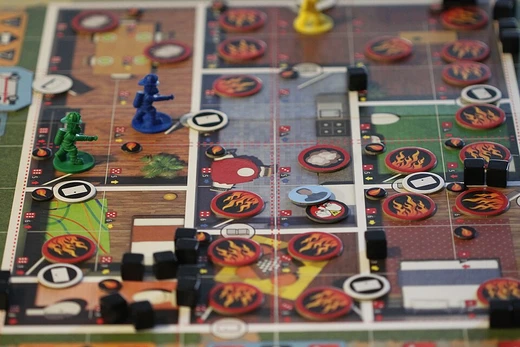
Citadel of Blood
Tile-based dungeon crawl without a gamemaster.

Citadel of Blood is a cooperative fantasy dungeon-crawl board game published by Simulations Publications, Inc. (SPI) in 1980. It is notable for being one of the first serious board games published in Poland, where it appeared in 1982 as Labirynt Śmierci, and for its tile-based dungeon-building mechanic that eliminated the need for a gamemaster.
- Publisher
- Simulations Publications, Inc. (SPI)
- Year published
- 1980
- Designers
- Eric Smith (modifications), based on Deathmaze by Greg Costikyan and Redmond A. Simonsen
- Players
- 1–6
- Genre
- Cooperative fantasy dungeon crawl
- Notable feature
- Random tile-drawing dungeon construction; no gamemaster required
Lore & Background
Citadel of Blood, subtitled 'Fantastic Adventure in the Fortress of Evil,' is a cooperative fantasy dungeon crawl where 1–6 players enter the dungeon of the evil wizard 'X the Unknown,' kill any monsters encountered and take their treasure. Unlike fantasy role-playing games such as Dungeons & Dragons, it does not need a gamemaster to design the dungeon or play the monsters, nor does it use numbered paragraphs as in Flying Buffalo's Buffalo Castle. Instead, players randomly draw tiles representing rooms and corridors one at a time, slowly building the dungeon tile by tile.
The game is based on SPI's previous publication Deathmaze (January 1980), but with the addition of character races, dungeon levels, and different 'colors' of magic depending upon phases of the moon. Eric Smith modified the original Deathmaze design by Greg Costikyan and Redmond A. Simonsen to create Citadel of Blood. It was first published as a pullout game in Ares Magazine #5 (September 1980), then released as a boxed set.
In 1982, the game was published in Poland as Labirynt Śmierci. It was one of the first, if not the first, 'serious' board game published in Poland, and likely contributed to the growing popularity of both board games and role-playing games in that market.
Reader's Guide
Citadel of Blood holds significance as an early example of a cooperative dungeon-crawl board game that eliminated the need for a gamemaster, using random tile drawing to generate the dungeon. Its publication in Poland as Labirynt Śmierci in 1982 marked a milestone, being one of the first serious board games in that market and likely helping to popularize board and role-playing games there. The game built upon SPI's Deathmaze, adding character races, dungeon levels, and a moon-phase magic system, which reviewers noted made it more advanced than its predecessor. Keith Gross in The Space Gamer No. 37 recommended it to fans of Deathmaze and fantasy gamers seeking a shorter play experience. Jules Leites in Moves Issue 54 praised the redesign as 'much more nearly state of the art' and capable of challenging advanced fantasy role-playing gamers. Leites also suggested rule variants to link Citadel of Blood with SPI's Swords & Sorcery boardgame. The game's legacy lies in its innovative tile-based design and its role in introducing serious board gaming to Poland.
Did You Know?
- Citadel of Blood was based on SPI's earlier game Deathmaze, designed by Greg Costikyan and Redmond A. Simonsen.
- The game was first published as a pullout in Ares Magazine #5 (September 1980) before being released as a boxed set.
- In Poland, it was published in 1982 as Labirynt Śmierci and was one of the first serious board games in that country.
- The magic system in Citadel of Blood changes 'colors' depending on phases of the moon.
Cooperative Design Philosophy
Citadel of Blood belongs to the cooperative board game tradition, a design framework in which every participant at the table shares a single fate. Rather than pitting opponents against one another for individual victory, the game asks players to unite their efforts toward a common, predetermined objective. Success is collective: the group either achieves that goal together or the game ends in shared defeat, often triggered by a final event that closes the window for victory. This win-together-or-lose-together structure is the defining mechanical spine of the title. As a series rather than a single standalone game, Citadel of Blood extends this cooperative framework across multiple adventures, giving groups of players a recurring shared challenge. The cooperative model also means that no single player is eliminated or declared the sole winner; the table operates as one team facing the game's systems. This stands in sharp contrast to competitive board games where alliances are temporary and only one individual ultimately prevails.
The 1980s Adventure Wave
Citadel of Blood arrived during a particularly fertile decade for cooperative tabletop gaming. The 1980s produced a notable cluster of adventure board game series that wove role-playing elements into cooperative play, and Citadel of Blood is consistently grouped alongside titles such as HeroQuest, Wizards, Advanced Heroquest, and Deathmaze as part of this creative wave. The same era also yielded other cooperative experiences like Arkham Horror, Time Tripper, and The Wreck of the B.S.M. Pandora, as well as the mystery-solving Sherlock Holmes: Consulting Detective series, in which players trace evidence collectively. This concentration of cooperative adventure games in a single decade suggests a period in which designers were actively exploring how to blend narrative-driven, character-based storytelling with the shared-stakes structure of cooperative play. Citadel of Blood's placement among these peers underscores its role as a participant in a broader design movement rather than an isolated experiment, helping establish the template that later cooperative titles would build upon.
Genre Boundaries and Distinctions
Understanding where Citadel of Blood sits in the broader board game landscape requires drawing clear lines around what it is and what it is not. It is not a noncompetitive game in the sense of titles like The Ungame, which lack any victory condition or set objective to complete. Nor is it a pure tabletop role-playing game, a category that features potentially infinite victory conditions and persistent player characters carried across sessions. It also does not fall into the team-based competitive category, where players form two or more groups or partnerships and ultimately only one side can claim victory, as seen in games like Axis & Allies or card games such as Bridge and Spades. Even multiplayer conflict games that feature temporary cooperation, like Diplomacy, remain outside the cooperative definition because players are eliminated and a single individual wins. Citadel of Blood, by contrast, operates under a fixed objective: the group succeeds together or fails together, with no individual elimination and no singular champion.
The Adventure and Role-Playing Blend
What sets Citadel of Blood apart within the cooperative board game family is its deliberate fusion of adventure storytelling with role-playing mechanics. The title is specifically categorized as an adventure board game series carrying role-playing elements, placing it in a hybrid space that draws from both the narrative-driven structure of adventure games and the character-embodiment traditions of tabletop role-playing. This blend distinguishes it from purely mechanical cooperative games focused on resource management or race-to-an-objective design. The 1980s context matters here: the same decade that produced the Sherlock Holmes: Consulting Detective series, where players collaboratively trace clues, also gave rise to dungeon-crawl-adjacent cooperative adventures like HeroQuest and Advanced Heroquest. Citadel of Blood occupies this same creative territory, offering players a shared narrative journey in which their roles and decisions matter within a cooperative framework. The series format suggests an evolving story or escalating challenges across multiple games, deepening the role-playing dimension over time while maintaining the collective win-or-lose structure that defines the cooperative genre.
Gallery

Frequently Asked Questions
What is Citadel of Blood?
Citadel of Blood is a cooperative fantasy dungeon-crawl board game released by Simulations Publications, Inc. (SPI) in 1980. It supports one to six players who work together to survive and navigate a randomly generated labyrinth.
Who designed Citadel of Blood?
The game is an adaptation of Deathmaze, originally created by Greg Costikyan and Redmond A. Simonsen, with modifications made by Eric Smith for its SPI publication.
Does Citadel of Blood require a gamemaster?
No. Because the dungeon is assembled entirely through random tile draws placed by the players themselves, there is no need for a dedicated narrator, referee, or gamemaster at the table.
What is Citadel of Blood's connection to Poland?
The title reached the Polish market in 1982 under the name Labirynt Śmierci, and it is recognized as one of the first serious board games ever published in that country.
How does the dungeon-building mechanic in Citadel of Blood work?
Rather than using a fixed map, players draw tiles at random and connect them to assemble the maze, so the layout is different every single playthrough and no two sessions follow the same route.
More in Cooperative board games 1-24
Spotted an error? Know more?
Reader corrections go straight into our review queue. Suggest an edit · How this site is sourced