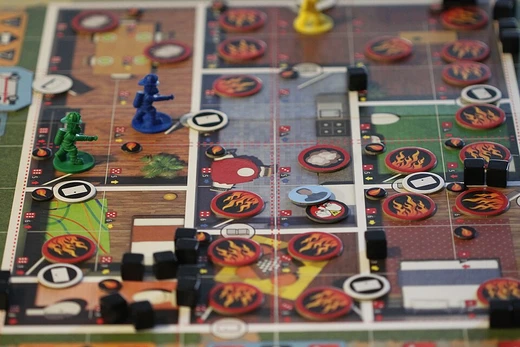
Descent: Journeys in the Dark
A dungeon crawl where one player actively opposes the heroes.

Descent: Journeys in the Dark is a high fantasy dungeon crawl board game for two to five players, published by Fantasy Flight Games in 2005. Designed and produced by Kevin Wilson, it is based on an improved version of the mechanics of FFG's licensed Doom: The Boardgame. The game is notable for its asymmetric gameplay, where one player takes the role of the Overlord, who controls enemies and uses threat points to hinder the hero players, with the goal of depleting the heroes' health or achieving scenario objectives.
Quick Facts
- Subject Name
- Descent: Journeys in the Dark
- Players
- 2-5
- Setup Time
- < 30 minutes
- Playing Time
- 2 to 4 hours
- Random Chance
- some
- Designer
- Jesper Ejsing, John Goodenough, Frank Walls
- Manufacturer
- Fantasy Flight Games
Facts from the source article.
Lore & Background
Descent: Journeys in the Dark was released in 2005 by Fantasy Flight Games, designed by Kevin Wilson. The game uses an improved version of the mechanics from FFG's Doom: The Boardgame. Players take the roles of adventurers delving into underground complexes for treasure, while one player acts as the Overlord, controlling enemies and playing cards to hinder the heroes. The Overlord's resources are limited by a threat point system, generated in response to hero actions. The game shares characters with other FFG titles such as Runebound, Runewars, and Rune Age, all set in the Terrinoth universe.
Reader's Guide
Descent: Journeys in the Dark is significant as a landmark dungeon crawl board game that refined the genre by giving the Overlord player a competitive win condition rather than a purely facilitative role. Its threat point mechanism, which limits the Overlord's resources based on hero actions, introduced strategic depth and tension. The game spawned multiple expansions—Well of Darkness (2006), Altar of Despair (2007), Road to Legend (2008), Tomb of Ice, and Sea of Blood—adding campaigns, quests, and new options. A second edition released in 2012 streamlined gameplay to reduce session time, with a conversion kit allowing first-edition content to be used. Descent influenced later FFG titles like Imperial Assault (2014), which uses a similar ruleset in the Star Wars universe. The game received critical acclaim, with Alan R. Moon calling it his favorite dungeon-crawl, and it was nominated for Golden Geek awards for both its first and second editions. An online PC version was planned but canceled in 2008. In 2020, a novel set in the Descent universe, The Doom of Fallowhearth, was published by Aconyte Books.
Did You Know?
- The first edition was nominated for the 2006 Golden Geek Best Gamer's Board Game award.
- A novel titled Descent–Journeys in the Dark: The Doom of Fallowhearth was released in 2020 by Aconyte Books.
The Overlord's Gambit: Redefining Adversarial Play
Descent: Journeys in the Dark, designed by Kevin Wilson and published by Fantasy Flight Games in 2005, reimagined the dungeon-crawl board game by introducing a fundamentally adversarial structure. Rather than treating the antagonist as a passive obstacle, the game assigns one of the two-to-five players the role of the Overlord, a figure whose explicit objective is to drain the hero players of victory points and claim the win for themselves. This design draws on the improved mechanics of FFG's earlier licensed Doom: The Boardgame, but pushes the concept further by giving the Overlord a genuine strategic identity. The Overlord must manage a pool of threat points—generated reactively by the heroes' own actions—to spawn monsters, deploy traps, and play hindering cards. The system echoes the Sauron optional expansion in The Lord of the Rings board game, yet Descent makes the antagonist a full participant with limited resources and real decision-making pressure. Meanwhile, the heroes progress through a series of tile-based maps, collecting treasure, equipping enchanted gear, and growing stronger across nine original quests, each session lasting roughly four to five hours.
A Growing World: Expansions and Shared Mythology
From its 2005 debut, Descent quickly grew into a sprawling interconnected universe. The first expansion, Well of Darkness, arrived in late October 2006, followed by Altar of Despair in early 2007 and Road to Legend in March 2008, the latter introducing campaign rules that let heroes begin with a single special skill and end far above their starting power. Tomb of Ice and Sea of Blood further extended the world, the latter creating an entirely separate campaign setting. Beyond the core line, Fantasy Flight released fifteen single-miniature expansions—ten depicting the evil lieutenants first introduced as counters in Road to Legend and five drawn from Sea of Blood—each offering a detailed metal figure. Crucially, Descent does not exist in isolation; it shares its roster of characters with FFG's Runebound, Runewars, and the card game Rune Age, weaving a common mythological thread across the publisher's fantasy catalogue, which also included licensed titles based on Warcraft III, World of Warcraft, and The Lord of the Rings. This cross-pollination meant that a hero or monster from one title could feel at home in another, reinforcing a sense of a single, persistent fantasy world.
Second Edition and the Digital Frontier
Descent's lifecycle extended well beyond its original print run. In 2012, Fantasy Flight Games released a streamlined second edition, explicitly designed to shorten the lengthy sessions that had characterized the first edition. The two editions are not directly compatible, but a conversion kit was made available so that first-edition heroes and monsters could be brought into the second-edition framework. Since then, the second edition has accumulated its own suite of expansions, hero packs, monster packs, and lieutenant packs, adding new quests, campaigns, secret rooms, and additional Overlord rules. The original first edition was ultimately discontinued in favor of the redesigned product. Descent also briefly touched the digital landscape: in October 2006, Board Games Online announced a PC adaptation built on their BattlePawn 3D board-game engine, intended as the platform's launch title. However, creative differences between Board Games Online and Fantasy Flight Games led to the project's termination on June 13, 2008, leaving the game firmly in the physical, tabletop domain.
From Tabletop to Page: Narrative and Mechanical Depth
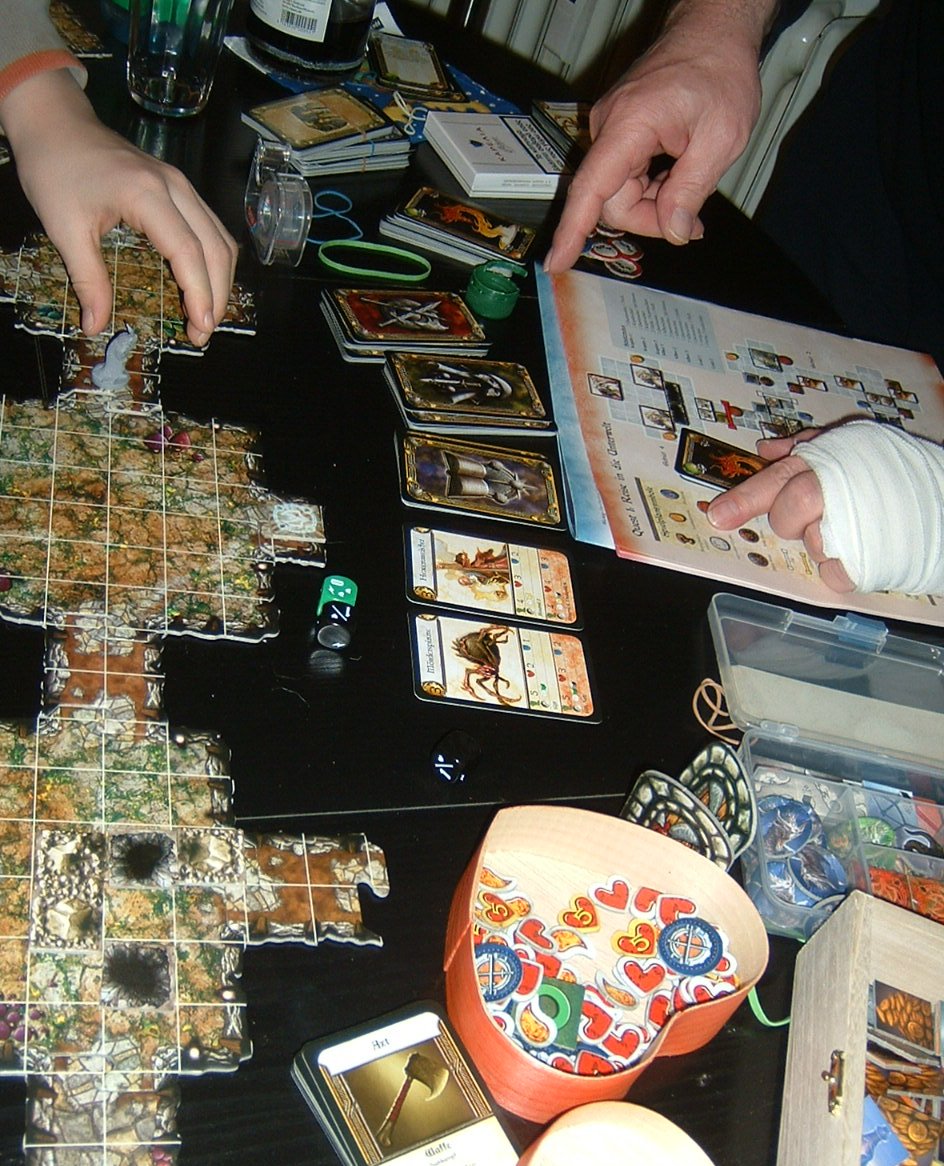
Descent's narrative reach extended beyond the game table into published fiction. In November 2019, Aconyte Books—a publishing imprint launched by Asmodee Entertainment—announced a program of novels drawn from several Asmodee games, with Descent: Journeys in the Dark among the selected titles. The resulting novel, Descent–Journeys in the Dark: The Doom of Fallowhearth, was released in 2020, translating the game's hero-and-Overlord conflict into a prose narrative. This move reflected the depth of storytelling already embedded in the game itself: each quest is built on a unique configuration of map tiles, with traps, special events, and treasures arranged to create a distinct scenario, and the campaign structure allows characters to evolve dramatically over time. Heroes are represented through a layered system of character cards, skill cards, equipment cards, and numerous tokens tracking health, stamina, potions, and status effects, while a variety of six-sided dice bearing different symbols govern damage, range, and other outcomes. The first edition's reception included a nomination, and the game's rich mechanical and narrative architecture clearly provided fertile ground for further creative expansion into other media.
Gallery
Frequently Asked Questions
What is Descent: Journeys in the Dark?
It is a high-fantasy dungeon-crawl board game for two to five players, published by Fantasy Flight Games in 2005. Kevin Wilson designed the title by reworking the mechanics he had used in FFG's licensed adaptation of Doom: The Boardgame.
What roles and powers do players have in Descent: Journeys in the Dark?
One player sits as the Overlord, directing every enemy and spending threat points to obstruct the heroes, while the remaining players each command a hero character. The heroes pursue scenario objectives and try to stay alive; the Overlord wins by draining their hit points or preventing those objectives from being met.
How does the story in Descent: Journeys in the Dark end?
There is no single canonical finale; each scenario defines its own victory conditions that the heroes must satisfy before their health is exhausted. If the Overlord reduces every hero's hit points to zero first, the heroes are defeated and the narrative concludes in their favor only if they reach the scenario goal in time.
Why is Descent: Journeys in the Dark considered important in the board-game hobby?
It brought the asymmetric 'one-versus-the-group' structure to a cooperative-feeling dungeon crawl, giving the antagonist a real seat at the table instead of a rulebook. That design choice went on to influence a wave of later titles that pit a single controlling player against a team of heroes.
How many players can sit down to play Descent: Journeys in the Dark?
The game accommodates two to five players. At the minimum, one person takes the Overlord seat while the other fields a single hero; at five, four heroes face the Overlord in a larger, more chaotic crawl.
More in Cooperative board games 1-24
Spotted an error? Know more?
Reader corrections go straight into our review queue. Suggest an edit · How this site is sourced