Doom: The Boardgame
A board game adaptation of the Doom video game series.

Doom: The Boardgame, released in 2004 by Fantasy Flight Games, is an adventure board game designed by Kevin Wilson. It supports two to four players (or two to five in the 2016 edition) and draws from the Doom video game series, though its design is more closely aligned with *Doom 3* than the earlier titles. The game was the top-selling board game of 2004.
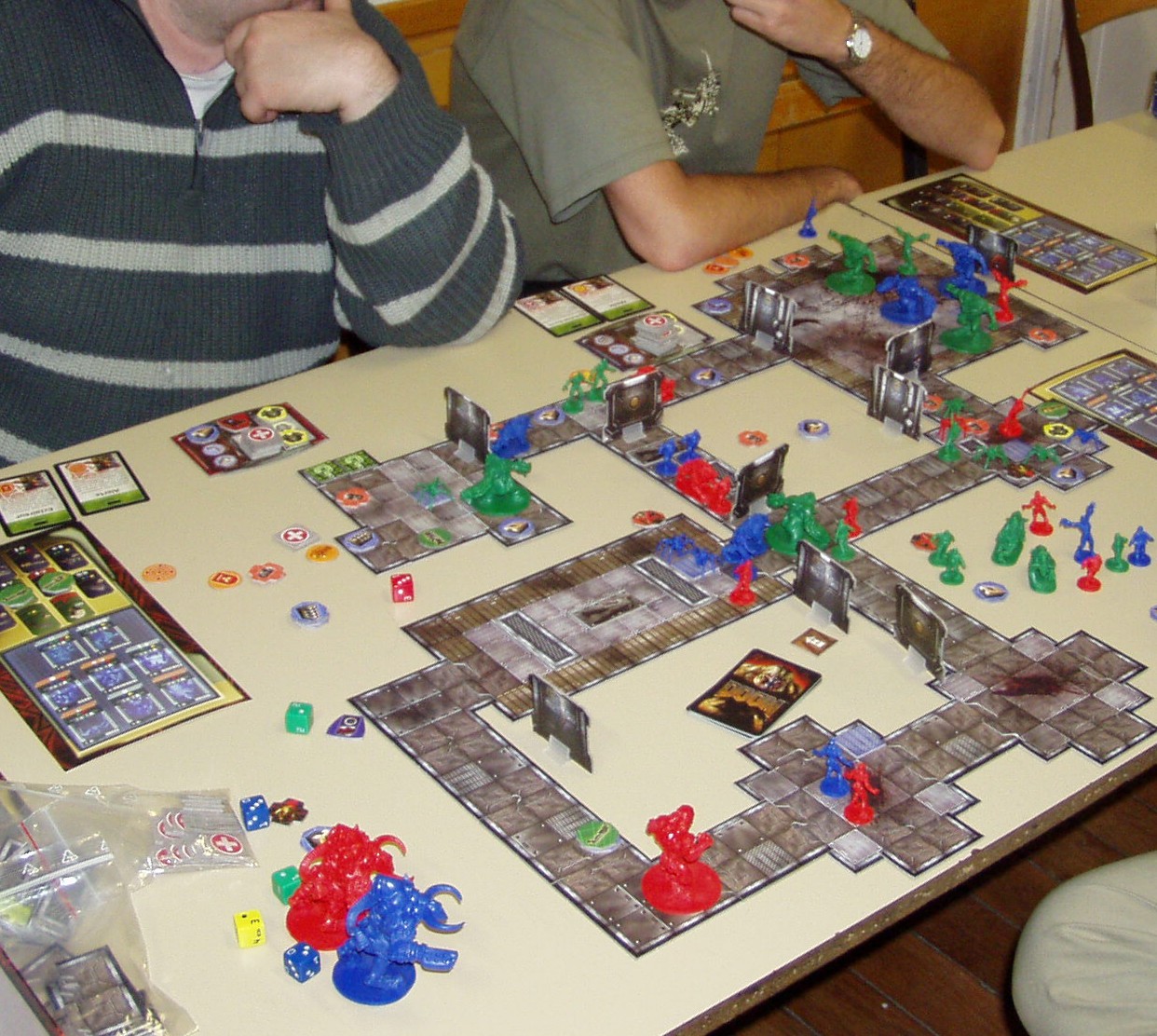
In gameplay, players split into two teams: one player controls all Invader pieces, while the others each control a single Marine. A scenario is chosen before play begins; the base game includes a five-scenario campaign, with additional scenarios available through freeware editors. The Invaders win by collecting six frags (each Marine death counts as one frag), while the Marines win by reaching the exit. When a Marine dies, it respawns between eight and sixteen spaces from its death location. A common criticism is that the game favors the Invaders, especially with four players, though designer Kevin Wilson claims he can win equally well on either side. Players often create house rules, called "mods," to adjust the balance.
An expansion released in 2005 added difficulty levels, new game pieces, rule updates, and modes for Deathmatch and Capture the Flag. Also in 2005, Fantasy Flight released *Descent: Journeys in the Dark*, an original fantasy dungeon-crawler unrelated to Doom, and soon after discontinued production of *Doom: The Boardgame*. A separate redesign titled *Doom: The Board Game* (2016) was released that same year, featuring different rules and components.
Quick Facts
- Title
- Doom: The Board Game
- Publisher
- Id Software / Bethesda Softworks
- Genre
- Dark Fantasy / Dungeon
Facts from the source article.
Lore & Background
Doom: The Boardgame pits players on one of two teams: the Invaders and the Marines. One player controls all Invader pieces, while the others each control one Marine. Before each game, players choose a scenario; a campaign of five scenarios is included, and many more have been created using freeware scenario editors. The Invaders win by getting six frags (a frag is awarded when a Marine dies), while the Marines win by reaching the exit. When a Marine dies, it respawns between eight and sixteen spaces from where it was killed.
An expansion released in 2005 added difficulty levels, new game pieces, rule updates, and rules for Deathmatch and Capture the Flag. In 2005, Fantasy Flight released *Descent: Journeys in the Dark*, an original fantasy dungeon-crawler not based on Doom, and soon after ceased production of *Doom: The Boardgame*. A separate redesign, *Doom: The Board Game* (2016), was released that same year, with different rules and components.
A common opinion holds that the game is biased in favor of the Invaders, especially with four players. Designer Kevin Wilson claims he can win equally well no matter which team he plays. Like many board games, players often develop house rules (called 'mods') to balance the game to their liking.
Reader's Guide
Doom: The Boardgame holds significance as a successful adaptation of a video game franchise into a board game, becoming the number one-selling board game in 2004. Its design by Kevin Wilson and publication by Fantasy Flight Games established a template for team-based asymmetric gameplay, where one player controls monsters and others control heroes. The game's influence is seen in the subsequent release of Descent: Journeys in the Dark, which is based on the Doom game and effectively replaced it in production. The 2016 updated edition shows the lasting appeal of the property. The game's reception includes reviews from Pyramid and Rue Morgue #45. Its legacy includes a dedicated community that creates additional scenarios via freeware editors and develops house rules to address perceived balance issues, particularly the common opinion that the Invaders have an advantage. The game remains a notable example of licensed board game design from the mid-2000s.
Did You Know?
- An expansion released in 2005 added rules for Deathmatch and Capture the Flag.
- Fantasy Flight Games ceased production of Doom soon after releasing Descent: Journeys in the Dark in 2005, which is an original fantasy dungeon-crawler, not an adaptation of Doom.
- The 2016 edition, titled 'Doom: The Board Game', is a separate redesign with different rules and components, not just an updated version of the 2004 game.
Origins & Design Philosophy
Doom: The Boardgame arrived in 2004 as an adventure board game crafted by designer Kevin Wilson and brought to shelves by Fantasy Flight Games. While it draws its inspiration from the iconic Doom first-person shooter franchise, the tabletop adaptation leans more heavily toward the aesthetic and mechanics of Doom 3 rather than the original four video game entries. The game supports two to four players in its initial release, a capacity that would later expand to two to five in the 2016 edition. Wilson's design translates the chaotic, fast-paced combat of the digital series into a structured tabletop experience where players navigate scenarios, manage movement, and engage in team-based conflict. The game's identity as an adventure title sets it apart from pure combat simulations, embedding the familiar Doom setting within a framework of scenario selection, progression, and cooperative-versus-opponent dynamics. This blend of licensed video game IP with accessible board game structure made it a natural entry point for fans who wanted to bring the Hell-raising action to the kitchen table without picking up a controller.
Gameplay & Team Dynamics
At the heart of Doom: The Boardgame lies an asymmetric team structure that mirrors the video game's core tension. Players split into two factions: the Invaders and the Marines. One player takes command of the entire Invader force, while every remaining player controls a single Marine piece. Before each session, the group selects a scenario to play; the base game ships with a five-scenario campaign, and the community has since generated many additional scenarios through freeware editors. Victory conditions are deliberately different for each side. The Invaders must accumulate six frags, each one awarded when a Marine is killed, while the Marines simply need to reach the exit. When a Marine falls, it respawns between eight and sixteen spaces from its death location, a mechanic that echoes the video game's quick-restart philosophy. A persistent community debate centers on whether the game favors the Invaders, particularly in four-player games. Designer Kevin Wilson has pushed back, asserting he can win equally well on either team. To smooth out perceived imbalances, players commonly craft house rules, which the community affectionately dubs mods in keeping with the video game tradition.
Expansion, Spin-offs & Revival
The original 2004 release was quickly supplemented by the Doom: The Boardgame Expansion Set, also from Fantasy Flight Games in 2005. This add-on introduced new difficulty levels, additional game pieces, and updated rules for several original mechanics. It also brought two entirely new game modes to the table: Deathmatch and Capture the Flag, both staples of the video game series. The board game's influence extended beyond its own product line as well. In 2005, Fantasy Flight released Descent: Journeys in the Dark, a title that drew directly from the Doom board game's design. However, the relationship proved short-lived; shortly after Descent launched, the company wound down production of Doom: The Boardgame, effectively shelving the property for over a decade. The long wait ended in 2016 when Fantasy Flight returned with an updated edition. This revised version was designed to mirror the aesthetics and feel of the newly released DOOM video game, and it expanded the player count to accommodate up to five participants, broadening the game's appeal for larger groups.
Commercial Success & Critical Reception
Doom: The Boardgame achieved remarkable commercial success upon its 2004 debut, earning the distinction of being the number-one-selling board game of that year. This top spot in a crowded market underscores how effectively the title translated a beloved video game franchise into a tangible tabletop experience that resonated with both dedicated fans and curious newcomers. Critical attention followed the commercial triumph. The game was reviewed in Pyramid, a well-known gaming publication, and also featured in issue number forty-five of Rue Morgue, a magazine with a strong following in the horror and gaming communities. These reviews helped cement the game's reputation within the broader board game landscape. The title and its 2005 expansion set remain catalogued on BoardGameGeek, one of the largest community-driven databases for tabletop games, and Fantasy Flight Games maintains an archived section dedicated to Doom: The Board Game on its own website. Together, these resources ensure that the game's history and components remain accessible to collectors, researchers, and players who still seek out the original experience.
Gallery
Frequently Asked Questions
What is Doom: The Boardgame?
It is a tabletop adventure game published by Fantasy Flight Games in 2004, with design work by Kevin Wilson. The game adapts the Doom first-person-shooter franchise into a physical, multi-player experience.
How many players can join a game of Doom: The Boardgame?
The original 2004 release accommodates two to four participants at the table. The 2016 revised edition expands the group size to allow up to five players.
How does the team structure work in Doom: The Boardgame?
One participant takes command of every enemy Invader piece on the board, while the remaining players each pilot a single Marine character. The Marine group cooperates to complete the chosen scenario against the Invader-controlled opposition.
Which Doom video game does the board game most closely follow?
Although it borrows from the broader Doom franchise, the thematic tone and mechanical design lean heavily toward Doom 3's atmosphere and structure rather than mirroring the first two entries.
How commercially successful was Doom: The Boardgame?
It claimed the number-one spot in board game sales for its launch year, 2004, making it the top-selling title in the category that year.
More in Cooperative board games 1-24
Spotted an error? Know more?
Reader corrections go straight into our review queue. Suggest an edit · How this site is sourced