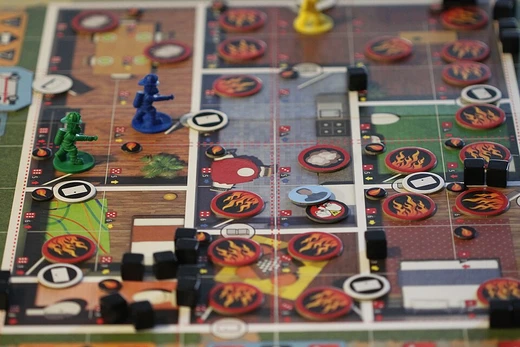
Advanced Heroquest
A more complex sequel to HeroQuest with modular dungeons and D12 mechanics.

Advanced Heroquest is a board game designed by Jervis Johnson and published by Games Workshop in 1989. It is a sequel to the earlier HeroQuest, which was designed by Stephen Baker and published by Milton Bradley, with Games Workshop contributing miniatures and lore for the European market. Advanced Heroquest introduced more complex, RPG-like rules, a modular board, and the use of henchmen, distinguishing it from its predecessor.
Quick Facts
- Title
- Advanced Heroquest
- Publisher
- Games Workshop
- Designer
- Jervis Johnson
- Date
- 1989
- Players
- 1 to 5
- Playing Time
- ca. 90 minutes
- Random Chance
- Dice (D12 system)
Facts from the source article.
Lore & Background
The original HeroQuest was an adventure board game designed by Stephen Baker and published by Milton Bradley, with Games Workshop contributing miniatures and lore for the European release. Later the same year, Games Workshop released Advanced Heroquest, a similar but more complex game. Changes from HeroQuest include more complex and RPG-like rules, a modular board and the use of henchmen. The included quests feature the heroes entering a Skaven-infested dungeon in order to retrieve a magical artefact. While the only monsters included in the miniatures set are the ratmen known as Skaven, statistics for all the monsters that appear in the HeroQuest game are given, and it is possible to meet some or all of them via the random generation encounter tables.
The boxed set includes a 64-page rulebook with an introductory campaign called the 'Quest for the Shattered Amulet' and solo gameplay rules, 36 plastic 25 mm miniatures (4 heroes, 20 Skaven, and 12 henchmen), 6 plastic doors, two twelve-sided dice, 78 counters, and interlocking room and corridor sections that combine to produce modular dungeon maps. The game uses 12-sided dice for skill and combat resolution. Both heroes and monsters are defined by Weapon Skill, Bow Skill, Strength, Toughness, Wounds, Speed, Intelligence, and Bravery. Combat is resolved in melee by rolling a target figure determined by the difference between the target's and player's Weapon Skills; in ranged combat, the target number is determined by how far away the target is versus the character's Bow Skill. In both cases, if the target number is achieved, the attacker rolls a number of dice determined by Strength and what weapon was being used. The number of dice that exceed the opponent's Toughness becomes the number of Wounds inflicted.
An expansion called Terror in the Dark was released in 1991, written by Graeme Davis and Jim Bambra, adding new monsters, treasures, and spells. The included quest, called the 'Quest for the Lichemaster', featured the heroes being pitted against the Lichemaster, a powerful necromancer. Contrary to popular belief, the Lichemaster did not appear in the original HeroQuest game; instead, this character is loosely based on Heinrich Kemmler, a necromancer from the Warhammer Fantasy Battle Lichemaster campaign. The material for Terror in the Dark was based on content from White Dwarf issues 136 and 137.
Reader's Guide
Advanced Heroquest holds significance as a transitional game between casual board games and hardcore role-playing games, as noted by Sinclair User in 1990. It was one of the first specialist games from Games Workshop to use a D12 system for all gameplay mechanics, including combat, magic, exploration, and random dungeon generation. The modular board and random encounter tables ensured that no two games were ever the same, a feature highlighted by French magazine Micro News in 1991. The game's production values were praised by reviewers such as Philip A. Murphy in Games International, who called the components 'a true delight,' though he criticized the constant references to Warhammer and Citadel products. The game's complexity was both a strength and a weakness: Murphy felt it was 'overproduced and a tad too complex,' while the German website Spielphase gave it a rating of 5 out of 6, noting that 'a reality is represented quite well by tables and a varied game is possible over a long period of time.' The 'Fate' point mechanic was praised as a necessary safety net in the more lethal system. In a 2018 retrospective, Retro Gamer noted the game's better quality components but criticized the base game's lack of monster variety, as all enemies were Skaven. Advanced Heroquest ultimately paved the way for later dungeon-crawler games like Warhammer Quest.
Did You Know?
- The only monsters included in the base game's miniatures set are Skaven, but statistics for all monsters from HeroQuest are provided for random encounters.
- The expansion Terror in the Dark was written by Graeme Davis and Jim Bambra and incorporated material previously published in White Dwarf issues 136 and 137.
The D12 Revolution in Dungeon Crawling
In 1989, Jervis Johnson's design for Advanced Heroquest represented a bold leap beyond its predecessor. Where the original HeroQuest had relied on a fixed board and card-driven encounters, Johnson's sequel embraced a fully dice-based architecture built around the twelve-sided die. Every core mechanic—melee combat, ranged attacks, spellcasting, exploration, and the random generation of dungeon corridors—was resolved through D12 rolls, making it one of the first specialist titles from Games Workshop to adopt that system. Characters were defined by a full stat block of Weapon Skill, Bow Skill, Strength, Toughness, Wounds, Speed, Intelligence, and Bravery, giving the game a distinctly role-playing feel. In melee, the target number derived from the gap between attacker and defender Weapon Skills; in ranged combat, distance against Bow Skill set the threshold. Once a hit was confirmed, the attacker rolled a pool of dice scaled by Strength and weapon type, and any die beating the opponent's Toughness translated directly into Wounds. Though optional hero-creation rules referenced smaller dice, the rulebook encouraged players to simulate those results with the included D12, reinforcing the system's internal consistency.
What's in the Box: A Modular Dungeon in a Kit
The boxed set of Advanced Heroquest delivered a substantial physical package. At its heart sat a 64-page rulebook containing the introductory campaign, the Quest for the Shattered Amulet, along with solo-play rules. The miniature lineup comprised 36 plastic figures at 25 mm scale: four hero types (warrior, dwarf, elf, and wizard), twenty Skaven ratmen, and twelve henchmen. Six plastic doors, two D12 dice, and 78 counters rounded out the components. The most distinctive element was the modular dungeon: interlocking room and corridor sections that players assembled to build ever-changing maps, replacing the static board of the original game. The included quest sent the heroes into a Skaven-infested dungeon to recover a magical artefact. Although the miniature set featured only Skaven as monsters, the rulebook provided full statistics for every creature appearing in the original HeroQuest, and random-generation encounter tables allowed players to roll up additional foes beyond the boxed set.
A Divided Critical Verdict
Reviews of Advanced Heroquest in 1990 painted a picture of a game that impressed on some fronts and frustrated on others. Philip A. Murphy in Games International acknowledged the production quality, calling the components a genuine delight that other publishers could learn from, yet he felt the game was overproduced and slightly too complex, and he grew impatient with the constant Warhammer branding and cross-references. He scored it a middling three out of five. Sinclair User's Precinct 19 column took a more positive view, describing the title as a useful bridge between casual board gaming and hard-core role-playing, and they singled out the Fate point mechanic as a thoughtful safety net that prevented the more lethal rules from wiping out heroes too early. They also appreciated that the Game Master functioned as a true adversary rather than a passive guide. French reviewer Tristan Lhomme in Casus Belli drew a sharper distinction, calling Advanced Heroquest a distant cousin of its predecessor rather than a direct sequel. He praised its dice-driven continuous map generation and noted it successfully evoked the atmosphere of early Advanced Dungeons & Dragons, though he felt the experience fell short of its potential.
Expansions and the White Dwarf Pipeline
Advanced Heroquest's post-release life was sustained largely through print media and a single boxed expansion. Between White Dwarf issues 121 and 159, Games Workshop published a steady stream of quest scenarios and supplemental rules, including the Quest for Sonneklinge, the Priests of Pleasure, a crossover adventure featuring Gotrek and Felix titled the Dark Beneath the World, the Trollslayer's Oath, the Eyes of Chaos, the Changing Faces of Tzeentch, and Rivers of Blood. Issues 138 and 139 introduced new henchman rules and expanded treasure lists, material that was later folded into the 1991 expansion Terror in the Dark. Written by Graeme Davis and Carl Sargent, that 96-page supplement added fresh monsters, spells, and treasures, and its headline quest, the Quest for the Lichemaster, pitted the heroes against a powerful necromancer. Contrary to a common assumption, the Lichemaster was not a character from the original HeroQuest; the figure was loosely adapted from Heinrich Kemmler, a necromancer from the Warhammer Fantasy Battle Lichemaster campaign. This expansion thus served as both a capstone for the Advanced Heroquest line and a bridge back into the broader Warhammer Fantasy universe.
Frequently Asked Questions
What is Advanced Heroquest?
Advanced Heroquest is a cooperative dungeon-crawl board game that Games Workshop released in 1989. It is the rules-heavy, RPG-flavored follow-up to the original HeroQuest, featuring a board you assemble tile by tile.
Who designed Advanced Heroquest?
Jervis Johnson took the design reins for this title, building on the foundation Stephen Baker laid with the first HeroQuest. Games Workshop handled publishing and supplied the miniatures and lore.
How is Advanced Heroquest different from the original HeroQuest?
The big jumps are the modular dungeon tiles, a henchman system that lets you lead a small party, and a deeper, RPG-style rule set. It also swaps in 12-sided dice for the simpler rolls of the first game.
What dice does Advanced Heroquest use?
All combat and skill checks run off 12-sided dice (D12), giving players more granular outcomes than the original HeroQuest's dice setup.
What expansions came out for Advanced Heroquest?
The main follow-up was Terror in the Dark, released by Games Workshop in 1991, which added new scenarios and content to the base set.
More in Cooperative board games 1-24
Spotted an error? Know more?
Reader corrections go straight into our review queue. Suggest an edit · How this site is sourced