Pope Benedict XVI
Pope who resigned in 2013, first pope to step down since 1415.
Last updated

Kancelaria Prezydenta RP · via Wikipedia: Pope Benedict XVI · GFDL 1.2
Pope Benedict XVI, born Joseph Alois Ratzinger in 1927, served as the head of the Catholic Church and sovereign of Vatican City from 2005 until his resignation in 2013, after which he held the title of pope emeritus until his death in 2022. Ordained a priest in Bavaria in 1951, he quickly gained recognition as a prominent theologian, becoming a full professor at age 31 in 1958. After a lengthy academic career at several German universities, he was appointed Archbishop of Munich and Freising and made a cardinal by Pope Paul VI in 1977—a notable promotion given his recent episcopal ordination and limited pastoral experience.
In 1981, he became Prefect of the Congregation for the Doctrine of the Faith, a key Vatican dicastery, and later served as Dean of the College of Cardinals. For a quarter-century before his papacy, he was a major figure in the Vatican and a close confidant of John Paul II, wielding immense influence over church priorities. Elected pope on 19 April 2005, he chose the name Benedict XVI in honor of Benedict XV and Benedict of Nursia.
His papacy was marked by prolific writings defending traditional Catholic doctrine, values, and liturgy. Originally a liberal theologian, he adopted conservative views after 1968, advocating a return to fundamental Christian values to counter secularization and condemning relativism’s denial of objective moral truths. He revived traditional practices, including greater use of the Tridentine Mass, promoted Latin and traditional papal vestments, and established personal ordinariates for former Anglicans and Methodists. His handling of sexual abuse cases and opposition to condom use in high-HIV areas drew criticism.
Citing advanced age and declining health, he resigned on 28 February 2013, the first pope to do so without external pressure since 1294. He lived in the Mater Ecclesiae Monastery until his death. Fluent in multiple languages, he was also a member of several social science academies.
Lore & Background
On the morning of 11 February 2013—the World Day of the Sick, a Vatican holy day—Pope Benedict XVI announced his intention to resign the Petrine Ministry effective 28 February 2013. The announcement was made at the Apostolic Palace, in the Sala del Concistoro, at a public ordinary consistory of cardinals that was being held to announce the date of the canonisation of 800 Catholic martyrs. Speaking in Latin, Benedict told mostly surprised cardinals and other attendees that he had made "a decision of great importance for the life of the church." He noted that the decision was made 'in full freedom'—that the resignation be voluntary is required by canon law. He cited his deteriorating strength due to old age and the physical and mental demands of the papacy.
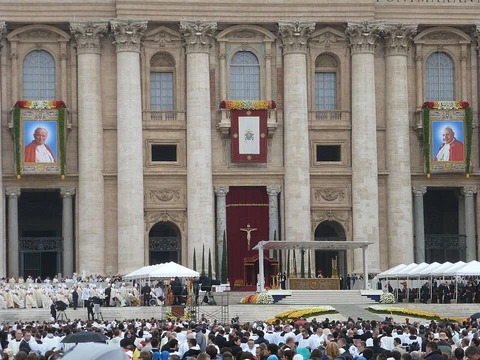
Funeral
The news story was broken by journalist Giovanna Chirri, who understood Latin. Two days later, he presided over his final public mass: a service for Ash Wednesday that ended with congregants bursting into a "deafening standing ovation that lasted for minutes" while the pontiff departed St. Peter's Basilica. On 17 February 2013, Benedict, speaking in Spanish, requested prayers for himself and the new pope from the crowd in St. Peter's Square. Benedict XVI delivered his final Angelus on Sunday, 24 February.
He told the gathered crowd, "Thank you for your affection. [I will take up a life of prayer and meditation] to be able to continue serving the church." The pope appeared for the last time in public during his regular Wednesday audience on 27 February 2013. By 16 February, 35,000 people had already registered to attend the audience. On the evening of 27 February there was a candlelight vigil to show support for Pope Benedict XVI at St. Peter's Square.
Pope emeritus: 2013–2022
On his final day as pope, Benedict held an audience with the college of Cardinals, and at 16:15 local time he boarded a helicopter and flew to Castel Gandolfo. At about 17:30, he addressed the masses from the balcony for the last time as pope. After this speech Benedict waited out the final hours of his papacy; at exactly 20:00 CET the see of Rome became vacant. The conclave to select his successor began on 12 March 2013 and on 13 March 2013 elected cardinal Jorge Mario Bergoglio, Archbishop of Buenos Aires, Argentina, who took the name of Francis.
Frequently Asked Questions
Who is Pope Benedict XVI?
Pope Benedict XVI, born Joseph Alois Ratzinger in 1927 in Germany, led the Catholic Church from 2005 until 2013. He was a deeply influential theologian and philosopher who spent his career defending traditional Catholic teaching before taking up the papal throne.
What was Pope Benedict XVI known for beyond the papacy?
He was a prolific academic and author in theology and philosophy, producing a large body of scholarly and pastoral writing over several decades. Many in the Catholic world regarded him as one of the most important Catholic thinkers of the twentieth and early twenty-first centuries.
Also in the Codexery
More in Catholic Saints & Popes
Related in Catholic Saints & Popes
Links follow this subject's own source article.
Sources
Compiled from Wikipedia and the sources listed below. Text from Wikipedia is available under CC BY-SA 4.0; this entry is adapted from it.
- Wikipedia: Pope Benedict XVI (CC BY-SA 4.0).
Spotted an error? Know more?
Reader corrections go straight into our review queue. Suggest an edit · How this site is sourced