
Dual-member mixed proportional
A mixed electoral system with two local representatives per district.

Dual-member mixed proportional (DMP) is a mixed electoral system where each district elects two representatives using a localized list rule. It resembles other mixed-member proportional systems but differs from the additional-member system because all representatives are elected locally in small districts, rather than through separate list seats in larger regional or nationwide districts. The system was created in 2013 by Sean Graham, a University of Alberta mathematics student, as a potential replacement for single-member plurality (SMP) in Canadian national and provincial elections. After several Canadian provinces rejected mixed-member proportional representation (MMP) and the single transferable vote (STV) in referendums, DMP was designed to keep key features of SMP—such as a one-vote ballot, small districts, and a single tier of local representatives—to gain broader acceptance.
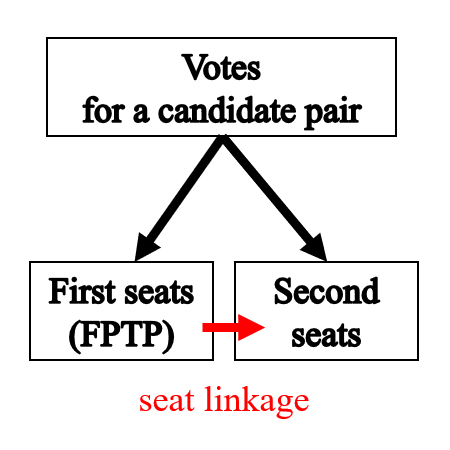
Under DMP, voting is similar to first-past-the-post. Each voter marks a preferred candidate or pair of candidates on a ballot. This is a mixed single vote: a single vote indicates both the preferred local candidate and the preferred party, with party vote totals calculated by adding up votes for all its candidates. Independents can run normally and win if they have the most votes in a district.
In the first step of seat allocation, each party is assigned a number of seats proportional to its share of the popular vote in the region, using Hamilton’s method. This allocation must be adjusted if independents are elected (which reduces seats available to parties) or if a party wins more than its proportional share through plurality. In the second step, one seat per district is awarded to the candidate or party with the most votes, as in first-past-the-post. If the winning primary candidate belongs to a party that listed a secondary candidate, votes are transferred at half weight to that secondary candidate—for example, a party winning 48% of the vote elects its primary candidate, and the secondary candidate is treated as having 24%. After this transfer, any independent with the highest remaining vote share in a district is elected; all other independents are eliminated.
In the third step, each district’s remaining unfilled seat is awarded. Party-affiliated candidates still in the running are sorted by their vote percentages from most to least popular. Seats are tentatively assigned
- inventor
- Sean Graham
- year_invented
- 2013
- field
- Electoral systems
- type
- Mixed electoral system
- related_system
- Mixed-member proportional representation
- ballot_type
- Mixed single vote
Lore & Background
DMP was designed after campaigns to adopt mixed-member proportional representation or the single transferable vote had been defeated in several Canadian provinces, including the 2005 British Columbia referendum, 2005 Prince Edward Island referendum, 2007 Ontario referendum, and 2009 British Columbia referendum. The intent was to gain broader acceptance by retaining features of single-member plurality such as a one-vote ballot, small districts, and a single tier of local representatives. Voting under DMP is similar to first-past-the-post: each voter marks their preferred candidate or pair of candidates, and vote totals for each party are determined by adding up votes for all candidates of that party.
Reader's Guide
Dual-member mixed proportional represents a significant attempt to reconcile proportional representation with the local accountability of single-member districts. Its invention by a mathematics student highlights the role of academic innovation in electoral reform. DMP differs from conventional mixed-member proportional representation by having only a single tier of representatives, with all elected candidates serving the district they contested, similar to multi-seat district systems like the single transferable vote. The system is designed to produce more geographically balanced representation and reduces the likelihood that a disproportionate number of representatives share an association with a particular district. Although DMP was not adopted in the referendums where it appeared, its inclusion in official plebiscites in Prince Edward Island and British Columbia demonstrates its consideration as a viable alternative. The system's ability to allow independent candidates to win seats and its use of a one-vote ballot are features that distinguish it from other proportional systems. The DMP algorithm can be modified to include electoral thresholds, but the article notes that such modifications break the proportionality mechanism and waste votes.
Did You Know?
- DMP was invented in 2013 by Sean Graham, a University of Alberta mathematics student.
- Under DMP, all representatives are elected locally in small districts, unlike other MMP systems that use separate list seats.
- DMP was one of five options on the 2016 Prince Edward Island plebiscite and one of three proportional systems on the 2018 British Columbia referendum.
- The DMP algorithm can be modified to include a standard or local threshold, but doing so breaks the proportionality mechanism.
Origins & Design Philosophy
DMP was created in 2013 by Sean Graham, a mathematics student at the University of Alberta. His motivation was practical: after mixed-member proportional and single transferable vote proposals were defeated in referendums across British Columbia (2005 and 2009), Prince Edward Island (2005), and Ontario (2007), Graham sought a proportional system that would feel familiar to voters accustomed to single-member plurality. He deliberately preserved the hallmarks of SMP—a single vote on one ballot, small geographic districts, and a single tier of local representatives—while adding a proportional correction layer. The result was a system that elects exactly two representatives per district, all through localized voting, eliminating the need for large regional or nationwide list seats that characterize other mixed-member approaches. This design choice was central to DMP's identity: it aimed to make proportional representation palatable in political environments where voters had already rejected more radical departures from plurality voting.
The Three-Step Election Process
DMP operates through a sequential three-step algorithm. In the first step, each party receives a target number of seats proportional to its share of the popular vote in the region, typically calculated using Hamilton's method. The second step awards at least half of all seats by simple plurality—the candidate or party with the most votes in a district wins that seat. A distinctive feature here is vote transfer: when a party's primary candidate wins, their secondary candidate's vote total is treated as half the primary's share. Independents who top the remaining field in any district are elected outright, while all other independents are eliminated. The third step fills remaining seats by ranking each party's unseated candidates from most to least popular across the region and tentatively assigning seats. Conflicts arise when multiple candidates claim the same district's second seat; the highest-vote candidate retains it, the others are eliminated, and their seats cascade to the next most popular candidate still awaiting assignment. This iterative resolution continues until every seat is filled.
Political Engagements & Referendums
DMP moved from academic proposal into real political contests in the mid-2010s. Proposals to consider the system were formally submitted to the governments of Canada, Alberta, Prince Edward Island, and British Columbia. The most significant test came in Prince Edward Island, where in April 2016 the Special Committee on Democratic Renewal officially recommended that DMP appear as one of five options on the province's plebiscite, with the winner determined by instant-runoff voting. The vote ran from October 29 to November 7, 2016. DMP was eliminated in the third round of the instant-runoff count; after its votes were redistributed, mixed-member proportional representation emerged as the winner ahead of first-past-the-post. However, the plebiscite was non-binding, and the sitting government chose to disregard the outcome. DMP's next major appearance was in British Columbia, where in May 2018 it was selected as one of three proportional systems on the 2018 referendum ballot, which used a two-question mail-in format with an extended deadline in December.
Structural Trade-offs & Edge Cases
While DMP achieves proportionality without large list districts, it carries inherent compromises. The system can be modified to include either a nationwide or local electoral threshold, requiring parties to clear a minimum vote share before winning seats. However, any such threshold disrupts the proportionality mechanism, introduces discontinuities in results, and wastes votes—trade-offs common to all threshold-based proportional rules. Independents occupy an unusual position: they can win a seat outright in step two if they top the remaining field in a district, but this removes a seat from the party pool and triggers proportional re-allocation. Parties may also forfeit seats if they nominate fewer than two candidates in a district or if a candidate fails to meet the district threshold; those forfeited seats are redistributed proportionally among remaining eligible parties, requiring an additional pass through the seat-assignment process. These edge cases demonstrate that DMP's elegance depends on sufficient candidate supply and the absence of thresholds, conditions not always met in practice.
Gallery
Frequently Asked Questions
Who invented Dual-member mixed proportional?
Sean Graham, a mathematics student at the University of Alberta, devised the system in 2013 as a proposed reform for Canadian elections.
How does DMP actually work at the ballot box?
Each two-member riding uses a localized list rule, so voters cast a mixed single vote that fills both seats within that small district rather than splitting between a local candidate and a party list.
What makes DMP different from standard mixed-member proportional representation?
In the usual additional-member model, some seats are allocated through regional or nationwide party lists, whereas DMP keeps every representative elected locally inside the two-seat district.
Why was DMP proposed for Canada?
Graham designed it as a drop-in replacement for the single-member plurality (first-past-the-post) system currently used in federal and provincial elections, aiming to improve proportionality without abandoning local representation.
What category of electoral system does DMP belong to?
It is a mixed electoral system and a specific variant of mixed-member proportional representation, distinguished by its two-seat local districts and mixed single vote ballot format.
More in Canadian inventions 1-24
Spotted an error? Know more?
This is a living reference — every entry is fact-audited, and reader corrections feed straight into our audit queue. Suggest an edit · See this site's audit record