
Canadian checkers
A large variant of draughts played on a 12×12 board.

Ihardlythinkso · CC0
Canadian checkers, also referred to as Canadian draughts, is a version of the board game draughts. It ranks among the largest draughts variants, using a 12×12 board and giving each player 30 pieces. French settlers in Quebec, Canada, created the game, originally calling it *Grand jeu de dames*. The exact date of its first play in Canada is not recorded. In 1880, the huff rule was removed following a disagreement during the Canadian championship match. The concept of a larger international draughts board predates this; boards with 12×12 squares were available for sale in London as early as 1805.
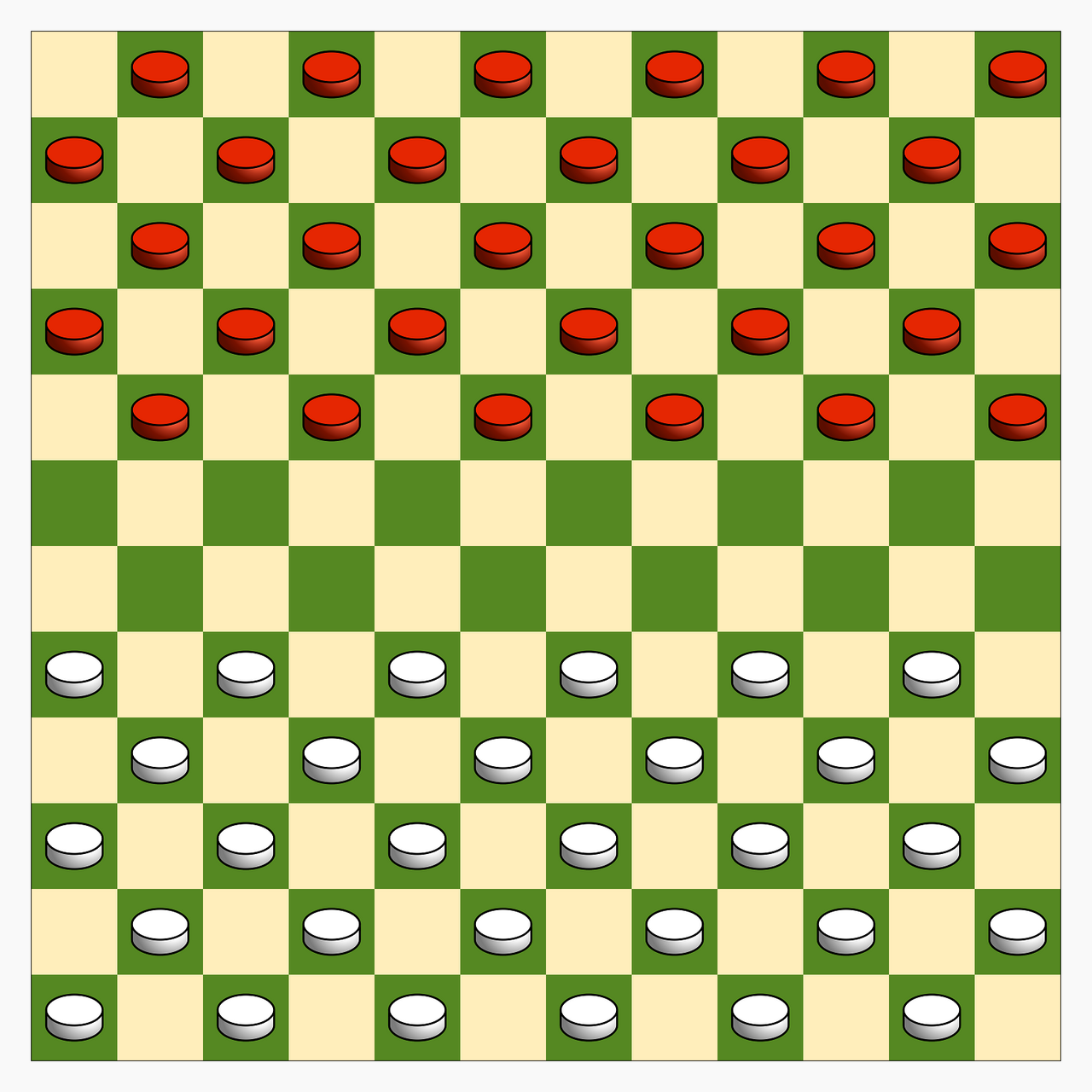
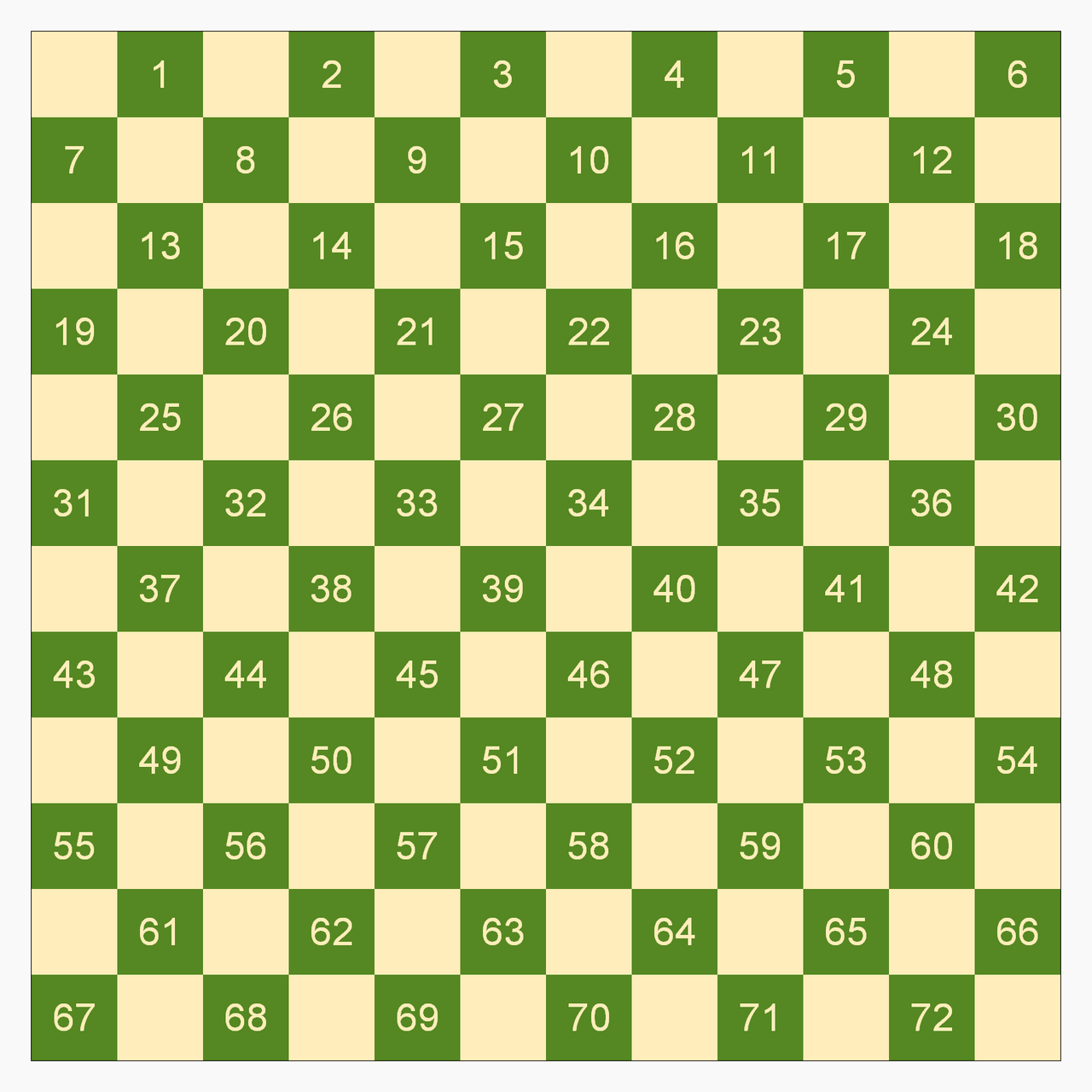
The rules of Canadian checkers match those of international draughts, with only two differences: the board is larger (12×12 squares rather than 10×10), and each player starts with 30 pieces instead of 20. The starting arrangement is shown in a diagram. Moves are recorded using the same notation system as other draughts variants, adapted for the 144-square board.
- board size
- 12×12 squares
- pieces per player
- 30
- variant of
- draughts (checkers)
- origin
- French settlers of Quebec, Canada
- original name
- Grand jeu de dames
- huff rule dropped
- 1880
Lore & Background
Canadian checkers follows the same rules and conventions as international draughts, with the only differences being the larger gameboard (12×12 squares instead of 10×10) and more checkers per player (30 instead of 20). The starting setup is shown in a diagram. Games are recorded using the same method of notation used by other draughts variants, extended for a board of 144 squares.
Reader's Guide
Canadian checkers is significant as one of the largest draughts variants, expanding the strategic depth of the game through its 12×12 board and 30 pieces per player. Its invention by French settlers in Quebec ties it to Canadian cultural history, though the exact date of first play in Canada is unknown. The game's rules mirror international draughts, but the larger board allows for more complex play. A notable historical event occurred in 1880 when the huff rule was dropped after a dispute during the Canadian championship match. The concept of an increased-size international draughts game predates Canadian checkers, with 12×12 boards sold in London as early as 1805. The game remains played under the governance of the Association Québécoise des joueurs de dames.
Did You Know?
- Canadian checkers is played on a 12×12 board with 30 pieces per player.
- The game was invented by French settlers of Quebec and originally called Grand jeu de dames.
- The huff rule was dropped in 1880 after a dispute during the Canadian championship match.
- Boards with 12×12 squares were on sale in London in 1805.
Origins & Historical Roots
Canadian checkers, also known as Canadian draughts, traces its invention to the French settlers who established communities in Quebec, Canada. These early colonists gave the game its original French name, Grand jeu de dames, a title that reflects both its French cultural roots and its place among the broader family of draughts strategy board games. The precise moment when the game was first played on Canadian soil remains unknown, a gap in the historical record that speaks to how deeply the pastime was woven into everyday life before anyone thought to document it. What is clear, however, is that the concept of scaling up a draughts board to twelve-by-twelve squares predates the game's formal Canadian identity. As early as 1805, boards of that dimension were already available for purchase in London, suggesting that the idea of a larger-scale draughts experience had been circulating in European circles well before it took its distinctive shape in the French-speaking regions of North America. Canadian checkers stands as one of the largest variants in the draughts family, a distinction that sets it apart from the more commonly encountered ten-by-ten international format.
The 1880 Championship Dispute
By the late nineteenth century, Canadian checkers had evolved from a casual parlor pastime into a competitive sport with organized championship matches. The most significant rule change in the game's recorded history came in 1880, when the so-called huff rule was officially abandoned. This decision was not the product of a quiet committee vote but rather the direct consequence of a heated dispute that erupted during a Canadian championship match. The incident underscores how, even in an era when board games were often played informally among friends and family, the stakes of competitive play could generate genuine friction over interpretation. The removal of the huff rule simplified the competitive framework and brought the rules into a more stable configuration, one that has persisted to the present day. The fact that a single disputed match could reshape the governing rules of a national game speaks to the passionate community that had formed around Canadian checkers by the 1880s. It also highlights an important truth about the game's development: its rules were not handed down from some distant authority but were shaped, refined, and occasionally overthrown by the very players who competed under them.
Rules & Gameplay Structure
At its core, Canadian checkers operates under the same fundamental rules and conventions as international draughts, the ten-by-ten variant more widely known around the world. The two defining departures from that standard are purely matters of scale. First, the playing surface expands from a 10×10 grid to a 12×12 checkered board, adding an extra two rows and two columns of squares. Second, each player begins with thirty pieces rather than the twenty used in the international format. These two changes compound in a way that dramatically increases the game's complexity. With forty-eight additional squares and ten extra pieces per side, the number of possible positions, tactical sequences, and strategic plans grows enormously. Players must track more material, manage longer capture chains, and think in terms of spatial relationships stretching across a wider field. Despite this increased complexity, the underlying mechanics—how pieces move, how captures are executed, how kings are promoted—remain identical to those of international draughts. A player well-versed in the ten-by-ten game can pick up a Canadian checkers board and recognize the fundamental logic, even as the sheer scale of the 144-square field demands a broader strategic vision.
Notation, Documentation & Community
Like other draughts variants, Canadian checkers has a standardized system of notation for recording games. The method is the same one used across the draughts family, simply extended to accommodate the larger board of 144 squares rather than the 100 found in the international format. This shared notation system means that a game score written in Canadian checkers is readable by anyone familiar with draughts notation, even if they have never seen a 12×12 board in person. The game has also been documented in several published works over the decades, including entries in Ruth Midgley's 1975 collection The Way to Play, Merilyn Simonds Mohr's 1997 New Games Treasury, H. J. R. Murray's 1978 history of board games, and David Parlett's 1999 Oxford History of Board Games. This breadth of publication reflects a game that has maintained a steady, if niche, presence in the world of strategy board games. In the modern era, the Association Québécoise des joueurs de dames (AQJD) serves as the official body for the Quebec draughts community, while the game also maintains a listing on the BoardGameGeek platform, ensuring that new players can discover it alongside the thousands of other board games catalogued there.
Gallery
Frequently Asked Questions
What is Canadian checkers?
Canadian checkers, also called Canadian draughts, is a large-board variant within the draughts family of games. It is played on a 12×12 grid where each side begins with 30 pieces.
Who invented Canadian checkers?
French settlers in Quebec, Canada, developed the game and originally named it *Grand jeu de dames*. No precise date for its first play was ever recorded, so its exact moment of creation remains unknown.
How does Canadian checkers differ from standard American checkers?
Standard American checkers uses an 8×8 board with 12 pieces per player, whereas Canadian checkers scales up to a 12×12 board and 30 pieces per side. This makes it one of the largest recognized draughts variants.
What happened to the huff rule in 1880?
The huff rule was eliminated from the game after a disagreement broke out during the Canadian championship match that year. Its removal helped standardize how the variant was played competitively going forward.
Was the 12×12 board size truly a Canadian innovation?
Not strictly—12×12 draughts boards were already being sold in London by 1805, so the larger board concept predates the game's formalization in Quebec. What the Canadian variant contributed was the specific ruleset and competitive structure built around that board size.
More in Canadian inventions 1-24
Spotted an error? Know more?
This is a living reference — every entry is fact-audited, and reader corrections feed straight into our audit queue. Suggest an edit · See this site's audit record