
Anti-roll bar
First patented by William H. Miner in 1915, with a later Canadian patent by Stephen Coleman in 1919.

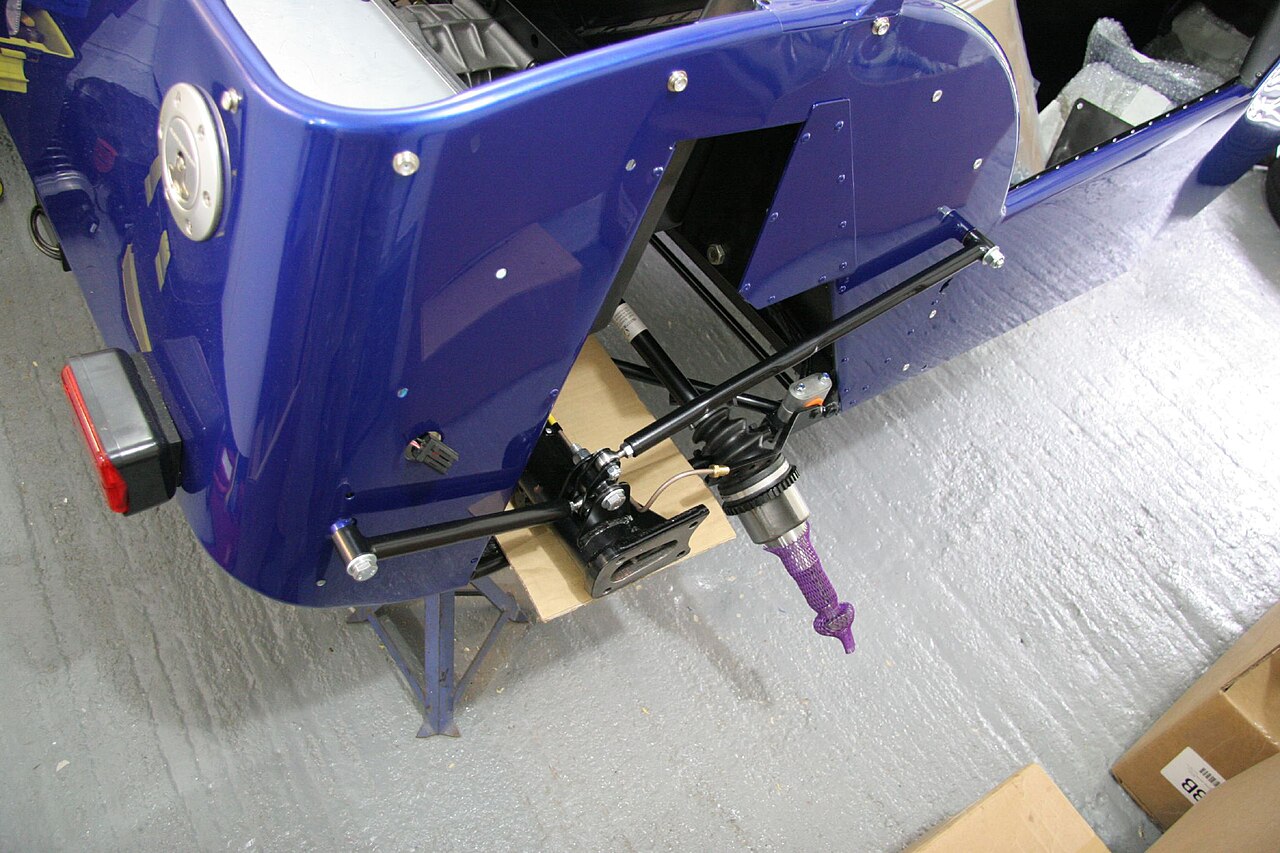
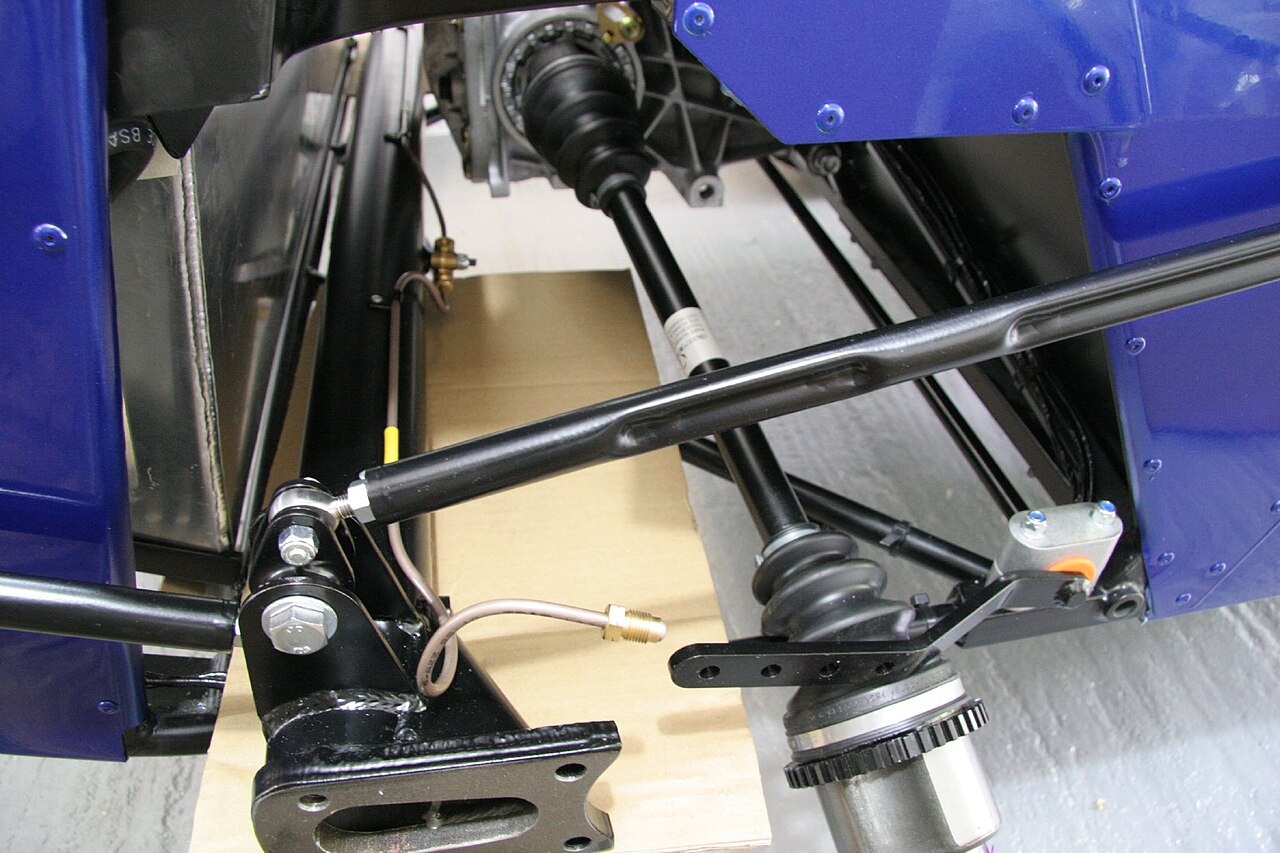
Evan Mason · CC BY-SA 3.0
An anti-roll bar—also known as a roll bar, anti-sway bar, sway bar, or stabilizer bar—is a suspension part that limits how much a vehicle’s body leans (rolls) during sharp turns or on uneven roads. It connects opposite wheels on the same axle to a torsion spring via short lever arms, boosting the suspension’s resistance to roll. The first patent for this device is often credited to Canadian inventor Stephen Coleman from Fredericton, New Brunswick, on April 22, 1919, but earlier patents exist, such as U.S. patent 1,131,359 awarded to William H. Miner in 1915. Before World War II, such bars were rare because cars had stiffer suspensions and drivers tolerated body roll more. Starting in the 1950s, however, they became standard on many production cars, particularly those with softer coil springs.
The bar’s main job is to keep the vehicle level by making the suspension on the inside of a turn compress along with the outside. In a corner, the outer wheel’s suspension compresses; the anti-roll bar then forces the inner wheel’s suspension to do the same, reducing lateral tilt. This also lowers the car’s center of gravity during the turn, improving stability. When both front and rear bars are used, they help the vehicle lean with the slope of the road.
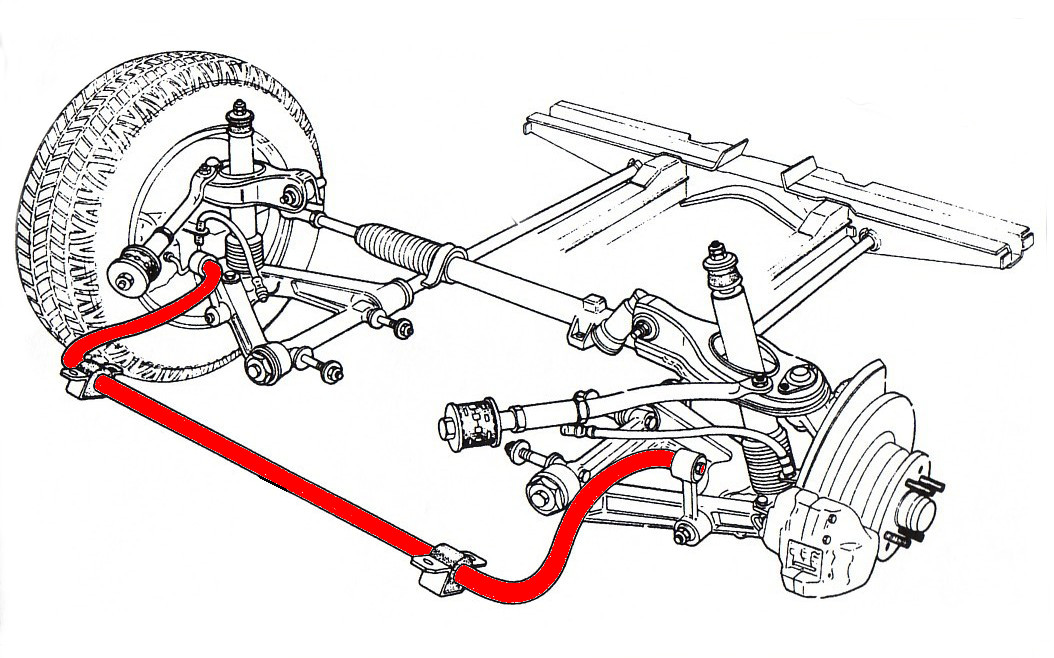
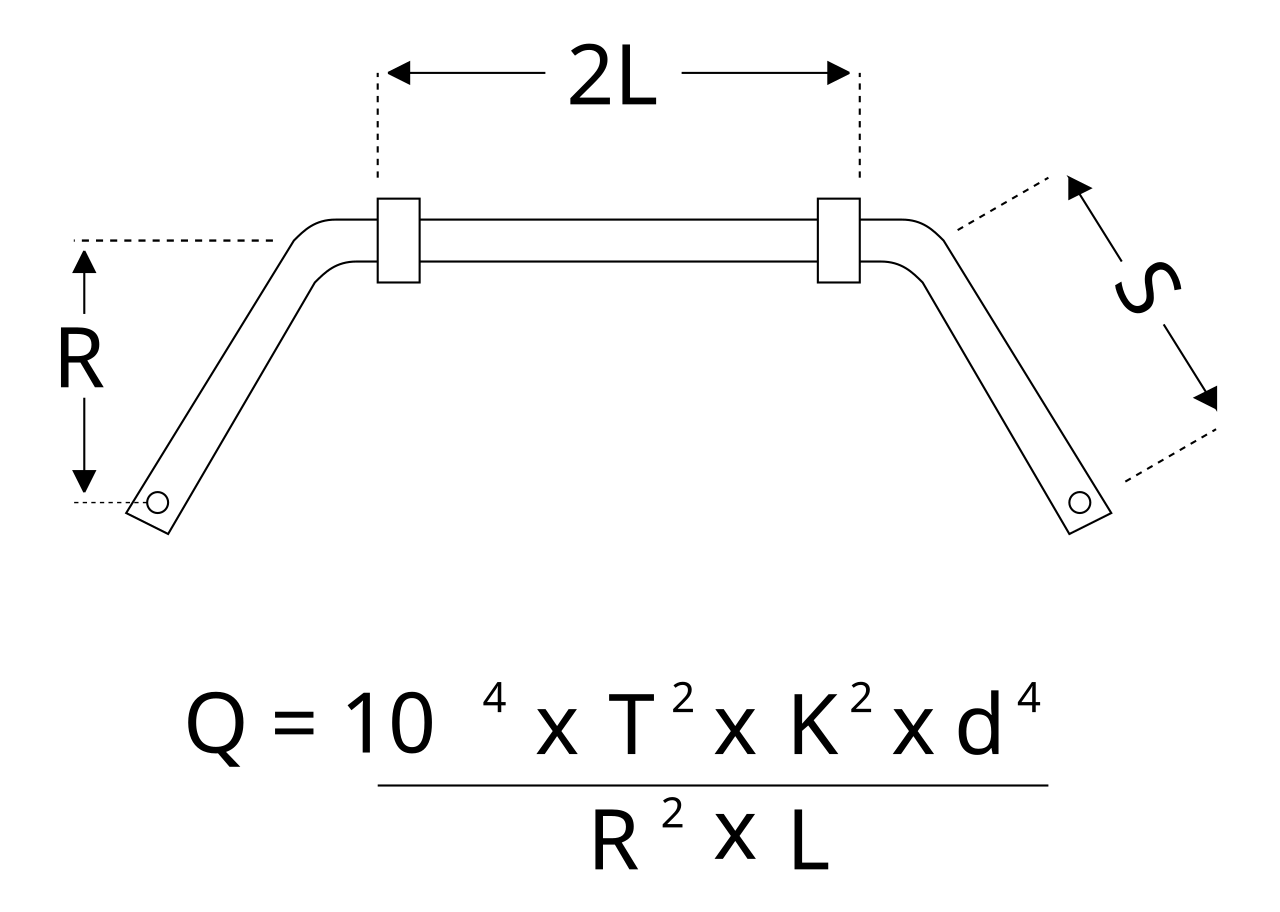
The bar itself is a torsion spring, usually a U-shaped steel cylinder, mounted to the body at two points along its center section. When both wheels move together, the bar just rotates on its mounts. When the wheels move in opposite directions, the bar twists. Each end connects to a link via a flexible joint, which then attaches near a wheel or axle. This transfers force from the heavily loaded side of the suspension through the link and bar to the opposite side. The bar resists twisting based on its material stiffness, the fourth power of its radius, and the length of its lever arms (shorter arms mean a stiffer bar). Mounting geometry and rigidity also affect stiffness. A stiffer bar requires more force to move the wheels relative to each other, which increases the force needed to roll the body.
In a turn, the body’s mass creates a lateral force at the center of gravity. Since the center of gravity is usually above the roll axis (the line connecting front and rear roll centers), this force produces a roll couple—a twisting moment that tries to lean the body. The suspension’s roll stiffness, from both springs and ant
- inventor
- William H. Miner (earlier patent); Stephen Coleman (later patent)
- nationality
- American (Miner); Canadian (Coleman)
- residence
- Fredericton, New Brunswick (Coleman)
- patent_date
- March 9, 1915 (Miner); April 22, 1919 (Coleman)
- field
- Automotive suspension
- known_for
- Early anti-roll bar patents
Lore & Background
The anti-roll bar is a torsion spring, usually a cylindrical steel bar formed into a U shape, that connects to the vehicle body at two points along its center section. When left and right wheels move together, the bar rotates on its mounts; when they move relative to each other, torsion forces twist the bar. Each end connects via a flexible joint and end link to a wheel or axle, transferring forces from the heavily loaded side to the opposite side. The bar resists torsion through its stiffness, which is proportional to the material's stiffness, the fourth power of its radius, and inversely proportional to lever arm length. While Canadian Stephen Coleman patented a version in 1919, earlier designs like William H. Miner's 1915 patent predate it.
Reader's Guide
The anti-roll bar serves two main functions: reducing body lean and tuning handling balance. Reducing body lean depends on total roll stiffness, but does not change total lateral load transfer, which is determined by center of gravity height and track width. By adjusting the proportion of roll stiffness between front and rear axles, understeer or oversteer can be reduced. Increasing front roll stiffness increases understeer; increasing rear roll stiffness decreases understeer. Drawbacks include transmitting bump forces to the opposite wheel, causing jarring motions on rough pavement, and excessive stiffness can lift inside wheels during hard cornering. Adjustable bars allow stiffness changes without replacing the bar. The MacPherson strut suspension originally used the anti-roll bar as an integral part controlling wheel position. Semi-active systems, such as the 1988 Mitsubishi Mirage Cyborg's Dual Mode Suspension, allow toggling between modes. The first active anti-roll bar system was Citroën's SC.CAR in the 1994 Xantia Activa, minimizing body roll to 2 degrees.
Did You Know?
- The first patent for an anti-roll bar was awarded to William H. Miner in 1915, not Stephen Coleman in 1919.
- The first production car with a semi-active anti-roll bar was the 1992 Citroën Xantia Activa, not the 1988 Mitsubishi Mirage Cyborg.
Origins and the Road to Standard Equipment
The concept of linking opposite wheels to resist body roll traces back to a Canadian inventor named Stephen Coleman, who received the first stabilizer bar patent on April 22, 1919, in Fredericton, New Brunswick. Despite this early intellectual property, the device remained a rarity in automotive design for decades. Before World War II, most cars featured suspension systems that were inherently stiff, and manufacturers and drivers alike simply accepted the lateral lean that came with cornering. The anti-roll bar was not yet considered necessary. The landscape shifted dramatically in the postwar era. Beginning in the 1950s, production vehicles increasingly adopted softer coil spring suspensions for improved comfort, but this flexibility made body roll more pronounced. Anti-roll bars became a practical solution, allowing engineers to preserve ride smoothness while still controlling lateral tilt. What had been a niche addition gradually became standard equipment, transforming from an optional refinement into a fundamental component of modern suspension design.
The Mechanics of Torsion
At its core, an anti-roll bar functions as a torsion spring shaped into a U from a cylindrical steel bar. The longer center section is anchored to the vehicle body at two points, while each end connects through a flexible joint to an end link that attaches near a wheel or axle. When both wheels on an axle travel in unison, the bar merely pivots on its central mounts. But when the wheels move relative to one another, as happens in a turn, the bar twists, and that torsional resistance is what resists body roll. The force path is elegant in its simplicity: load from the heavily compressed side passes through a bushing into the end link, through the flexible joint into the bar, across to the opposite end link, and finally into the other side of the suspension. The bar's stiffness depends on the material's rigidity, the fourth power of its radius, and the inverse of the lever arm length, meaning shorter arms produce a stiffer response. Mounting geometry and the rigidity of the anchor points also play a role in the overall roll resistance the bar provides.
Tuning the Balance: Understeer, Oversteer, and Racing
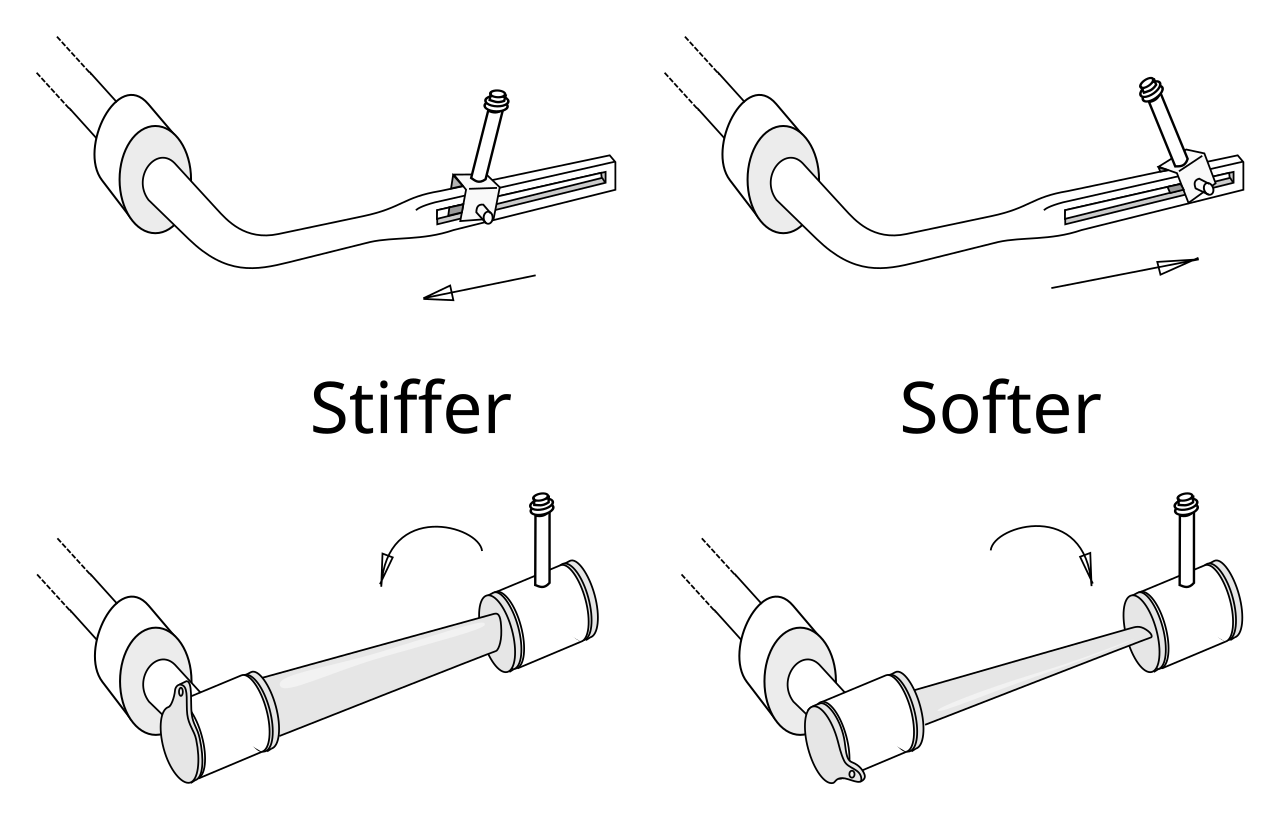
Beyond simply reducing body lean, anti-roll bars serve as a critical tool for dialing in a car's handling character. By adjusting the proportion of total roll stiffness allocated to the front versus rear axle, engineers can shift the balance between understeer and oversteer. Stiffer front bars cause the outer front wheel to operate at a higher slip angle relative to the rear, promoting understeer. Conversely, increasing rear roll stiffness reduces understeer and can push the car toward oversteer. This principle is exploited extensively in motorsport. In many racing series, anti-roll bars are externally adjustable during pit stops, letting crews change lever arm lengths to alter stiffness. In Super GT, for example, drivers can modify the bar's behavior in real time from the cockpit. Some systems achieve this by rotating a flat lever arm from a stiff edge-on orientation to a more flexible flat-side-on position. This level of dynamic tuning allows teams to adapt to changing track conditions and tire wear without sacrificing the fundamental geometry of the suspension.
The Cost of Stiffness: Trade-offs and Wheel Lift
No suspension component is without compromise, and the anti-roll bar is no exception. Because it mechanically links the left and right wheels, any impact on one side is transmitted across to the other. On rough or broken pavement, this coupling can produce a jarring side-to-side rocking motion often described as a waddling sensation. The effect grows more pronounced as the bar's diameter and stiffness increase, and while other suspension design techniques can help dampen this cross-coupling, it remains an inherent consequence of the connecting bar. A more extreme consequence occurs when roll stiffness is set too aggressively. During hard cornering, the inside wheels can be forced completely off the ground. While this might sound detrimental, some front-wheel-drive production cars deliberately exploit this behavior: lifting a rear wheel during a turn overloads the opposite rear wheel, which helps limit understeer. Thus, what appears to be a drawback can be harnessed as a performance advantage, illustrating the nuanced engineering trade-offs that define modern suspension design.
Gallery
Frequently Asked Questions
Who is credited with inventing the anti-roll bar?
While American engineer William H. Miner holds an earlier 1915 U.S. patent, the device is often associated with Canadian inventor Stephen Coleman, who filed his own patent on April 22, 1919, from Fredericton, New Brunswick.
What does an anti-roll bar actually do?
It is a torsion-spring bar that links the left and right wheels on the same axle, resisting the body's tendency to lean sideways during hard cornering or when one side encounters a bump.
Where was Stephen Coleman based when he patented the anti-roll bar?
Coleman was based in Fredericton, New Brunswick, and filed his patent there on April 22, 1919.
Why does the anti-roll bar matter in Canadian invention history?
Coleman's 1919 patent is frequently cited as a Canadian contribution to automotive suspension design, even though Miner's 1915 filing predates it, making the device a shared North American milestone.
What other names do people use for the anti-roll bar?
You will also hear it called a roll bar, anti-sway bar, sway bar, or stabilizer bar, all referring to the same torsion-bar suspension component.
More in Canadian inventions 1-24
Spotted an error? Know more?
This is a living reference — every entry is fact-audited, and reader corrections feed straight into our audit queue. Suggest an edit · See this site's audit record