
Diaphone
A powerful noisemaker used as a foghorn and fire alarm.

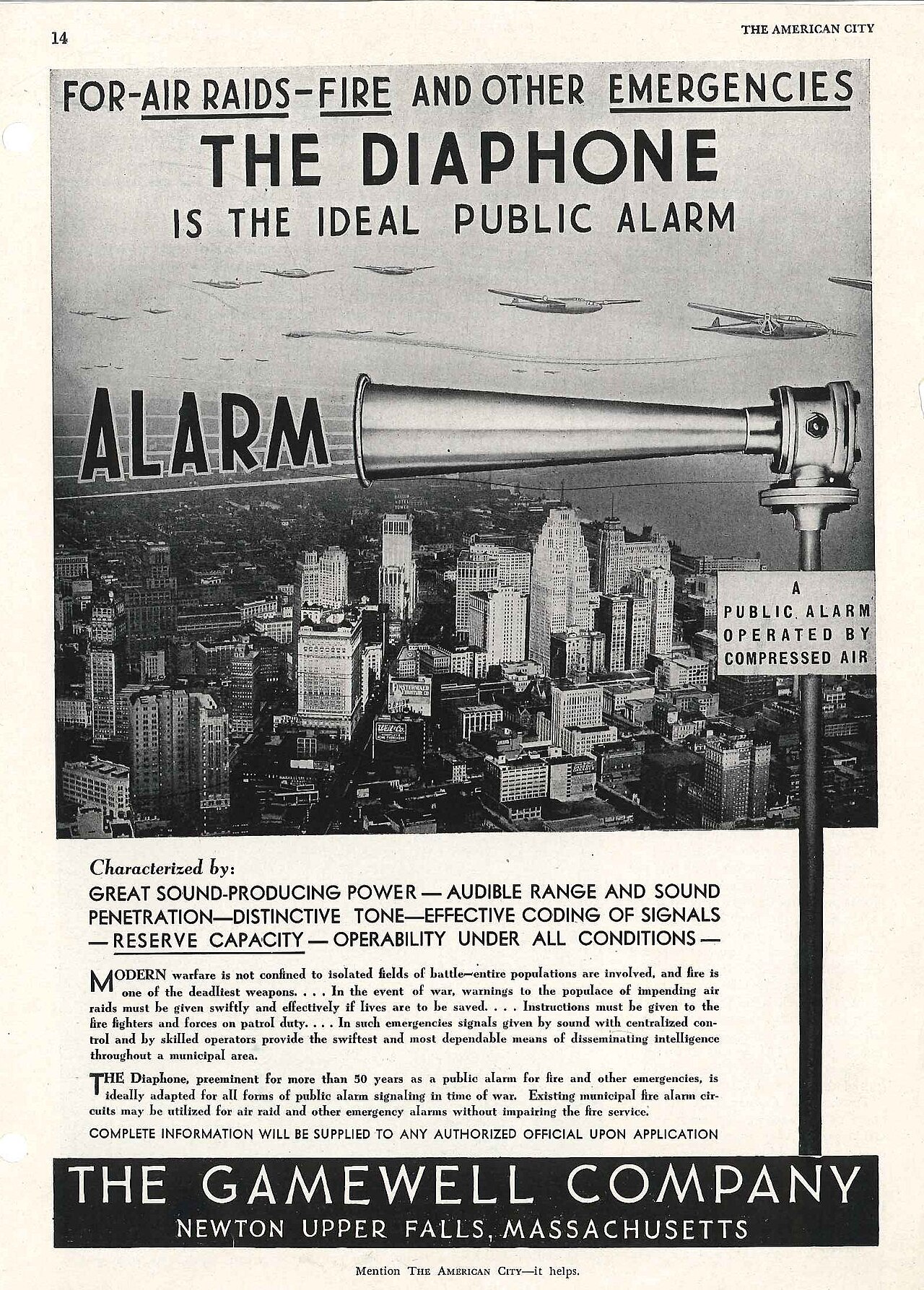
The Gamewell Company · Public domain
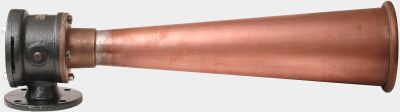
The diaphone is a noisemaking device most famous for serving as a foghorn. It generates deep, powerful tones that can travel over great distances. Though no longer common, diaphones were once used at fire stations and other locations needing a loud, clear signal.
The device shares its name with an organ stop invented by Robert Hope-Jones, who also created the theatre organ. Hope-Jones’s design used a piston closed only at the bottom, with slots cut through its sides perpendicular to its axis. This slotted piston moved inside a similarly slotted cylinder, which was surrounded by a reservoir of high-pressure air. High-pressure air initially pushed the piston forward. When the piston’s slots aligned with the cylinder’s slots, air entered the piston, producing sound and forcing the piston back to its starting position, where the cycle repeated. However, the foghorn mechanism was not a direct adaptation of this organ stop. John Pell Northey, head of the Northey Co. Ltd. in Toronto, Ontario, Canada, independently developed the diaphone foghorn by adapting the principle, patenting a modification. He added a secondary compressed air supply to power the piston during both its forward and backward strokes, creating an even louder sound. A compressor drove the entire horn apparatus.
Northey founded the Diaphone Signal Co. in Toronto in 1903 to manufacture the new equipment. The company produced several models. The large “Type F,” which produced a tone around 250 Hz, was used worldwide as a fog signal, especially in lighthouses. The diaphone’s mechanism produced a noticeable low-frequency “grunt” at the end of each note, caused by the piston decelerating when the air supply was cut. Because this low sound could travel farther, Northey’s son Rodney redesigned the “Type F” to sustain the second low tone. This created the familiar two-tone fog signal commonly used in lighthouses and lightvessels in the United States and Canada, as well as in a famous series of Lifebuoy soap radio commercials. This version, called the “Improved Type F” or later “F2T,” was especially common on the U.S. West Coast and on lightvessels. European installations generally used single-tone diaphones.
Rodney Northey sold the Diaphone Signal Co. in 1932 to the Gamewell Company. This company still exists but no longer makes diaphones. European manufacturing rights went to Chance Brothers of Birming
- inventor
- Robert Hope-Jones (organ stop); John Pell Northey (foghorn mechanism)
- patent_holder
- John Pell Northey
- field
- Audible signaling devices
- known_for
- Foghorn and municipal alarm use
- manufacturer
- Diaphone Signal Co. (Toronto, Canada); later Gamewell Company
- first_production
- 1903
Lore & Background
The diaphone horn shares its name with an organ stop invented by Robert Hope-Jones, creator of the theatre organ. Hope-Jones' design used a slotted piston moving within a slotted cylinder, driven by high-pressure air. However, the foghorn mechanism was not directly copied from this organ stop. John Pell Northey, head of the Northey Co. Ltd. of Toronto, Ontario, Canada, independently developed the diaphone foghorn by adapting the principle, patenting a modification that added a secondary compressed air supply to power the piston during both forward and reverse strokes, creating an even more powerful sound. The entire horn apparatus was driven by a compressor.
To manufacture the new equipment, Northey set up the Diaphone Signal Co. at Toronto in 1903. It manufactured a range of models, including the large 'Type F', which created a tone of about 250 Hz and found worldwide use as a fog signal, especially in lighthouses.
Reader's Guide
The diaphone's significance lies in its role as a reliable, long-range audible signal for maritime navigation and municipal alerts. Its deep tones could carry far, making it ideal for fog signals at lighthouses and lightvessels, especially in the United States and Canada where the two-tone 'F2T' variant became iconic. The device was also adapted by the Gamewell Corporation for use as a municipal alarm, particularly at fire stations, with a range of about six miles under optimum conditions. The diaphone's design, based on a lightweight piston floating on a cushion of air, proved reliable and suffered little wear, though custom-made pistons affected individual sound characteristics. Its legacy endures in a handful of working installations preserved as tourist attractions, such as Detour Reef Lighthouse, East Brother Island Light, and Low Head Lighthouse, which possesses the only working Type G diaphone in the world. The diaphone's distinctive two-tone sound also gained cultural recognition through a famous series of radio commercials for Lifebuoy soap.
Did You Know?
- The diaphone was based on an organ stop invented by Robert Hope-Jones, creator of the theatre organ.
- John Pell Northey added a secondary compressed air supply to power the piston during both forward and reverse strokes.
- The 'Improved Type F' or 'F2T' two-tone fog signal was commonly used in lighthouses and lightvessels in the United States and Canada.
- The Gamewell diaphone, used for municipal alarms, has a range of about six miles (9.7 km) under optimum conditions.
Mechanical Ingenuity & Design Origins
The diaphone traces its mechanical DNA to Robert Hope-Jones, the man behind the theatre organ, who conceived a stop of the same name. His core idea was elegant in its simplicity: a piston, sealed only at its base, bore slots cut perpendicular to its axis, sliding within a matching slotted cylinder. A reservoir of high-pressure air sat outside this assembly. The cycle began when pressurized air forced the piston forward; once its slots aligned with the cylinder's, air rushed through, producing a deep tone while simultaneously driving the piston back. This self-repeating oscillation generated the characteristic powerful sound. John Pell Northey, heading the Northey Co. Ltd. in Toronto—a firm that built pumps and small gasoline engines—patented a critical refinement. He introduced a second compressed-air supply that powered the piston on both its forward and reverse strokes, amplifying the output substantially. The entire apparatus was driven by a compressor, and this dual-stroke design became the foundation for every subsequent diaphone model.
The Two-Tone Signature & Cultural Footprint
Rodney Northey, son of the company's founder, noticed something peculiar in the Type F model's sound: as the piston decelerated at the end of each note when the air supply was cut, a low-frequency grunt emerged. Because lower frequencies travel farther, he saw an opportunity. He redesigned the Type F to sustain that second, deeper tone, producing the now-iconic two-tone fog signal. This Improved Type F, later designated F2T, became the standard on West Coast United States installations and aboard lightvessels, while European lighthouses generally retained single-tone diaphones. The two-tone pattern transcended maritime use; it became so recognizable that a famous series of radio commercials for Lifebuoy soap built their jingles around the sound. The F2T's deep, resonant tone—approximately 250 Hz on the original Type F—gave it a carrying power that made it the preferred fog signal in lighthouses worldwide, cementing a sound that generations of sailors and listeners would associate with coastal safety.
Corporate History & Gradual Obsolescence
The Diaphone Signal Co. was established in Toronto in 1903 by John Pell Northey to manufacture the improved horn. The company produced a range of models, with the large Type F achieving global adoption as a fog signal, particularly in lighthouses. In 1932, Rodney Northey sold the firm to Deck Brothers of Buffalo, New York, which operated under contract for the United States Lighthouse Service; that company still exists today, though it no longer builds diaphones. European manufacturing rights passed to Chance Brothers of Birmingham, already a major supplier of Fresnel lenses to lighthouse authorities. The diaphone's reliability was notable: the lightweight piston floated on an air cushion during oscillation, minimizing wear. When wear did occur, it stemmed from the piston becoming loose, and because each custom-made piston subtly altered the signal's tonal character, manufacturers included two spares with every unit. Yet by the 1960s and 1970s, most installations were removed or abandoned. Lighthouse automation reduced the need for manual signals, and modern diaphragm horns matched the diaphone's volume while demanding far smaller, less powerful compressors. By 1983, the last full-time F2T in the United States operated at Edgartown, Martha's Vineyard.
Living Voices Around the World
Despite their widespread retirement, a handful of diaphones continue to sound, preserved as working heritage. At Detour Reef Lighthouse near Detour, Michigan, the original Type F2T units were restored and reinstalled with new compressors and air tanks. East Brother Island Light off Richmond, California, maintains a fully restored fog signal building with operational two-tone F2T diaphones. Grand Traverse Light in Michigan operates a Type CC model, while the Nantucket Light Ship museum in Boston sounded its restored diaphone for the first time on August 7, 2015. Across the Atlantic, Nash Point Lighthouse in South Wales and Portland Bill Lighthouse on the Isle of Portland, United Kingdom, keep their installations functional—Portland Bill's Type F, decommissioned in 1996, was restored in 2003 for visitors. In Tasmania, Low Head Lighthouse houses the only working Type G diaphone in the world, one of the largest models ever built, with an audible range extending up to twenty miles. In southern Norway, Lindesnes Lighthouse hosts Fog Horn Day on the last Sunday of July, inviting the public to hear the ancient signal still thunder across the fjord.
Gallery

Frequently Asked Questions
Who invented the Diaphone?
The organ stop that gave the device its name was designed by Robert Hope-Jones, while John Pell Northey developed the specific foghorn mechanism and held the patent. Northey's design became the basis for the commercial product.
What was the Diaphone primarily used for?
It served as a loud audible signaling device, most notably as a foghorn for maritime navigation and as a fire alarm at municipal fire stations. Its deep, powerful tone could carry over long distances, making it ideal for any situation requiring a clear, penetrating warning.
Where and when was the Diaphone first manufactured?
Production began in 1903 under the Diaphone Signal Company, based in Toronto, Canada. The company was later absorbed into the Gamewell Company, which continued making the device.
How does the Diaphone produce its sound?
It relies on a slotted piston that moves within a matching slotted cylinder, a concept borrowed from Hope-Jones's organ stop design. This mechanism drives air in a way that generates a deep, resonant tone capable of traveling great distances without electronic amplification.
Is the Diaphone still in common use today?
No, it has largely been replaced by modern electronic foghorns and alarm systems. However, it remains a notable piece of early 20th-century Canadian industrial history and can still be found on some heritage ships and historic fire stations.
More in Canadian inventions 1-24
Spotted an error? Know more?
This is a living reference — every entry is fact-audited, and reader corrections feed straight into our audit queue. Suggest an edit · See this site's audit record