
Alpha particle X-ray spectrometer
Space instrument analyzing elemental composition via alpha particles and X-rays.

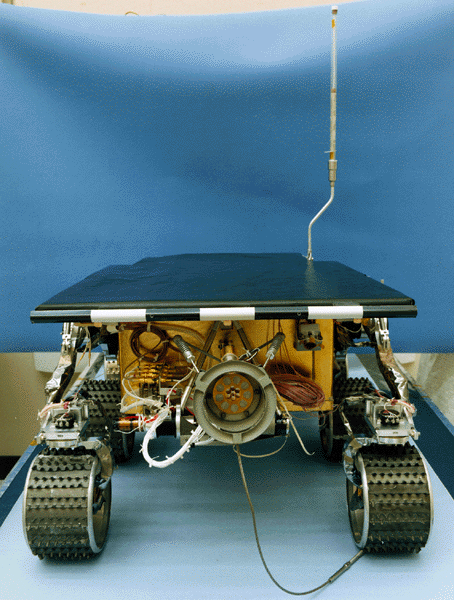
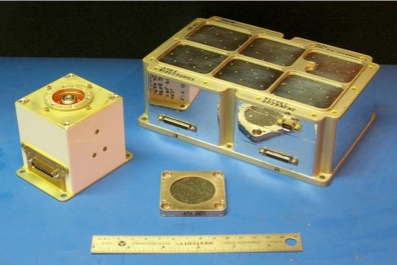
An alpha particle X-ray spectrometer, or APXS, determines a sample's chemical elements by bombarding it with alpha particles and X-rays from radioactive sources, then analyzing the scattered alpha particles and fluorescent X-rays that result. This technique is primarily employed on space missions where instruments must be lightweight, compact, and energy-efficient. While other methods like mass spectrometry work faster and avoid radioactive materials, they demand larger, more power-hungry equipment. A variant, the alpha proton X-ray spectrometer—used on the Pathfinder mission—also detects protons. Over time, modified versions of this instrument (such as APS, which lacks the X-ray spectrometer, or APXS) have flown on Surveyor 5–7, Mars Pathfinder, Mars 96, the Mars Exploration Rovers, Phobos, the Mars Science Laboratory, the Philae comet lander, and the Chandrayaan-3 lunar rover. Several upcoming missions will also carry APS or APXS devices.
The instrument relies on three forms of radiation: alpha particles, protons, and X-rays, all emitted during radioactive decay. Curium-244 is a common alpha source, releasing particles at 5.8 MeV, while plutonium-238 or curium-244 serve as X-ray sources, emitting characteristic X-rays at specific energies. For example, the Mars Exploration Rovers' Athena payload uses curium-244 with a source strength of about 30 millicuries (1.1 GBq).
When alpha particles strike atomic nuclei, some backscatter to the detector. The physics of Rutherford backscattering—conservation of energy and momentum—allows calculation of the nucleus's mass. Light elements cause greater energy loss in the alpha particle, whereas heavy nuclei result in smaller fractional energy loss. The resulting energy spectrum shows peaks from 25% to nearly 100% of the initial alpha energy, revealing the sample's composition, especially for lighter elements. Because backscattering rates are low, irradiation typically takes about ten hours.
Some alpha particles are absorbed by atomic nuclei, producing protons via an [alpha, proton] process. These protons have defined energies and can detect sodium, magnesium, silicon, aluminum, and sulfur. This method appeared only on the Mars Pathfinder APXS; later Mars Exploration Rovers replaced the proton detector with a second alpha sensor, hence the name alpha particle X-ray spectrometer.
Alpha particles can also eject electro
- type
- Scientific instrument
- method
- Alpha particle scattering and X-ray fluorescence
- common source
- Curium-244 (alpha); Plutonium-238 or Curium-244 (X-rays)
- missions flown
- Surveyor 5-7, Mars Pathfinder, Mars 96, Mars Exploration Rover, Phobos, Mars Science Laboratory, Philae comet lander, Chandrayaan-3 lunar rover
- variation
- Alpha proton X-ray spectrometer (used on Pathfinder)
Lore & Background
The alpha particle X-ray spectrometer uses radioactive sources to irradiate a sample. Alpha particles from curium-244 (5.8 MeV) and X-rays from plutonium-238 or curium-244 are emitted. Some alpha particles backscatter off atomic nuclei; the energy loss reveals the mass of the nucleus, with light elements causing greater energy loss and heavy elements causing smaller fractional energy loss. Other alpha particles are absorbed, producing protons that allow detection of sodium, magnesium, silicon, aluminium, and sulfur—a method used only on Mars Pathfinder. Alpha particles also eject inner-shell electrons, causing characteristic X-ray emission (particle-induced X-ray emission), which is sensitive to heavier elements.
Reader's Guide
The APXS has been a key instrument on multiple planetary missions, including Surveyor 5-7, Mars Pathfinder, Mars 96, Mars Exploration Rovers, Phobos, Mars Science Laboratory, the Philae comet lander, and the Chandrayaan-3 lunar rover. Its design prioritizes low weight, small size, and minimal power consumption, making it suitable for space missions where other methods like mass spectrometry are faster but require larger equipment. The instrument's ability to detect both light and heavy elements through alpha backscattering and X-ray fluorescence has provided valuable data on the composition of rocks, soils, and cometary material. Upcoming missions will continue to include APS/APXS devices.
Did You Know?
- The Mars Exploration Rovers' Athena payload uses curium-244 with a source strength of approximately 30 millicuries (1.1 GBq).
- The alpha proton X-ray spectrometer on Mars Pathfinder also detects protons, a method not used on later Mars Exploration Rovers.
- Light elements absorb more energy of the alpha particle, while heavy nuclei reflect alpha particles with nearly the same energy.
- The low backscattering rate makes prolonged irradiation necessary, approximately 10 hours.
The Physics of Elemental Detection
The APXS determines what elements are present in a sample by exploiting three distinct nuclear and atomic interactions. When alpha particles strike atomic nuclei at angles approaching 180 degrees, they undergo Rutherford backscattering governed by conservation of energy and linear momentum. Because light nuclei absorb a larger fraction of the incoming particle's kinetic energy while heavy nuclei bounce the alpha back with nearly its original energy, the resulting energy spectrum displays characteristic peaks spanning roughly 25 to 100 percent of the initial alpha energy. This makes the technique especially sensitive to lighter elements, though the low backscattering rate demands irradiation periods of about ten hours. A second channel involves the absorption of an alpha particle by a nucleus, triggering an alpha-proton reaction that releases protons of defined energy; this pathway was used on Mars Pathfinder to identify sodium, magnesium, silicon, aluminium, and sulfur. The third channel is particle-induced X-ray emission: alpha particles knock electrons out of inner K- and L-shells, and as outer-shell electrons fill those vacancies, characteristic X-rays are released. This mechanism offers the best sensitivity and resolution for heavier elements.
Radioactive Sources and Design Trade-offs
The entire analytical capability of an APXS rests on compact radioactive sources that emit the particles and photons needed to interrogate a target. Curium-244 serves as a common alpha-particle source, releasing particles at 5.8 MeV of energy, while plutonium-240 decay produces X-rays at 14 and 18 keV. On the Mars Exploration Rovers, the Athena payload carried a curium-244 source with a strength of roughly 30 millicuries, equivalent to about 1.1 gigabecquerels. These sources are attractive for spaceflight because the instrument they power is small, light, and draws very little electrical power—critical constraints when every gram and watt on a spacecraft must be justified. The trade-off is that the backscattering signal is inherently weak, forcing the spectrometer to irradiate a sample for approximately ten hours to accumulate a usable energy spectrum. Competing techniques such as mass spectrometry can deliver results more quickly and avoid radioactive materials entirely, but they demand considerably larger hardware and higher power budgets, making them less practical for the tight mass and energy envelopes of planetary landers and rovers.
A Legacy Across Planetary Missions
Few analytical instruments have racked up as diverse a flight record as the alpha-particle X-ray spectrometer family. Modified versions have been carried on the Surveyor 5, 6, and 7 lunar landers, the Mars Pathfinder rover, the Mars 96 mission, both Mars Exploration Rovers (Spirit and Opportunity), the Phobos landers, the Mars Science Laboratory rover Curiosity, ESA's Philae comet lander aboard Rosetta, and the Chandrayaan-3 lunar rover. Additional APS and APXS payloads are slated for several upcoming missions, underscoring the technique's continued relevance. The instrument family has also evolved in design: the Pathfinder version included a dedicated proton detector, while the Mars Exploration Rover variants swapped that component for a second alpha-particle sensor, giving rise to the "alpha particle X-ray spectrometer" name that stuck. This progression from the Moon to Mars to a comet and back to the Moon demonstrates that the core physics—backscattering, proton emission, and X-ray fluorescence—remains broadly applicable regardless of the celestial body being studied.
International Collaborations and Instrument Lineage
The APXS family is a product of sustained international scientific collaboration. The earliest variant, Alpha-X, flew on the DAS landers of Phobos 1 and Phobos 2. The ALPHA instrument for the Mars 96 landers was a joint effort among Germany, Russia, and the United States. The Pathfinder APXS was developed by the Max Planck Institute together with a University of Chicago group that included Thanasis Economou. For the Mars Exploration Rovers, the APXS was built for Spirit (MER-A) and Opportunity (MER-B). Curiosity's APXS was developed and funded by the Canadian Space Agency, with Ralf Gellert, a physicist at the University of Guelph in Ontario, serving as principal investigator; operations were supported by both Guelph and NASA. The Philae lander's APXS was part of ESA's Rosetta mission to study comet 67P/Churyumov–Gerasimenko. Beyond planetary science, the acronym APXS is also used in a completely different domain to denote the APache eXtenSion tool, an extension for Apache web servers, illustrating how the same three-letter abbreviation can belong to two unrelated fields.
Gallery
Frequently Asked Questions
What exactly is an Alpha particle X-ray spectrometer?
It is a compact scientific instrument that identifies the chemical elements in a sample by bombarding it with alpha particles and X-rays from onboard radioactive sources, then reading the scattered radiation that bounces back. Its small size and low power draw make it a go-to tool for space-based chemistry.
How does the APXS figure out which elements are in a sample?
The instrument fires alpha particles (typically from a Curium-244 source) and X-rays at the target material. Each element scatters alpha particles and fluoresces X-rays at characteristic energies, so the returned signal acts like a fingerprint that reveals the elemental mix.
Why do space missions prefer the APXS over faster methods like mass spectrometry?
Mass spectrometers can be quicker and avoid radioactive materials, but they require bulky, power-hungry hardware. The APXS sidesteps those drawbacks by relying on tiny radioactive sources, keeping the whole package lightweight and energy-efficient—exactly what a spacecraft budget demands.
Which space missions have carried an APXS?
The instrument has flown on an impressive roster: the Surveyor 5, 6, and 7 lunar landers; Mars Pathfinder; Mars 96; both Mars Exploration Rovers; the Mars Science Laboratory; the Philae comet lander; and India's Chandrayaan-3 lunar rover.
What does the 'proton' version of the APXS add?
The alpha proton X-ray spectrometer, which rode on the Mars Pathfinder mission, extends the standard design by also detecting protons scattered from the sample. That extra detection channel gives scientists one more piece of elemental information from the same compact package.
More in Canadian inventions 1-24
Spotted an error? Know more?
This is a living reference — every entry is fact-audited, and reader corrections feed straight into our audit queue. Suggest an edit · See this site's audit record