
Canadian pipe mine
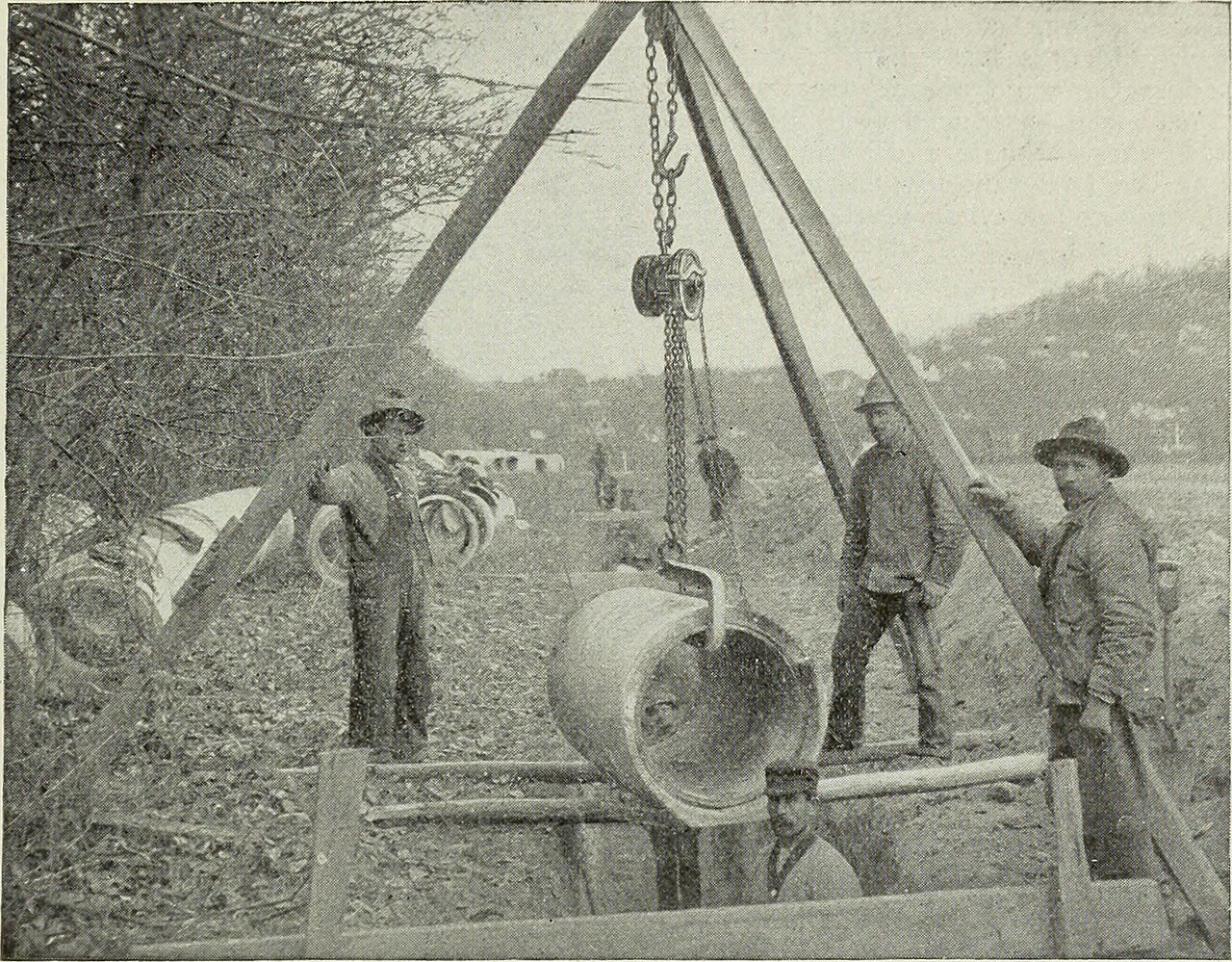
A buried pipe mine that created instant anti-tank ditches.

Internet Archive Book Images · No restrictions
During the 1940–1941 invasion crisis in Britain, a device called the Canadian pipe mine—later renamed the McNaughton tube—was deployed. It consisted of a horizontally bored pipe filled with explosives, which could be detonated to instantly create an anti-tank ditch or ruin a road or runway, denying its use to an enemy.
The idea originated with Lieutenant-General Andrew McNaughton. In November 1939, he met in Toronto with mining engineers and military officers to discuss using experimental diamond drilling for military purposes. McNaughton saw potential in placing explosives under fortifications or introducing poison gas. He proposed forming a section of the 12th Field Company, Royal Canadian Engineers from experienced diamond drillers, offering command to Colin Campbell, a mining engineer and Ontario’s Minister of Public Works. Campbell accepted and recruited from northern Ontario mining districts.
After arriving in Britain in February 1940, McNaughton inspected defences in northern France and the Maginot Line, finding them unsatisfactory. He obtained working drawings of fortifications so his drillers could clear German defenders from captured areas. At a meeting with British engineers at Aldershot, he suggested pushing pipes at a shallow angle into the ground, packing them with explosives, and detonating them to create surprise obstacles. The pipes could be inserted using a hydraulic jack fitted to a tank transporter—an idea McNaughton reportedly got from bootleggers in Windsor, Ontario, who used similar jacks to push pipes during Prohibition.
Campbell and his drillers arrived in England in February 1940 and began experiments near Aldershot. A demonstration at Bourley Hill proved the obstacles could stop tanks, and attendees supported expanding the section into a tunnelling company. By May 1940, the tunnelers were assigned to prepare defences in England. After the fall of France, they worked on anti-invasion measures. McNaughton noted that ditches were being dug across unused airstrips to deny enemy use, even though bombed active airfields might soon be needed. By 18 June, the Chief Engineer, Home Forces and the Inspector General of Fortifications were convinced of the pipe mine’s benefits and ordered large quantities of pipe for destroying runways. Later that month, the tunnelers demonstrated surprise anti-tank obstacles near Shornmead Fort, Chatham.
T
- type
- Anti-tank landmine / obstacle
- origin
- Canada / United Kingdom
- inventor
- Lieutenant-General Andrew McNaughton
- introduced
- 1940
- used_by
- Canadian and British forces
- material
- Steel pipe, explosives (blasting gelatine, later stable explosives)
- length
- Approximately 55–60 feet (17–18 m)
Lore & Background
In November 1939, Lieutenant-General Andrew McNaughton met with mining engineers and officers in Toronto to discuss military uses of diamond drilling. He recognized the possibility of placing explosives under fortifications. McNaughton proposed forming a section of the 12th Field Company, Royal Canadian Engineers from experienced diamond drillers, and offered command to Colin Campbell, a mining engineer and Ontario Minister of Public Works. Campbell accepted and recruited from northern Ontario mining districts.
After arriving in Britain in February 1940, Campbell's section experimented near Aldershot. They demonstrated that pipes could be pushed into the ground at a shallow angle using hydraulic jacks fitted to tank transporters, creating surprise anti-tank obstacles. By June 1940, the Chief Engineer, Home Forces and the Inspector General of Fortifications were convinced of the benefits, and large quantities of pipe were acquired. The pipes were packed with explosives and detonated to produce ditches about 28 feet wide and 8 feet deep.
Originally known as the Canadian Pipe Mine, it was later named the McNaughton Tube Tank Obstacle. By October 1940, 179 Special Tunnelling Company of the Royal Engineers was formed, and about 40,000 feet of the obstacle were installed, requiring some 90 tonnes of explosives. The mines were virtually invisible from the air and could be placed under roads, railways, and runways without interfering with normal use.
Reader's Guide
The Canadian pipe mine was significant as a defensive innovation during the invasion crisis of 1940–1941, offering a concealed, surprise anti-tank obstacle that could be deployed at short notice. Its chief characteristic was surprise, not speed, allowing defenders to create apparent gaps in anti-tank defences and then block them instantly. The mines could be installed without visible disturbance, making them undetectable from the air. However, the system had defects: blasting gelatine explosives deteriorated when affected by water, sometimes turning into a porridge-like mush. A method of washing out the explosives with water was devised by Second Lieutenant Cameron, an experienced oil drilling engineer. After the war, most installations were removed, but some were missed. In April 2006, 20 unexploded pipe mines were discovered under a runway at HMS Daedalus, Lee-on-Solent, Hampshire, leading to the evacuation of some 900 homes over five weeks. The mines were destroyed by controlled explosion.
Did You Know?
- McNaughton got the idea of using hydraulic jacks from bootleggers in Windsor, Ontario, who pushed pipes from a brewery during Prohibition.
- The pipes were placed in an overlapping pattern at intervals of 25 feet, with each pipe about 55 feet long.
- In April 2006, 20 unexploded pipe mines were discovered under a runway at HMS Daedalus, Lee-on-Solent, containing 2,400 pounds of explosive.
- The mines were originally charged with blasting gelatine, which in some cases deteriorated into a porridge-like mush due to water ingress.
Origins & Conception
In November 1939, a gathering in Toronto brought together military and civilian minds that would reshape British defensive thinking. Lieutenant-General Andrew McNaughton met with Lieutenant-Colonel Charles Hertzberg, Lieutenant-Colonel Guy R. Turner, Oliver Hall of the Mining Association of Ontario, and Colin Campbell, a seasoned mining and construction engineer who also served as Ontario's Minister of Public Works. The conversation centred on experimental diamond drilling, a technique championed by R.A. Bryce, president of the Ontario Mining Association. McNaughton saw beyond civilian applications, envisioning explosives placed beneath fortifications or poison gas introduced into enemy positions. As he readied Canadian troops for deployment to Britain, he proposed assembling a specialized unit drawn from experienced diamond drillers in northern Ontario's mining districts, offering Campbell the command. His approach was characteristically incremental: begin modestly, then scale up if results justified expansion. A vivid anecdote preserved by his biographer John Swettenham reveals that the idea of using hydraulic jacks to push pipes into the ground was inspired by Windsor, Ontario bootleggers during Prohibition, who had employed similar jacks to slide pipes from breweries to other premises for loading contraband liquor.
Engineering & Testing
Colin Campbell and his detachment of diamond drillers reached England in February 1940 and immediately began trials in a quarry near Aldershot. Their breakthrough came at Bourley Hill, where they demonstrated a surprise obstacle that tanks could not cross, convincing attendees to back McNaughton's proposal to grow the unit into a full tunnelling company. The engineering behind the device was deceptively simple yet highly effective. Drills and pipe-pushing machines buried 3-inch (76 mm) diameter pipes, each roughly 55 feet (17 m) long, at a shallow angle to a maximum depth of about 8 feet (2.4 m). Pipes were spaced 25 feet (7.6 m) apart in an overlapping arrangement: the lower end of one pipe would sit about 15 feet underground, and the next pipe pushed behind it would have its upper end overlapping the previous pipe's lower end. When the packed explosives were detonated, the result was a crater approximately 28 feet (8.5 m) wide and 8 feet (2.4 m) deep, with loose soil at the bottom. This was enough to halt a tank entirely or force it into a vulnerable crossing where anti-tank guns could engage it for several minutes. The same machines could also be positioned at bridge approaches or embankments, ready for instantaneous demolition.
Strategic Adoption & Scale
The fall of France in June 1940 redirected the tunnellers' mission from experimental work in France to urgent anti-invasion measures on British soil. McNaughton, observing ditches being cut across unused airstrips to deny them to the enemy, recognized a broader application. By 18 June, the Chief Engineer of Home Forces and the Inspector General of Fortifications were fully convinced of the pushed-pipe concept and moved to procure large quantities of pipe for rapid runway destruction. A successful surprise anti-tank demonstration near Shornmead Fort in Chatham followed that month. The device's profile rose dramatically on 9 August 1940, when McNaughton's secret anti-tank obstacle was demonstrated to General Alan Brooke, Commander-in-Chief of Home Forces and the man ultimately responsible for Britain's defence. By October, demand had outstripped the small Canadian section's capacity, and plans were underway to train additional British units in installation. The 179 Special Tunnelling Company of the Royal Engineers was formed specifically for this task, and approximately 40,000 feet (12 km) of the obstacle were laid across the country, consuming some 90 tonnes of explosives. Originally called the Canadian Pipe Mine, the device was renamed the McNaughton Tube Tank Obstacle in honour of the Canadian Corps commander who had championed it.
Tactical Philosophy & Legacy
A classified assessment of the McNaughton tube captured what made it strategically unique: its defining characteristic was surprise rather than speed. The report stressed that conventional anti-tank obstacles were easily spotted from the air, making them predictable to an advancing enemy. The buried pipe, by contrast, was invisible until detonation, allowing defenders to shape the enemy's decision-making. The obstacle could lure an attacker toward an apparent gap in the anti-tank line while retaining the ability to stop him outright. It was equally valuable for last-minute road blocks laid behind retreating or advancing friendly troops, instantly denying a route. This emphasis on psychological impact and tactical deception set the device apart from static fortifications. The McNaughton tube thus represented a philosophy of defence rooted in ambiguity and timing rather than brute mass. Its legacy endured in the institutional memory of both Canadian and British engineering corps, and the naming of the device after its patron, Lieutenant-General Andrew McNaughton, ensured that the contribution of a small group of northern Ontario diamond drillers would be remembered as a meaningful, if brief, chapter in the defence of Britain during the invasion crisis of 1940–1941.
Gallery
Frequently Asked Questions
What is the Canadian pipe mine?
It is an anti-tank obstacle device made from a horizontally buried steel pipe packed with explosives. Detonating it instantly carves out a ditch or destroys a road or runway, blocking enemy vehicles. The weapon was later renamed the McNaughton tube.
Who invented the Canadian pipe mine?
The concept was developed by Lieutenant-General Andrew McNaughton, who in November 1939 convened mining engineers and military officers in Toronto to explore adapting diamond-drilling techniques for defensive military use.
How did the Canadian pipe mine work in practice?
A steel pipe filled with blasting gelatine or a later stable explosive was bored horizontally into the ground along a road, runway, or defensive line. A single detonation would instantly open a wide anti-tank ditch or render the surface impassable, denying enemy tanks and vehicles a route.
When and where was the Canadian pipe mine used?
It was fielded in 1940 during Britain's invasion crisis and employed by both Canadian and British forces. It formed part of the rapid defensive preparations against a possible German land crossing of the Channel.
Why is the Canadian pipe mine considered a significant Canadian invention?
It turned civilian mining and diamond-drilling expertise into a seconds-fast military obstacle, eliminating the need for hours of manual ditch-digging under fire. Its 1939 development in Toronto demonstrates how Canadian engineering directly shaped Allied defensive strategy in the early war years.
More in Canadian inventions 1-24
Spotted an error? Know more?
This is a living reference — every entry is fact-audited, and reader corrections feed straight into our audit queue. Suggest an edit · See this site's audit record