
Bag tag
Bag tags route luggage and enable tracing since 1882.

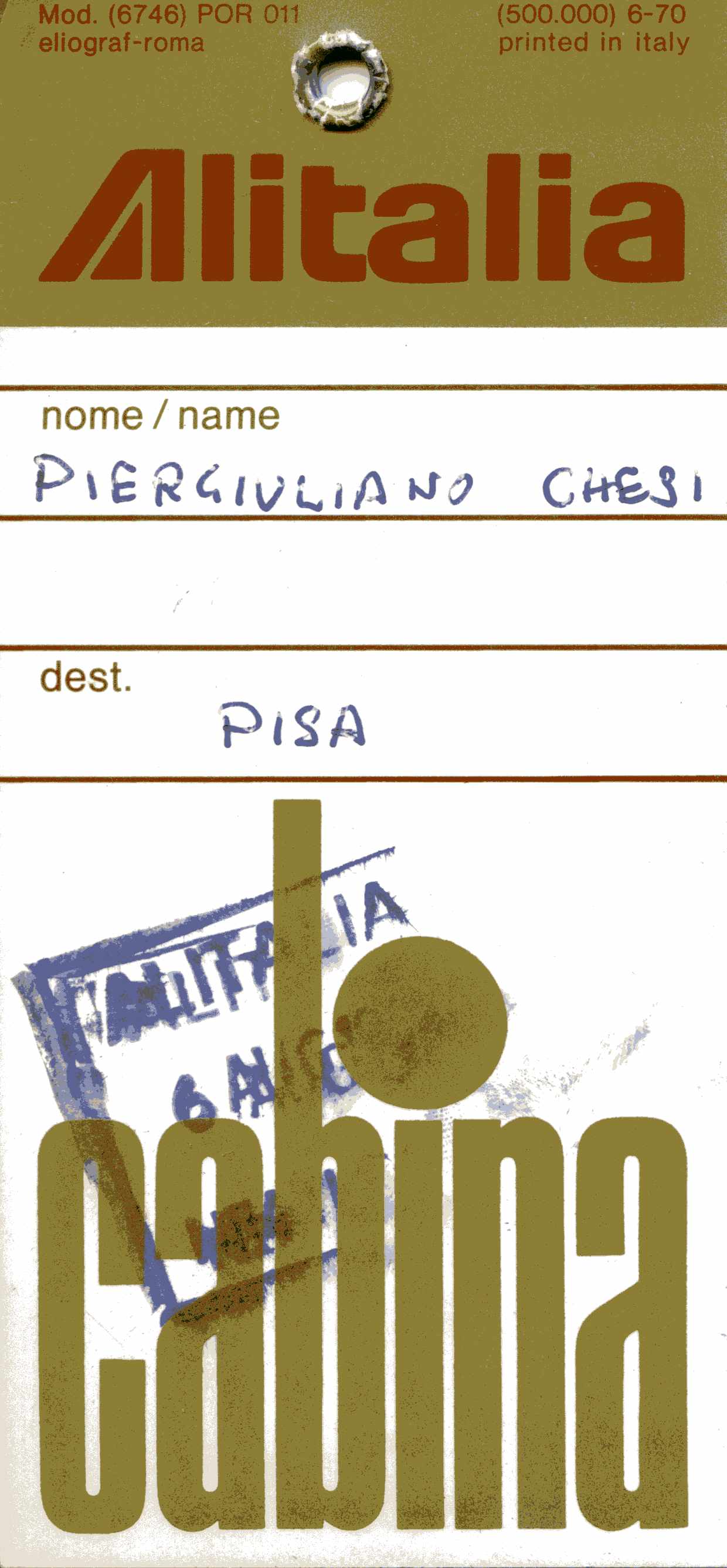
Piergiuliano Chesi · CC BY-SA 3.0
Bag tags—also called baggage tags, baggage checks, or luggage tickets—are identification tools used by bus, train, and airline carriers to direct checked luggage to its correct destination. They help passengers spot their own bags among similar ones at the carousel, serve as proof (still required at some airports) that a passenger is not taking someone else’s bag from the reclaim area, and allow both the passenger and carrier to trace a missing bag that was not delivered. Carrier liability is limited by published tariffs and international agreements.
**History**
The first known separable coupon ticket for baggage was introduced in the late 19th century, though the specific inventor and patent date are not reliably recorded. Early versions showed the departure station, destination, and a consecutive reference number. The passenger received the lower half, while the upper half—punched with a hole at the top—was placed into a brass sleeve and strapped to the baggage. Later, reinforced paper tags were introduced to reduce the chance of detachment during transit.
The Warsaw Convention of 1929, in Article Four, addressed the passenger ticket, not baggage checks; rules for baggage checks were covered elsewhere in the convention, establishing limits on carrier liability for checked baggage.
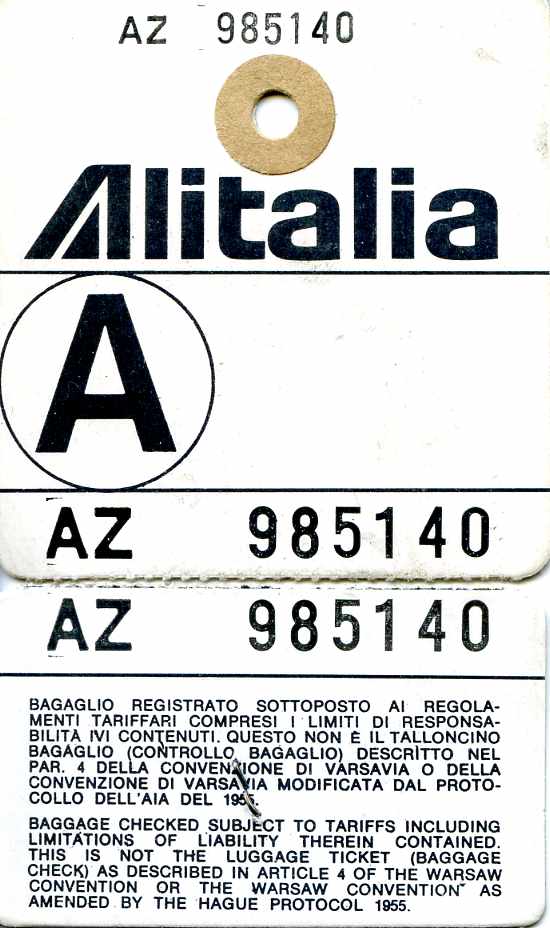
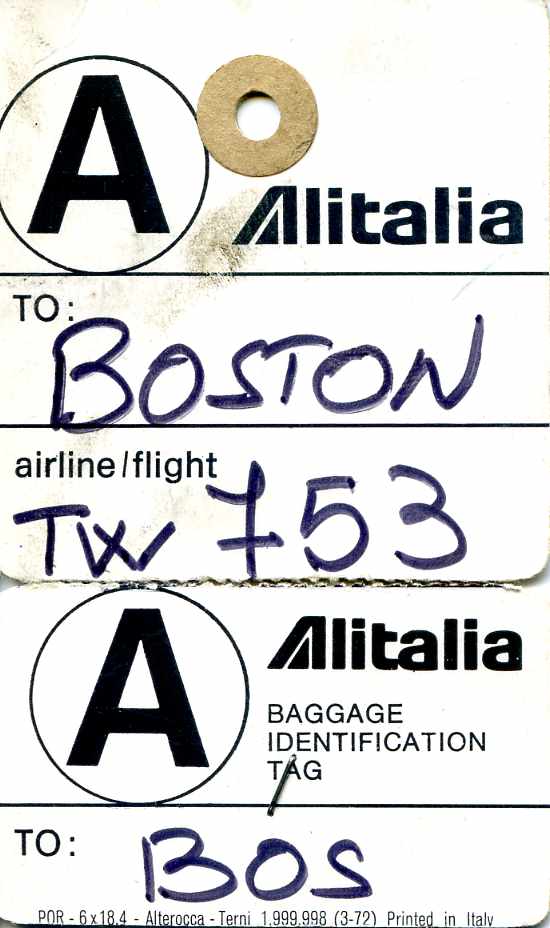
Before the 1990s, airline bag tags were paper tags attached with string. They carried basic information: the airline or carrier name, flight number, a baggage tag number (made up of the two-letter airline code and six digits), and the destination airport code. These tags became obsolete because they offered little security and were easy to counterfeit.
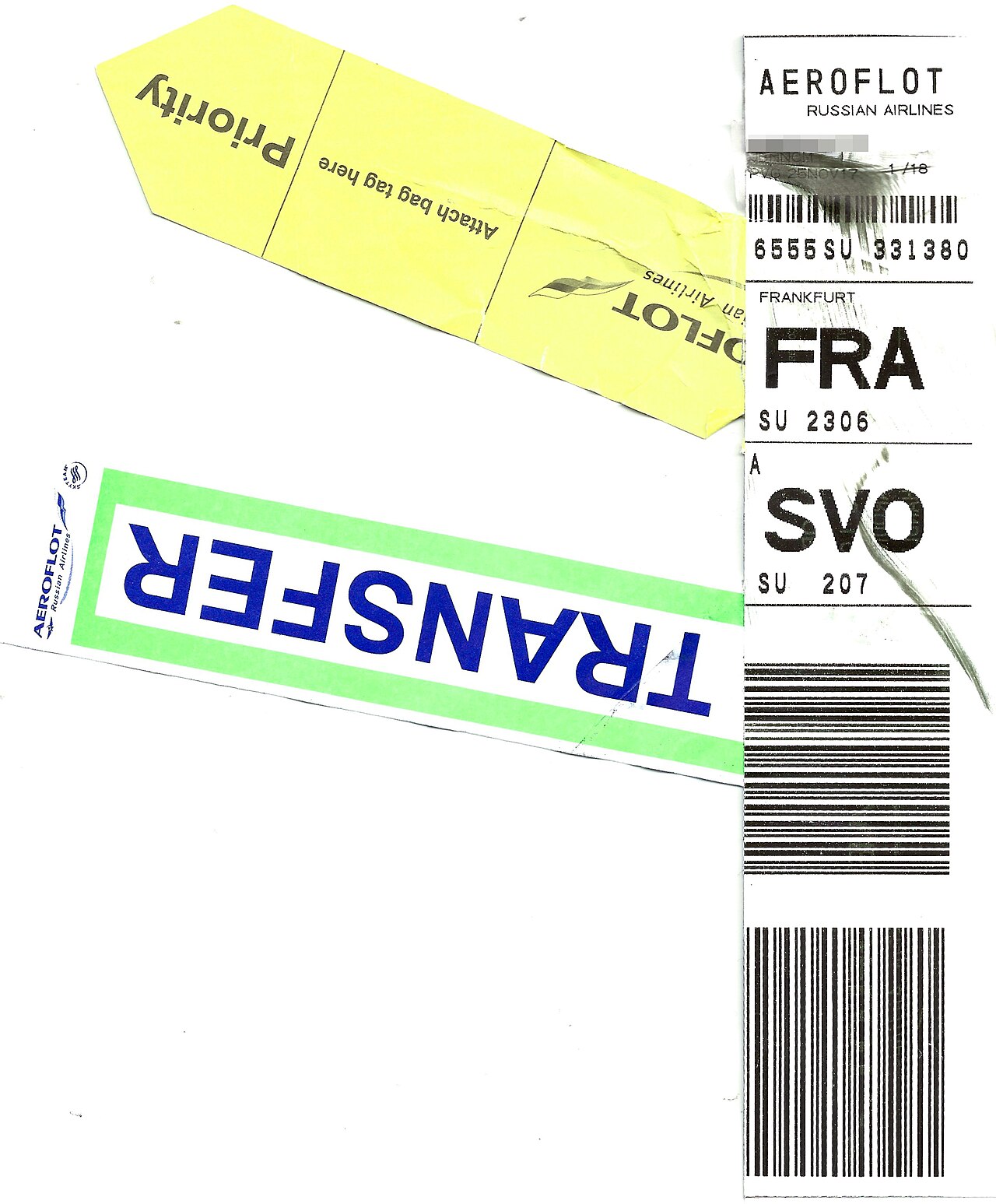
Current bag tags use a bar code in the Interleaved 2 of 5 format, printed with a thermal or bar code printer on adhesive thermal paper. This strip is attached to luggage at check-in, enabling automated sorting by bar code readers. Readers come in two types: handheld scanners and in-line arrays. In-line arrays are built into the conveyor system and use a 360-degree arrangement of lasers or cameras to read tags from multiple angles, since bags and tag orientation can shift on the belt. Camera systems are replacing lasers because they can better read damaged or folded tags. A limitation is that to read tags from the bottom of the belt, arrays are placed in gaps between conveyor sections; debris and dust often build up on these lo
- inventor
- Unknown (not reliably recorded)
- patent_date
- Not confirmed
- field
- Transportation and baggage handling
- first_patent_location
- Not confirmed
- key_standard
- Warsaw Convention of 1929 (baggage check rules, not Article Four)
- modern_technology
- Bar code (Interleaved 2 of 5), RFID, electronic paper
Lore & Background
The first known separable coupon ticket for baggage appeared in the late 19th century, though the specific inventor and patent date are not reliably recorded. It showed the issuing station, destination, and a consecutive number; the lower half went to the passenger, while the upper half was attached to baggage via a brass sleeve and strap. Reinforced paper tags were later introduced to reduce detachment during transport.
The Warsaw Convention of 1929 established rules for baggage checks and set liability limits, but Article Four specifically dealt with passenger tickets, not baggage checks. Prior to the 1990s, airline bag tags were paper attached with string, containing airline name, flight number, tag number, and destination code; these were easy to replicate and offered little security.
Current bag tags use Interleaved 2 of 5 bar codes, RFID, or electronic paper for tracking and sorting.
Reader's Guide
Bag tags have evolved from simple paper coupons to sophisticated electronic devices, reflecting the growing complexity of global air travel. The 1882 patent by John Michael Lyons established the basic concept of a separable tag for passenger and baggage. The Warsaw Convention of 1929 formalized the baggage check's legal role, setting liability limits that still underpin carrier responsibility. The shift to bar-coded tags in the 1990s enabled automated sorting, but low read rates (as low as 85%) led to innovations like RFID and electronic paper tags, which offer higher reliability and passenger convenience. The license plate system, adopted by IATA in 1987, standardized baggage reconciliation after the Air India Flight 182 bombing, linking each tag to passenger and flight data. Today, bag tags remain essential for security, sorting, and tracing, with ongoing efforts to improve read rates and reduce operational costs.
Did You Know?
- The first separable coupon ticket was patented by John Michael Lyons on June 5, 1882.
- The Warsaw Convention of 1929, Article Four, established criteria for issuing baggage checks.
- Current bar code bag tags use Interleaved 2 of 5 symbology and can have read rates as low as 85%.
- In the European Union, bag tags with green edges allow passengers to use a separate 'Blue Channel' at customs.
Origins and Early Standards
The story of the baggage tag begins in 1882, when John Michael Lyons of Moncton, New Brunswick, secured a patent for what he called a separable coupon ticket. His design displayed the issuing station, the destination, and a sequential reference number. The ticket split into two halves: the lower portion went to the passenger, while the upper half, punched with a hole at its top, slid into a brass sleeve and was lashed to the luggage with a strap. Over time, reinforced paper tags entered service, engineered to resist the tugs and jolts of transit better than their predecessors. A major regulatory milestone arrived in 1929 with the Warsaw Convention, whose Article Four set out the formal criteria for issuing a baggage check and, crucially, capped the carrier's financial liability for lost or damaged checked baggage. These early frameworks laid the groundwork for every tag system that followed, establishing the dual purpose of the tag as both a routing tool for the carrier and a claim document for the traveler.
The Barcode Revolution and Reading Challenges
Before the 1990s, airline bag tags were simple paper slips tied to luggage with a string, carrying the carrier name, flight number, a tag number built from a two-letter airline code plus six digits, and the destination airport code. These proved vulnerable to counterfeiting and offered minimal security. The modern era brought bar codes printed in the Interleaved 2 of 5 symbology onto adhesive thermal paper, applied at check-in so that automated systems could sort bags without human intervention. Reading these codes happens two ways: hand-held scanners or in-line arrays embedded in the conveyor belt. In-line arrays fire a 360-degree ring of lasers or cameras to catch the tag from any angle as bags tumble and shift. A persistent weakness is that arrays mounted beneath the belt gap collect dust and debris, dragging successful read rates down to roughly 85 percent, meaning more than one in ten bags must be pulled aside for manual scanning, adding labor and delay. Camera-based systems, with their software algorithms, push read rates toward 99.5 percent under ideal conditions, outperforming their laser predecessors.
RFID and the Rise of Electronic Tags
Frustrated by the fragility of printed bar codes, where crumpled, scored, or poorly rendered tags simply cannot be scanned, airlines and technology firms have turned to radio-frequency identification chips embedded directly in the tag. Harry Reid International Airport in the United States and Hong Kong International Airport have both rolled out full RFID tracking systems, while the International Air Transport Association is working toward a global RFID tag standard. In 2013, British Airways trialed re-usable electronic tags powered by electronic paper; passengers checked in via a smartphone app and tapped the phone to the tag, transmitting flight details and a barcode over NFC. Fast Travel Global's eTag took a similar electronic-paper approach but used Bluetooth Low Energy and was not tied to a single carrier. Qantas launched its Q Bag Tags in 2011, though the absence of a scannable barcode limited them to domestic Australian routes. The concept truly broke into mainstream service in March 2016, when Rimowa partnered with Lufthansa to launch the first successful electronic tag product, followed by Lufthansa's BAGTAG in January 2018, the first fully secure, RFID-integrated tag that fits any suitcase.
The Passenger Stub and Practical Functions
Beyond routing bags through a carrier's sorting network, the tag serves several practical roles for the traveler. The passenger stub, handed directly to the traveler or tucked into the ticket envelope, helps a passenger spot their own suitcase on a crowded baggage carousel where dozens of similar bags appear. At a handful of airports it still functions as proof that the person collecting the bag is its rightful owner, deterring someone from walking off with another passenger's luggage. If a bag goes missing and fails to appear at the destination, the stub and its tag number give both the passenger and the carrier a traceable reference to locate it. Carrier liability for lost or damaged checked baggage is governed by published tariffs and international agreements, a limitation rooted in the Warsaw Convention. In the European Union, bag tags for intra-EU flights carry distinctive green edges, signaling to customs that the bag may pass through a separate Blue or Green Channel, streamlining the arrival process for passengers who have nothing to declare.
Gallery


Frequently Asked Questions
Who invented the bag tag?
No single inventor is reliably credited in the historical record, and neither a confirmed patent date nor a first patent location has been established for the device.
What is the bag tag's role in travel?
It acts as a routing, identification, and traceability tool: it directs checked luggage to the right destination, lets a passenger spot their own bag among look-alikes on the carousel, and creates a paper trail so both traveler and carrier can track a bag that was never delivered.
How far back does the bag tag's history go?
A separable luggage tag has been in continuous practical use since at least 1882, making it one of the longest-running instruments in the transportation and baggage-handling field.
What legal framework governs the bag tag?
The Warsaw Convention of 1929 set the international baggage-check rules under which tags operate, while carrier liability for lost or damaged baggage is further capped by published tariffs and subsequent multilateral agreements.
How has the bag tag changed technologically over time?
What started as a simple paper slip has since been augmented with Interleaved 2 of 5 bar-code scanning, RFID transponders, and electronic-paper systems to speed up sorting and reduce misrouting.
More in Canadian inventions 1-24
Spotted an error? Know more?
This is a living reference — every entry is fact-audited, and reader corrections feed straight into our audit queue. Suggest an edit · See this site's audit record