
Electrical burn
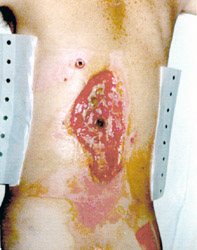
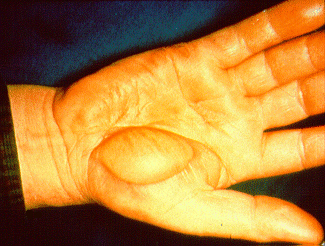
Electrical burns cause severe subdermal damage often hidden by minor surface wounds.

Wikimedia Commons · CC BY 4.0
An electrical burn happens when electricity moves through the body and causes immediate injury. In the United States, about 300 to 400 deaths from electrical injuries are reported each year, with a mortality rate between 3 and 5 percent. Unlike thermal or chemical burns, electrical burns tend to cause far more damage beneath the skin. While surface wounds can occur, the deeper tissues are often severely harmed, which makes these burns hard to diagnose correctly. Many people downplay how serious their burn actually is. In severe cases, electricity can shock the brain, strain the heart, and injure other organs.
For a burn to count as electrical, electricity must be the direct cause. Burning a finger on a hot electric steam iron, for instance, is a thermal burn, not an electrical one. Joule’s first law explains that electricity passing through resistance generates heat, but in that scenario no current enters the body. Similarly, a fire labeled “electrical” in origin does not automatically mean any injuries or deaths are due to electrical burns. Unless someone was hurt at the exact moment the fire started, electrical burns are unlikely.
**Causes**
Electrical burns come from various situations: touching or grabbing live objects, short-circuiting, sticking fingers into electrical sockets, or falling into electrified water. Lightning strikes can also cause them, though this is less common. As technology advances, electrical injuries are happening more often and are now the fourth leading cause of work-related traumatic death. About one-third of all electrical traumas and most high-voltage injuries happen on the job, with over half of those resulting from power line contact.
These burns fall into six categories, and a victim may have any combination of them:
- **Low-voltage burn:** Caused by contact with a source of 500 volts or less. The current at this level isn’t strong enough to damage tissue along its path except at the contact site. The burn can be mild, superficial, or severe, depending on how long contact lasts. - **High-voltage burn:** Very severe, occurring when someone directly touches a high-voltage supply (500 volts or more). Damage runs throughout the body. External injuries are misleading because most harm is underneath the skin, where subdermal tissues are badly damaged.
- Annual deaths (us)
- approximately 300-400
- High voltage threshold
- 500 volts or less (low-voltage); 500 volts or more (high-voltage)
Lore & Background
Electrical burns can be caused by touching or grasping electrically live objects, short-circuiting, inserting fingers into electrical sockets, falling into electrified water, or lightning strikes. They are classified into six categories: low-voltage burn, high voltage burn, arc burn, flash burn, flame burn, and oral burn. Any combination of these categories may be present on a victim. Low-voltage burns (500 volts or less) cause damage only at the contact site, while high voltage burns (500 volts or more) cause severe internal damage throughout the body. Arc burns occur when electricity ionizes air particles, generating heat as high as 4,000 °C and a pressure wave blast exceeding 1,000 pounds per square inch.
Reader's Guide
Electrical burns are significant because they are the fourth leading cause of work-related traumatic death, with one third of all electrical traumas and most high-voltage injuries being job related, and more than 50% of these injuries resulting from power line contact. The severity of damage depends on voltage, current, resistance, frequency, and the pathway the current takes through the body, which follows the least resistant tissues: blood vessels, nerves, muscle, then skin, tendon, fat, and bone. Only entry and exit wounds are visible, making internal damage hard to diagnose. Prevention focuses on basic electrical safety, including using GFCI outlets, avoiding wet conditions, and keeping children away from outlets and cords. Oral burns, caused by biting or sucking on electrical cords, commonly occur in children and cannot be prevented by GFCI.
Did You Know?
- Electrical burns can cause shock to the brain, strain to the heart, and injury to other organs.
- Arc burns generate heat as high as 4,000 °C (7,200 °F), hotter than the boiling points of several metals.
- Oral burns from biting or sucking on electrical cords most commonly happen to children.
- More than 50% of high-voltage job-related injuries result from power line contact.
The Six Faces of an Electrical Burn
Electrical burns are not a single injury but a spectrum of six distinct categories, and a single victim may suffer any combination of them. At the lower end, a low-voltage burn results from contact with a source of 500 volts or less; the current is insufficient to damage tissue along its full path, so injury is confined to the contact point and may range from mild to severe depending on duration. At the opposite extreme, a high-voltage burn—direct contact with a 500-kilovolt supply—drives damage deep through the body while the skin surface deceptively appears intact. An arc burn requires no physical contact at all: electricity ionizes air particles to complete a circuit, generating heat up to 4,000 °C and a pressure-wave blast exceeding 1,000 pounds per square inch that can hurl the victim. Flash burns, often linked to higher-frequency alternating current such as that found in aircraft systems, scorch large areas of skin but leave deeper tissues largely untouched. Flame burns occur when an electrical source ignites nearby objects, and oral burns, most common in young children who bite or suck on cords, can produce facial deformity as current crosses the mouth from one side to the other.
The Hidden Wound: Pathophysiology and the Diagnostic Challenge
Understanding how electricity injures the body reveals why these wounds are so treacherous. Four electrical variables—voltage, current, resistance, and frequency—govern the severity of damage, and the specific pathway the current traces through the body adds another layer of complexity. Because the body becomes part of the circuit, current enters at one point and exits at another, and it preferentially follows tissues of lowest resistance: blood vessels, nerves, and muscle come first, followed by skin, tendon, fat, and bone. The entry wound typically appears as a small, depressed, leathery mark, while the exit wound is often far more extensive and explosive in character. This asymmetry creates a profound diagnostic problem. Only the two surface wounds are visible to the clinician; the catastrophic internal destruction remains hidden beneath intact-looking skin. In the United States, roughly one thousand deaths per year are attributed to electrical injuries, with an overall mortality rate of three to five percent. In the most severe cases, the electrical shock extends beyond soft tissue to strain the heart, damage the brain, and injure other vital organs.
Drawing the Line: What Counts as Electrical and the Occupational Toll
Electrical burns occupy a distinct and often misunderstood place in the landscape of traumatic injury. For a wound to qualify as electrical, the electric current itself must be the direct mechanism of harm. A finger scorched by the hot metal of a steam iron, for instance, is a thermal burn: no current passes through the body, and the heat is simply a by-product of Joule's law acting on the appliance's internal resistance. Similarly, a house fire that investigators trace back to faulty wiring does not automatically mean the victims suffered electrical burns; unless a person was struck at the precise instant the fire ignited, the injuries are thermal or smoke-related rather than electrical. The real-world causes of true electrical burns include grasping live conductors, short-circuiting a circuit, inserting fingers into wall sockets, and falling into electrified water. Lightning strikes can also produce electrical burns, though they remain a comparatively rare mechanism. As technology proliferates, electrical injuries have climbed to become the fourth leading cause of work-related traumatic death, with one-third of all electrical traumas and the majority of high-voltage cases occurring on the job. More than half of those occupational injuries stem from direct contact with power lines.
Everyday Hazards and the Logic of Prevention
Preventing electrical burns largely comes down to recognizing the everyday conditions that turn ordinary environments into lethal circuits. One of the most common hazards is using electrical appliances while the body is wet—showering, bathing, or standing in a stream of water—because plumbing is frequently bonded to the electrical ground and wet skin loses much of its natural resistance. Newer bathroom appliances are an exception, provided the user is not simultaneously in the water path or touching bare concrete or sheet metal; standing on a dry carpet or rug is the safest footing. Wall outlets should always have protective covers, particularly in homes with young children whose small fingers can slip into the gap between the wall plate and the socket and contact live metal. Around bathtubs, swimming pools, and hot tubs, only battery-operated devices should be used, since any AC appliance that falls into the water can become a source of electrocution. Child safety plugs on every outlet and keeping cords out of a child's reach add further protection. Finally, adjusting plug prongs that are too wide or too narrow with bare fingertips while simultaneously inserting the plug into a live socket is a practice that should be avoided entirely.
Gallery

Frequently Asked Questions
What exactly is an electrical burn?
An electrical burn is the tissue injury that occurs when an electric current travels through a person's body, disrupting cells and structures along its path. The damage is essentially instantaneous, happening the moment the current makes contact.
How does an electrical burn differ from a thermal or chemical burn?
The hallmark of an electrical burn is that the most destructive harm is buried deep beneath the skin rather than visible on the surface. A tiny entry or exit wound can conceal catastrophic injury to muscles, nerves, and internal organs, which is not the pattern you see with heat or chemical burns.
Why do victims and even clinicians often underestimate the severity of an electrical burn?
Because the external wound is frequently small or looks almost cosmetic, it is easy to assume the injury is minor. In reality, the subdermal damage can be extensive, making accurate diagnosis genuinely difficult compared to burns where the injury is right on the surface.
What are the low-voltage and high-voltage thresholds in electrical burn cases?
In burn medicine, currents at 500 volts or below are classified as low-voltage, while anything at 500 volts or above is considered high-voltage. Higher voltages carry a far greater risk of systemic injury, including cardiac strain and neurological shock.
How common are fatal electrical burns in the United States?
Approximately 300 to 400 deaths from electrical injuries are recorded in the U.S. each year. The overall mortality rate for electrical burn cases falls in the 3-to-5-percent range.
More in Burns 1-24
Spotted an error? Know more?
Reader corrections go straight into our review queue. Suggest an edit · How this site is sourced