Burn scar contracture
Skin tightening after burns that restricts movement.

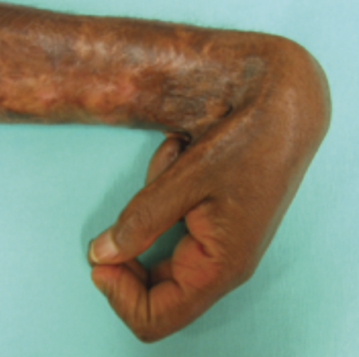
Burn scar contracture is the tightening of the skin following a second or third degree burn, where the surrounding skin pulls together, mediated by myofibroblasts. It requires prompt treatment to prevent restriction of movement around the injured area.
Quick Facts
- Field
- Dermatology
Facts from the source article.
Lore & Background
Burn scar contracture occurs when second or third degree burns cause the surrounding skin to pull together, mediated by myofibroblasts. Treatment begins upon hospitalization, with wound depth and location predicting outcomes. Epidermal and partial thickness wounds heal in 1 to 3 weeks with low contracture risk, while full-thickness injuries heal by excision and grafting, contracture, or epithelial ingrowths.
Reader's Guide
Burn scar contracture is significant because it can lead to long-term impairment and disability, especially in the hands and face, which are most frequently burned and have the highest contracture rate. Mechanical engineering principles, using stress-strain curves, help assess skin biomechanics: persistent gentle force causes tissue elongation and increased range of motion, while fast forceful stress is less effective. Rehabilitation applies mild, prolonged stretch for at least 6 to 8 hours daily, guided by tolerable pain and scar blanching. Hypertrophic scarring often develops in wounds healing longer than two to three weeks and can be prevented by compression at about 24 mm Hg applied as soon as the wound heals. Scar maturity—avascular, flat, pliable, soft—may take six months to five years. The position of comfort becoming the position of contracture is a key treatment tenet, emphasizing range of motion before strength training.
Did You Know?
- Burn scar contracture is mediated by myofibroblasts.
- Persistent gentle stretch is more effective than fast forceful stress for treating contracture.
- Scars may take six months to five years to fully mature.
The Biological Mechanism of Contracture
Burn scar contracture is the progressive tightening of skin that follows second- or third-degree burns. Once the skin sustains such a deep injury, the surrounding tissue begins to draw inward, pulling the wound edges closer together in a process that steadily narrows the available range of motion. At the cellular level, this tightening is mediated by myofibroblasts—specialized cells that generate the contractile force driving the scar's progressive shortening. The clinical consequence is a growing restriction of movement around the injured area, which is precisely why treatment must begin as soon as possible. If left unaddressed, the contracture can lock a joint or region into a fixed, dysfunctional position, transforming what was once a healing wound into a permanent mechanical limitation. The urgency of early intervention stems directly from this biological drive: the myofibroblast-mediated remodeling does not simply pause or reverse on its own. Instead, it continues to tighten and shorten the tissue over time, making the initial rehabilitation window a critical period for preserving function and preventing the kind of long-term disability that severe integument damage can otherwise produce.
Wound Depth and Healing Pathways
The severity of a burn determines both the healing pathway and the likelihood of contracture. Superficial epidermal and partial-thickness wounds typically close within one to three weeks as new epithelium migrates from the wound margins and buds out from the appendages of sweat and hair glands. These shallower injuries carry only a modest risk of contracture or hypertrophic scarring. Full-thickness injuries, by contrast, destroy the dermis and trigger a more complex healing cascade involving an inflammatory phase with edema, a proliferative phase of collagen synthesis that drives wound closure, and a maturation phase marked by contraction and increasing tensile strength. Full-thickness wounds may heal through surgical excision and grafting, through progressive contracture, or through epithelial ingrowth from the wound margins. Because full-thickness damage eliminates the structural scaffolding of the dermis, the resulting scar is far more prone to the tightening that characterizes contracture, making these injuries the primary concern in burn rehabilitation planning.
Biomechanical Principles of Scar Rehabilitation
The rehabilitation of burn scars draws on mechanical engineering concepts to understand and counteract tissue tightening. By constructing stress-strain curves—where stress represents the applied force and strain represents tissue elongation—clinicians can evaluate the biomechanical behavior of both normal skin and scar tissue. An adult burn scar behaves much like a tendon in terms of its elastic response to a stretch. However, a critical distinction exists: while elastic deformation is temporary and the tissue springs back, a sustained, persistent force applied over time produces a plastic, permanent increase in tissue length and range of motion. Clinical evidence shows that fast, forceful stretching is far less effective than a gentle, prolonged stretch that the patient can comfortably tolerate. The standard protocol calls for applying mild, continuous stress to the healing tissue at its maximum length for at least six to eight hours each day throughout the healing period. Treatment intensity is calibrated using the patient's tolerable pain threshold and the degree of scar blanching as practical gauges. A foundational tenet of burn rehabilitation holds that the position of comfort will eventually become the position of contracture, so range-of-motion work takes clear priority over strength training, and a variety of positioning and splinting techniques help protect healing wounds while preserving tissue length.
Scar Maturation, Compression, and Priority Areas
A scar is considered immature while it remains red, raised, and stiff, and is deemed mature only when it becomes avascular, flat, pliable, and soft. The full maturation process can take anywhere from six months to as long as five years, a timeline that underscores the importance of sustained intervention over an extended period. Hypertrophic scarring—a raised, thickened scar—is a common complication in wounds that require more than two or three weeks to close, and it frequently appears weeks after the wound has technically healed. To mitigate this, compression therapy applied immediately upon wound closure at a pressure of approximately 24 mm Hg has been shown to reduce the development of raised scarring. Among all body regions, the hands and face demand the most vigilant attention. These areas are the most frequently burned in clinical practice and also carry the highest rate of burn scar contracture. Because the hands and face are central to dexterity, speech, and social interaction, even modest contracture in these regions can produce profound long-term impairment and disability, making them the highest priority in both acute wound care and long-term rehabilitation planning.
Gallery
Frequently Asked Questions
What is burn scar contracture?
It is the progressive tightening of skin that occurs after a second- or third-degree burn has healed, where the surrounding tissue draws inward and restricts normal movement around the affected area.
What causes burn scar contracture at the cellular level?
Myofibroblasts in the healing tissue pull the skin edges together during remodeling, producing the characteristic tightening and shortening of the scar.
How is burn scar contracture treated?
The standard rehabilitation approach involves gentle, prolonged stretching sessions lasting six to eight hours each day to gradually restore range of motion.
How can burn scar contracture be prevented?
Applying compression therapy at roughly 24 mm Hg as soon as the wound has closed is the key preventive measure to limit excessive skin tightening.
Why does burn scar contracture need prompt attention?
If left unaddressed, the tightening progressively limits joint and soft-tissue mobility, making later rehabilitation far more difficult and potentially permanent.
More in Burns 1-24
Spotted an error? Know more?
Reader corrections go straight into our review queue. Suggest an edit · How this site is sourced