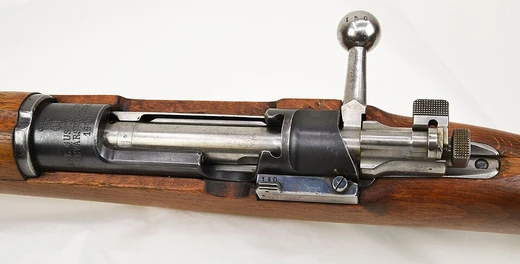
Siamese Mauser style rifle
Siam's Mauser-based service rifle, built in Japan, served until after WWII.

The Siamese Mauser style rifle refers to a series of bolt-action service rifles adopted by the Kingdom of Siam (now Thailand) as part of a modernization program under King Rama V. Facing colonial expansion from France and Britain, Siam sought to secure its independence by acquiring modern infantry weapons. After experimenting with other designs, the Siamese military chose a Mauser-based rifle derived from the Gewehr 98, which was produced with Japanese assistance and served as the principal infantry arm until after World War II.
Quick Facts
- Origin
- Siam
- Is Ranged
- YES
- Service
- 1903 ~ 1950
- Used By
- Siam/Thailand
- Wars
- World War I / World War II
- Design Date
- 1903
- Manufacturer
- Koishikawa Arsenal
- Variants
- Type 46, Type 47, Type 46/66, Type 47/66, Type 66
- Cartridge
- 8×50mmR Siamese, 8×52mmR Siamese / 30-06 Springfield / .30 Carbine
- Caliber
- 8 mm, .30 carbine (Type 66)
- Action
- Bolt action
- Velocity
- ~ 680 m/s (Type 46/66) ~ 620 m/s (Type 46)
Facts from the source article.
Lore & Background
King Rama V (Chulalongkorn) considered modernization essential to counter French colonial expansion from Indochina and British expansion from Malaya, following territorial concessions forced upon Siam. Many countries refused to sell Siam modern weapons under pressure from France and Britain. The Siamese military was able to buy out a defaulted Bulgarian contract for Austrian Mannlicher Model 1888/90 rifles, but decided against adopting the Mannlicher straight-pull bolt action; however, they were impressed with the Austrian 8×50mm rimmed cartridge. Despite British and French efforts, Siam also managed to buy a license to build Mauser's Gewehr 98 rifle, but lacked the necessary manufacturing capability. Japan had the required capability, and Siam contracted with Japan's Koishikawa Arsenal to build their rifles.
The first Siamese Mauser, the Type 46 rifle, used the Gewehr 98 bolt with cock-on-open action but removed the recoil lug with narrower lines of the Mauser model of 1896. It incorporated features from the Japanese Type 35 rifle, such as a sliding dust cover and long wrist tangs; some Type 46 rifles also have a split buttstock common on Arisaka rifles. Although licensed from Mauser, none of the components are interchangeable with other Mauser rifles. The Type 46 was chambered for the Type 45 8×50mm rimmed cartridge. The cartridge designation is the source of a misnomer for the rifle, leading some to refer to a 'Type 45' rifle. The cartridge was formally adopted before the rifles, as cartridge dimensions needed to be settled before production could begin.
The Type 47 carbine is a carbine-length version of the Type 46 with a shorter barrel. Many Type 46 rifles were converted to carbine length in the 1960s; converted rifles can be identified because the receiver bridge markings were not changed. In 1923, the Siamese military upgraded their ammunition with a spitzer bullet, adopting the Type 66 8×52mm rimmed cartridge. Existing Type 46 and Type 47 rifles were rechambered for this round and redesignated Type 46/66 and Type 47/66. The rear sight ramps were ground down to reflect the flatter trajectory, partially cutting off Thai numerals. The Type 66 rifle is an export model of the Japanese Type 38 rifle ordered in 1923 and built at Koishikawa Arsenal, with delivery delayed until 1928–29 due to the 1923 Great Kantō earthquake. Although a Type 38 in appearance, very few parts are interchangeable with the Japanese rifle.
Reader's Guide
The Siamese Mauser style rifle represents a significant chapter in Siam's efforts to maintain sovereignty during the colonial era. By securing a license for the Gewehr 98 and contracting production in Japan, Siam obtained a modern service rifle despite diplomatic pressure from France and Britain. The rifles served as the main infantry weapon of Siam until after World War II, undergoing modifications such as rechambering for spitzer ammunition and later conversions to .30-06 Springfield. The Type 66 rifle, though based on the Arisaka Type 38, is considered part of the Siamese Mauser family due to its Mauser-derived action. The legacy of these rifles lies in their role in Siam's military modernization and their unique blend of Mauser, Japanese, and Siamese design elements. Post-war, some were shortened and rechambered for .30-06, though recoil was found excessive in shorter rifles. The rifles are now collectible items, often bearing Thai numerals and importer-added serial numbers that rarely match the original.
Did You Know?
- The Type 46 rifle is marked with 'ร,ศ,๑๒๑' (R.S. 121) representing the 121st year of the Chakri Dynasty, equated to 1903.
- The Type 45 cartridge was adopted before the Type 46 rifle, leading to confusion where some refer to a 'Type 45' rifle.
- After World War II, some Siamese Mausers were shortened and chambered for .30-06 Springfield, but recoil was found excessive.
More in Bolt-Action Rifles 1-24
Spotted an error? Know more?
Reader corrections go straight into our review queue. Suggest an edit · How this site is sourced