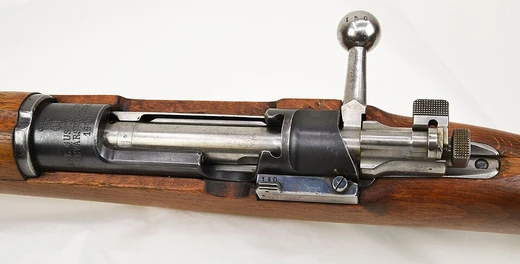
Chiang Kai-shek rifle
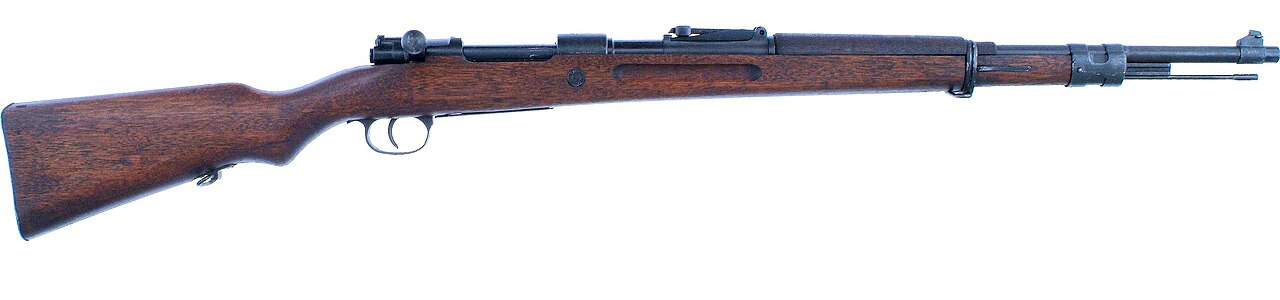
Chinese copy of the German Standardmodell, named after Generalissimo Chiang Kai-shek.

Gary Todd from Xinzheng, China · CC0
The Chiang Kai-shek rifle, sometimes called the Generalissimo rifle or Type 24, was a Chinese copy of the German Standardmodell, the design that led to the Karabiner 98k. Preproduction began in 1935—year 24 of the Republican calendar, hence the Type 24 name—and full-scale production followed later that year. However, standardized manufacturing only took hold during the Second Sino-Japanese War, and the older Hanyang 88 rifle was still produced in larger numbers.
The weapon was a shortened, lightened version of the Gewehr 98, specifically based on the Oberndorf Export Mauser known as the Standardmodell. China had bought 10,000 of these in 1934, and the Germans supplied tooling to produce the Type 24. The initial materials proved faulty, so new tools arrived in early 1935. Production began at the Gongxian Arsenal in July 1935, but China’s limited industrial capacity kept output low. After Generalissimo Chiang Kai-shek visited the factory, the rifle was renamed from Type 24 to Type Chiang Kai-shek.
As the war went on, industry in western cities like Chongqing and Kunming allowed more rifles to be made, though quality control suffered because machinery had to be moved to avoid Japanese capture or destruction. Alongside the Mauser C96 pistol and the M35 helmet, the rifle became a recognizable symbol of the National Revolutionary Army during China’s turbulent early 20th century. In an ironic turn, it was also heavily used by the Communists Chiang fought against in the Chinese Civil War.
Chinese Sergeant Tung Chih Yeh claimed to have killed over 100 Imperial Japanese Army soldiers with a Chiang Kai-shek rifle, sometimes scoped, in the Yangtze area. In 1941, the Chinese Communists produced their own copies, calling them the Type 55 rifle in honor of Eighth Route Army commander Zhu De’s 55th birthday. Between 1935 and 1949, about 600,000 of all models were made, roughly 400,000 of them during the war.
By the late 1940s, the rifle was phased out of frontline Nationalist service in favor of American-supplied weapons like the M1 Garand, M1 carbine, and Thompson submachine gun. Still, it remained in use with ROC reserve forces into the 1970s and is still used ceremonially by the ROC Army today, alongside the M1 Garand. The Chinese People’s Volunteer Army carried it during the Korean War, alongside Soviet-supplied arms including captured Karabiner 98ks.
Quick Facts
- Is Ranged
- yes
- Origin
- Republic of China
- Wars
- Chinese Civil War · Second Sino-Japanese War · World War II · First Indochina War · Korean War · Vietnam War · Laotian Civil War
- Design Date
- 1934
- Production Date
- 1935–1949
- Service
- 1935–1980s
- Part Length
- 600 mm
- Cartridge
- 7.92×57mm Mauser
- Feed
- 5-round stripper clip, internal magazine
- Action
- Bolt action
- Rate
- 15 rounds per minute
Facts from the source article.
Lore & Background
Preproduction of the Chiang Kai-shek rifle started in 1935, and full-scale production began as early as late 1935. However, full standardization only occurred during the Second Sino-Japanese War, and the Hanyang 88 rifle was produced in greater numbers. The weapon was a shortened and lightened version of the Gewehr 98, specifically the Oberndorf Export Mauser Standardmodell. China had bought 10,000 of these rifles in 1934, and the Germans provided tooling to produce the Type 24. Initial materials proved incorrect, and new tools were sent in early 1935. Production started at the Gongxian Arsenal in July 1935, but China's limited industrial capacity meant relatively low numbers were built. The name changed from Type 24 to Type Chiang Kai-shek after a visit by the Generalissimo to the factory. As the war progressed, industry in western cities like Chongqing and Kunming allowed more rifles to be produced, though quality controls persisted due to the need to move machinery to avoid Japanese capture or destruction.
Reader's Guide
The Chiang Kai-shek rifle became a recognizable feature of the National Revolutionary Army, alongside the Mauser C96 handgun and the M35 helmet. In an ironic twist, although named after Chiang Kai-shek, it was heavily used by the Communists he fought against during the Chinese Civil War. Chinese Sergeant Tung Chih Yeh claimed to have shot and killed over 100 Imperial Japanese Army soldiers using this rifle with and without a scope in the Yangtze area. In 1941, Chinese Communists produced copies called the Type 55 rifle in honor of Eighth Route Army Commander-in-chief Zhu De's 55th birthday. By the end of the 1940s, the rifle was phased out from frontline Nationalist service in favor of American aid equipment such as the M1 Garand, M1 carbine, and Thompson submachine gun, but it served ROC reserve forces into the 1970s and remains a ceremonial rifle for the ROC Army. The Chinese People's Volunteer Army used it during the Korean War, and it was seen in the hands of the Viet Minh and Viet Cong. The Chinese People's Militia used it into the early 1980s before replacement by more modern small arms, and it became a supplemental ceremonial weapon for the People's Liberation Army. Many were used by Red Guard factions during the Cultural Revolution.
Did You Know?
- The rifle was designated Type 24 because production began in year 24 of the Republican calendar.
- About 600,000 of all models were produced between 1935 and 1949, with roughly 400,000 made during the war.
- The rifle was also used by the Viet Minh during the First Indochina War and by the Viet Cong during the Vietnam War.
German Roots and the Birth of a National Rifle
The Type Chiang Kai-shek rifle traces its lineage directly to German small-arms engineering. In 1934, China purchased ten thousand Oberndorf Export Mauser rifles—designated Standardmodell, the immediate predecessor to the famous Karabiner 98k—and the German manufacturers supplied the production tooling needed to replicate the weapon domestically. The initial batch of materials arrived with errors, forcing a second shipment of corrected tooling in early 1935. Preproduction work began that same year, and by July the Gongxian Arsenal had the weapon rolling off its lines. Full-scale manufacturing followed by late 1935, though China's still-limited industrial base kept output modest. The rifle originally carried the designation Type 24, referencing the twenty-fourth year of the Republic calendar. The name was later changed to honor Chiang Kai-shek personally after the Generalissimo made a visit to the factory. Despite these early steps, the weapon would not achieve full standardization until the pressures of the Second Sino-Japanese War demanded it.
War-Driven Expansion and the Western Retreat
When the Second Sino-Japanese War erupted, the demand for standardized infantry weapons surged, and the Type Chiang Kai-shek finally entered full standardization. Yet the Hanyang 88 rifle was actually produced in greater numbers during this period, reflecting the chaotic priorities of wartime manufacturing. As Japanese forces advanced, China's industrial capacity shifted westward to cities such as Chongqing and Kunming, where additional rifles could be turned out. The constant threat of Japanese capture or destruction meant that machinery had to be moved repeatedly, a process that inevitably degraded quality control. Even so, roughly four hundred thousand of the approximately six hundred thousand total rifles produced between 1935 and 1949 were manufactured during the war years. In a parallel development, Chinese Communist forces produced their own copies in 1941, designating them the Type 55 rifle to mark the fifty-fifth birthday of Eighth Route Army commander Zhu De. The Communists also applied their own nomenclature, referring to the weapon as the Type 79 throughout the civil conflict.
Tactical Profile and Battlefield Character
The Type Chiang Kai-shek was conceived as a shortened, lightened descendant of the Gewehr 98, landing at a length comparable to the Karabiner 98k and noticeably shorter than both the full-length Gewehr 98 and the Japanese Arisaka Type 38. In practical combat terms, the rifle offered the National Revolutionary Army a meaningful edge over the Arisaka: superior stopping power, a faster rate of fire, and a longer effective range. The trade-off was a heavier recoil impulse and more muzzle blast, a consequence of the cartridge and action design. The weapon accepted the HY1935 bayonet via the standard Mauser bayonet lug, giving infantry a close-combat option when the situation demanded. Alongside the Mauser C96 sidearm and the M35 steel helmet, the Type Chiang Kai-shek became one of the most visually recognizable symbols of the Nationalist army through China's turbulent early twentieth century. Sergeant Tung Chih Yeh, a Chinese infantryman operating in the Yangtze region, reportedly killed more than one hundred Imperial Japanese Army soldiers with this rifle, using it both with and without a telescopic sight.
A Century of Service: From Frontline to Parade Ground
When American military aid flooded in during the late 1940s—bringing semiautomatic M1 Garands, M1 carbines, and Thompson submachine guns—the Type Chiang Kai-shek was withdrawn from Nationalist frontline units. Yet the rifle's life was far from over. It continued to equip ROC reserve forces well into the 1970s and remains in use today as a ceremonial and parade rifle in the ROC Army, often displayed alongside the M1 Garand. The weapon also saw action in the Korean War, where Chinese People's Volunteer Army units carried it alongside Soviet-supplied small arms including captured Karabiner 98k rifles. In Southeast Asia, Viet Minh fighters employed it during the closing phase of the First Indochina War, and Viet Cong guerrillas were still seen with it during the Vietnam War. On the mainland, the People's Militia kept the rifle in service until the early 1980s, when it was supplanted by Type 56 assault rifles and carbines. Red Guard factions wielded these weapons during the Cultural Revolution of the mid-to-late 1960s. Today the Type Zhongzheng serves as a supplemental ceremonial piece for the PLA, a quiet echo of the Generalissimo whose name it bears.
Gallery

Frequently Asked Questions
What is the Chiang Kai-shek rifle?
It is a Chinese bolt-action rifle manufactured from 1935 to 1949, built as a shortened and lightened derivative of the German Standardmodell (the Oberndorf Export Mauser). It is also widely known as the Generalissimo rifle or, by its military designation, the Type 24.
Why is it called "Type 24"?
The number refers to 1935, which was year 24 of the Republic of China calendar when preproduction of the weapon began. That calendar-year label became the standard designation and stuck through the rest of the rifle's service life.
How does the Chiang Kai-shek rifle relate to the Karabiner 98k?
Both weapons descend from the same German Standardmodell design, so they are essentially siblings rather than one being a copy of the other. The Chinese version specifically adapted the Oberndorf Export Mauser into a shorter, lighter platform suited to its own logistical needs.
How many Chiang Kai-shek rifles were produced in total?
Approximately 600,000 units across all variants rolled off the line, with roughly 400,000 of those built during the Second Sino-Japanese War. The older Hanyang 88 actually outproduced it in many periods because fully standardized manufacturing only took hold once the war was already underway.
What happened to the rifle after the Communist victory in 1949?
The People's Liberation Army absorbed existing stock and re-designated the rifles as Type 79. They also developed a domestic copy known as the Type 55, keeping the platform in active service well beyond the Nationalist era.
More in Bolt-Action Rifles 1-24
Spotted an error? Know more?
Reader corrections go straight into our review queue. Suggest an edit · How this site is sourced