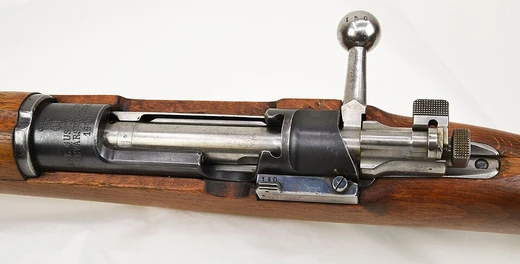
Geweer M. 95
The Dutch Mannlicher, a modified Schriever design, served from 1895 to 1940.

The Geweer M.95, often called the Dutch Mannlicher by collectors, served as the standard rifle for the Dutch armed forces from 1895 until 1940, taking over from the outdated Beaumont-Vitali M1871/88. While many assume it was derived from the earlier Mannlicher 1893 model, it was actually a modified version of the Mannlicher design created by August Schriever and the Dutch rifle commission. Roughly 470,000 M.95s were produced. Initial manufacturing was done by Steyr, but from 1904 onward, production shifted under license to a Dutch state-owned factory in Zaandam, named after the nearby Hembrug bridge.
The rifle used a rimmed cartridge, the 6.5x53.5mmR (also called the "Romanian" or "Dutch 6.5" 6.5×53 mmR, or .256 Mannlicher), which was shared with Romanian military rifles. Reloading relied on an en-bloc clip, similar in concept to the clip later used by the M1 Garand. With the bolt fully open and retracted, the clip was loaded from the top into the magazine, which was part of a trigger guard and magazine housing assembly designed by Ferdinand Mannlicher. Once all cartridges were spent, the empty clip fell out through a hole in the magazine base. For quick unloading, a spring-loaded latch at the rear of the magazine, operated by a recessed button in the front of the trigger guard, could eject a full clip upward. Clips were considered disposable, as ammunition came pre-loaded from the factory.
The search for a new rifle began in the 1880s, driven by the adoption of repeating rifles and smokeless powder. On 23 February 1886, the Dutch Minister of War appointed a commission to study the rifle question. Since finding a new rifle was a long-term goal, an interim solution came in 1888 with the addition of a 4-round Vitali magazine to the M1871 Beaumont. The commission set two principles: the rifle must have been adopted or considered by other nations, and they would focus on barrel, bolt, and cartridge. Initially, a magazine cut-off was required, but in 1890, the chief of the General Staff and the Inspector of the Infantry allowed the commission to drop this feature, making the rifle a pure repeater.
Quick Facts
- Origin
- Netherlands
- Is Ranged
- yes
- Service
- 1895–1949
- Used By
- Netherlands / Republic of Indonesia / Empire of Japan / Nazi Germany
- Wars
- Aceh War / Dutch intervention in Bali (1906) / Dutch intervention in Bali (1908) / World War I / World War II / Indonesian National Revolution
- Designer
- Otto Schönauer and Ferdinand Mannlicher
- Design Date
- 1895
- Manufacturer
- ŒWG, Artillerie Inrichtingen
- Production Date
- 1895–1940
- Number
- approx. 650,000
- Weight
- M95 Rifle: 4.35 kg / Carbine.No 4: 3.37 kg
- Length
- M95 Rifle: 1287 mm / Carbine.No 4: 951 mm
Facts from the source article.
Lore & Background
In the 1880s, two developments disrupted the armament paradigm: repeating rifles and smokeless gunpowder. On 23 February 1886, the Dutch Minister of War appointed a commission to evaluate the rifle question. By 1888, the M1871 Beaumont rifle was modified with a 4-round Vitali magazine as an interim solution. The commission focused on rifles adopted or considered by other nations, examining barrel, bolt, and cartridge. Nine rifles using a clip system were trialled, including the Austrian Mannlicher 1886, the Krag–Jørgensen, and an improved Mannlicher from August Schriever's factory in Belgium. The German Gewehr 1888 was removed from consideration after a double-feed could cause the rear cartridge's bullet to hit the chambered cartridge's primer with catastrophic results. The Schriever modified Mannlicher became the preferred candidate, and after small changes to stock, barrel bands, and sight, the weapon was officially designated the Geweer M. 95 on 4 December 1895.
The rifle used an en-bloc clip similar in concept to the later M1 Garand. With the bolt open and fully retracted, the full clip was loaded into the magazine from the top; the empty clip fell out through a hole in the magazine base when empty. Full clips could also be ejected upward via a spring-loaded latch operated by a recessed button in the trigger guard. Clips were essentially disposable, as ammunition was issued already loaded into clips from the factory. The M.95 was the standard weapon of the Royal Netherlands East Indies Army (KNIL) until the Japanese invasion, and was later used by both sides during the Indonesian National Revolution. After the war, remaining rifles were handed over to the new Indonesian Armed Forces, which rechambered some into .303 British and added muzzle brakes to carbine variants. The M.95 remained in Dutch colonial service at least to 1955, used by the police force of Suriname.
Reader's Guide
The Geweer M. 95 represents a significant step in Dutch military small arms, replacing the Beaumont-Vitali and serving as the primary infantry weapon for nearly half a century. Its adoption of the en-bloc clip system, derived from Mannlicher designs but modified by August Schriever and the Dutch commission, allowed rapid reloading in combat. The rifle's 6.5×53 mmR cartridge, shared with Romanian service, offered a lighter round compared to contemporary 7.5–8 mm calibers, a factor that influenced the commission's choice. The M.95 saw extensive use not only in the Netherlands but also in the Dutch East Indies, where it remained in service through World War II and the Indonesian National Revolution. Its post-war rechambering to .303 British by Indonesian forces and continued use by Suriname police into the 1950s demonstrate its durability. The rifle's variants, including carbines for cavalry, artillery, bicycle troops, and a trench periscope version, show its adaptability to different roles. After the German occupation of the Netherlands, captured M.95s were catalogued under German designations, further attesting to its widespread distribution. The M.95's legacy lies in its long service life, its role in colonial and post-colonial conflicts, and its distinctive en-bloc loading mechanism.
Did You Know?
- The Geweer M. 95 is a modification of the Mannlicher rifle by August Schriever and the Dutch rifle commission, not a direct copy of the Mannlicher 1893 Model.
- The rifle's en-bloc clip is similar in concept to the clip used later by the US Army's M1 Garand.
- After the Indonesian National Revolution, Indonesian forces rechambered some M.95 rifles and carbines into .303 British and added muzzle brakes to carbine variants.
The Commission and the Trials
In the late 1880s, the Dutch military confronted a paradigm shift driven by magazine-fed rifles and the arrival of smokeless powder. The aging Beaumont-Vitali M1871/88 was patched with a four-round Vitali magazine as a stopgap in 1888, but a proper replacement was urgently needed. On 23 February 1886, the Minister of War convened a commission to evaluate new repeating rifle systems. The commission applied two guiding rules: the candidate had to be adopted or at least under consideration by other nations, and evaluation would center on barrel, bolt, and cartridge. Nine clip-loading rifles entered the trial pool, including the Austrian Mannlicher 1886, the Italian Vinci, a Bergman design, Belgian Mosin-Nagant and Pieper rifles, the Krag-Jørgensen, a Swiss Frey, the German Gewehr 1888, and an improved Mannlicher from August Schriever's Belgian factory. Several were quickly eliminated—the Vinci arrived with insufficient ammunition, and the German rifle came with none at all. The Schriever-modified Mannlicher emerged as the preferred base, though a late entry from Nagant using a Mauser-style stripper clip forced a second round of trials. The German 1888 was ultimately dropped after a catastrophic double-feed incident during testing.
The En-Bloc Clip and Magazine Design
The M.95's most distinctive operational feature was its top-loading en-bloc clip system, housed within a trigger guard and magazine assembly designed by Ferdinand Mannlicher. With the bolt fully retracted, a pre-loaded clip was pushed into the magazine from the open receiver. Once the last round was fired, the empty clip dropped out through a hole at the base of the magazine housing. For rapid combat reloading, a spring-loaded latch at the rear of the magazine allowed the shooter to eject a full clip upward by pressing a recessed button on the front of the trigger guard. The clips themselves were essentially disposable, as ammunition arrived from the factory already seated in them. This mechanism bore a conceptual resemblance to the clip-loading method later employed by the U.S. Army's M1 Garand. The rifle fired the rimmed 6.5×53 mmR cartridge, shared with Romanian service rifles and sometimes catalogued as .256 Mannlicher. The 6.5 mm caliber was chosen over a 7.65 mm option after the commission found no performance penalty and noted the lighter weight advantage.
Production, Numbers, and Variants
Initial production of the M.95 was handled by Steyr for the Dutch military, but after 1904 manufacturing shifted to a Dutch state weapon factory in Zaandam, identified by the nearby Hembrug bridge. Over its service life, approximately 470,000 M.95 rifles were issued to Dutch forces. The weapon family expanded into nine distinct variants, most of them carbines that differed primarily in their sling swivels. The Karabijn No. 1 Oud Model, introduced in 1896, was designed for cavalry and the Marechaussee and later became the standard carbine of the KNIL in 1911, extending to non-European units in Java by 1925. The rifle's designation was formally fixed on 4 December 1895, following minor adjustments to the stock, barrel bands, sights, and other small components after a draft contract for 100 rifles was submitted to the Minister of War in March 1892. Collectors commonly refer to the weapon as the 'Dutch Mannlicher,' though it was technically a Schriever modification rather than a direct copy of the earlier Mannlicher 1893 Model.
Colonial Service and Post-War Legacy
Beyond the Netherlands proper, the M.95 served as the standard arm of the Royal Netherlands East Indies Army (KNIL) until the Japanese invasion of the 1940s. During the subsequent Indonesian National Revolution, the rifle appeared on both sides of the conflict. After hostilities ended, the KNIL transferred its remaining M.95 stock to the newly formed Indonesian Armed Forces. In the 1950s, Indonesian gunsmiths rechambered their M.95 rifles and carbines to fire .303 British ammunition, and a muzzle brake was fitted to the carbine variant. The rifle's service life extended even further afield: it remained in Dutch colonial service at least until 1955, when it was still in the hands of the Surinamese police force. This long tail of service—from the 1895 adoption through mid-century colonial policing—underscores how a single design could outlive its original nation's military establishment and find new roles across multiple theaters and decades.
Frequently Asked Questions
What is the Geweer M.95 and who designed it?
The Geweer M.95, a nickname collectors popularly call the 'Dutch Mannlicher,' is a bolt-action military rifle that armed Dutch infantry from 1895 to 1940. It was developed by August Schriever together with a Dutch rifle commission as a modified Mannlicher design, replacing the obsolete Beaumont-Vitali M1871/88.
What cartridge does the Geweer M.95 use?
The rifle is chambered for the rimmed 6.5×53 mmR round, also catalogued as .256 Mannlicher or 6.5×53.5mmR. This cartridge was loaded in groups of five via an en-bloc clip into a fixed internal magazine.
How many Geweer M.95 rifles were made and where?
Roughly 470,000 were produced over the rifle's manufacturing life. Steyr handled the initial runs, but from 1904 onward a Dutch state-owned factory in Zaandam, situated near the Hembrug bridge, took over licensed production.
How does the Geweer M.95's feed system work?
It employs a five-round en-bloc clip that drops into a fixed internal magazine, with the bolt-action mechanism cycling each rimmed round one at a time. No external box magazine or detachable clip is involved.
Why is the Geweer M.95 considered important in firearms history?
It was the final standard bolt-action service rifle of the Netherlands, remaining in issue for 45 years until the country's occupation in 1940. Its origin as a Schriever-modified Mannlicher rather than a straight derivative of the 1893 model makes it a distinctive entry in late-19th-century European small-arms development.
More in Bolt-Action Rifles 1-24
Spotted an error? Know more?
Reader corrections go straight into our review queue. Suggest an edit · How this site is sourced