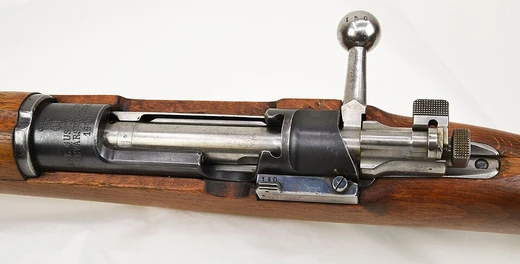
Cabañas RC-30
Side-lever bolt-action rifle series firing the Munisalva cartridge.

NS777 · CC BY 4.0
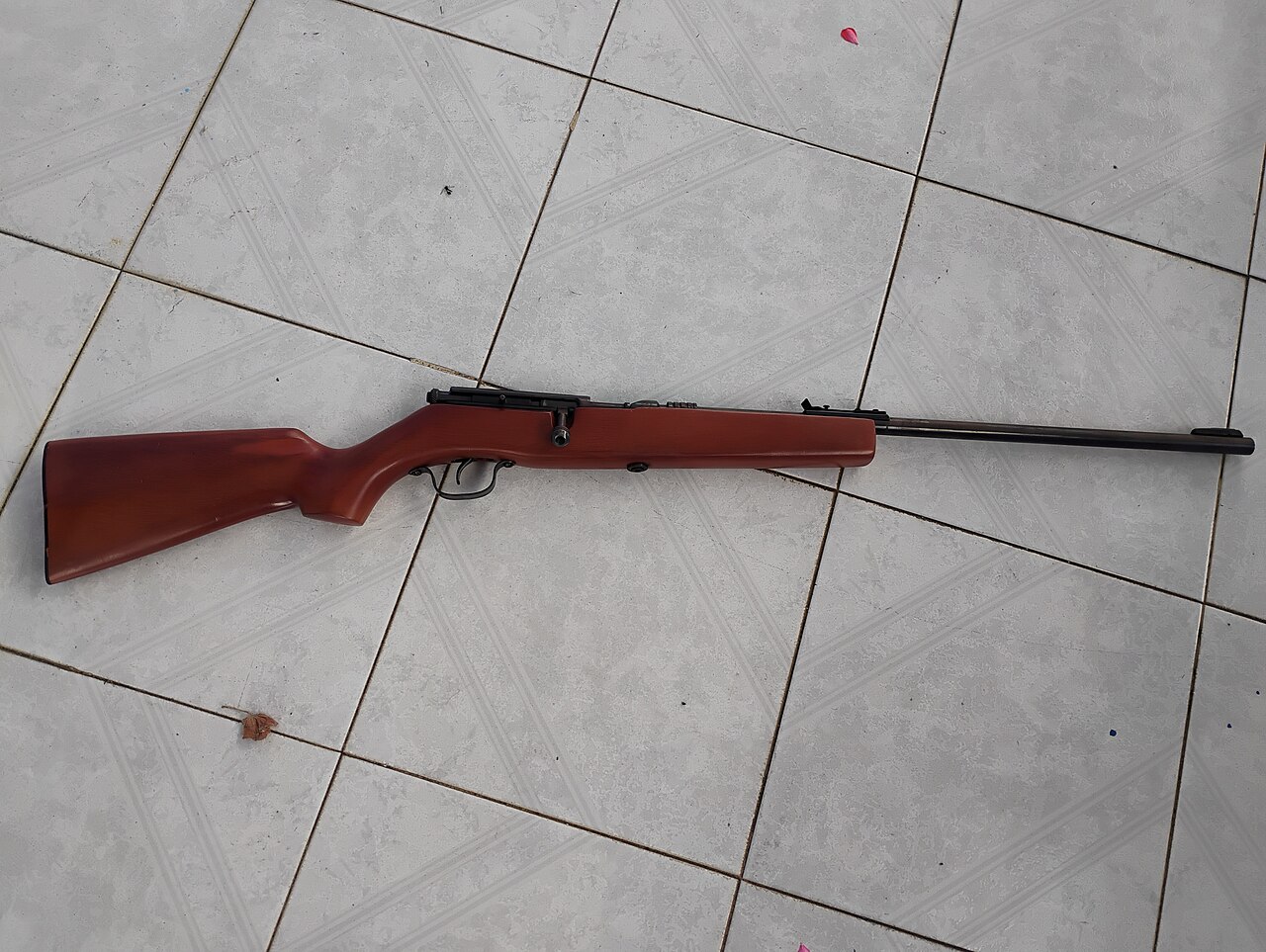
The Cabañas RC-30 is a series of side-lever-operated bolt-action rifles manufactured by Industrias Cabañas. Designed to fire the Munisalva cartridge, the RC-30 series comprises several models that differ in stock design, safety type, and recoil compensator. These are single-shot, side-lever cocked rifles.
Quick Facts
- Origin
- Mexico
- Is Ranged
- yes
- Designer
- Alfonso Ruiz Cabañas
- Manufacturer
- Industrias Cabañas
- Unit Cost
- $2,499ºº-$4,999ºº MXN, / (about $185ºº-$370ºº USD) in 2012
- Production Date
- 1949-present
- Variants
- Mini 82, Pony, Varmint, Master, Espronceda IV, Laser, AR15
- Weight
- 1.45 kg-3.63 kg
- Length
- 84 cm-114 cm
- Part Length
- 41 cm-55 cm
- Cartridge
- .17 Munisalva
- Action
- Bolt action
Facts from the source article.
Lore & Background
The RC-30 series was marketed in the United States during the 1980s through Mandall Shooting Supplies of Scottsdale, Arizona. The extractors are engaged by sliding the extractor handle located at the rear of the barrel. The safety is engaged by a secondary lever located behind the charging handle.
Models in the series include the RC-30 "Pony" with an English style stock, the RC-30 "Mini" with a Semi-Pistol stock, the RC-30 "Varmint" with a Pistol stock, the RC-30 "Leyre" with a Monte Carlo style stock, and the RC-30 "Laser" with a thumbhole stock. The RC-30 "AR15" model features a stock design that bears a strong resemblance to the Crosman AIR17 and is inspired by early generations of AR-15 rifles.
According to the manufacturer, the RC-30 series can achieve velocities of 380 m/s with 3.5-grain projectiles, generating an impact energy of 16.6 Joules. Independent tests achieved velocities of 340 m/s with the same projectile—yielding an impact energy of 13.3 J—and velocities of 112 m/s with an 18-grain projectile, resulting in 10.6 Joules of impact energy.
Reader's Guide
The Cabañas RC-30 series represents a distinctive approach to bolt-action rifle design, employing a side-lever cocking mechanism rather than a traditional bolt handle. Its single-shot action and use of the Munisalva cartridge set it apart from many contemporary rifles. The variety of stock configurations—from the English-style "Pony" to the thumbhole "Laser" and the AR-15-inspired "AR15" model—allowed the series to appeal to different shooter preferences.
The manufacturer's claimed ballistic performance differs from independent test results, with the latter recording lower velocities and impact energies for both light and heavy projectiles. This discrepancy is noted without resolution. The RC-30's presence in the United States market during the 1980s was facilitated by Mandall Shooting Supplies, though the series did not achieve widespread adoption. Its legacy lies in its unusual operating system and the range of stock options, which reflect an effort to blend traditional bolt-action reliability with ergonomic variety.
Did You Know?
- The RC-30 "AR15" model has a stock inspired by early generations of AR-15 rifles.
- Independent tests recorded lower velocities than the manufacturer's claims for the same 3.5-grain projectile.
- The RC-30 was distributed in the United States by Mandall Shooting Supplies of Scottsdale, Arizona.
Mechanical Architecture & Firing Mechanism
The Cabañas RC-30 stands as a single-shot, side-lever-operated bolt-action rifle built around the Munisalva cartridge. Its firing cycle relies on a distinctive side-lever mechanism that cocks the action, setting it apart from conventional top-lever or in-line bolt designs. The extraction process is handled by a dedicated extractor whose engagement is controlled through a sliding handle positioned at the rear of the barrel. The barrel itself features twelve rifling grooves with a twist rate of 480 millimetres—approximately 18.9 inches—giving the projectile a measured spin as it travels down the bore. For safety, the rifle employs a secondary lever situated behind the charging handle, offering a tactile means of securing the action. Aiming is supported by a fixed steel front sight paired with a rear sight that adjusts for both elevation and windage, giving the shooter practical range-finding capability. All of these elements were engineered and produced by Industrias Cabañas, a manufacturer known for its compact air rifle designs.
Model Line & Stock Configurations
The RC-30 series was never a single fixed design; rather, Industrias Cabañas offered a family of variants that distinguished themselves primarily through stock geometry, safety type, and the presence or absence of a recoil compensator. The RC-30 "Pony" carried a traditional English-style stock, evoking classic hunting rifle aesthetics. The "Mini" adopted a Semi-Pistol configuration for a more compact grip, while the "Varmint" moved to a full Pistol stock for a modern, aggressive hold. The "Leyre" featured a Monte Carlo style stock, and the "Laser" broke further convention with a thumbhole design. Perhaps most striking was the RC-30 "AR15," whose stock layout bore a strong visual resemblance to the Crosman AIR17 and drew clear inspiration from the early generations of AR-15 pattern rifles. This breadth of options allowed shooters to select a platform that matched their preferred ergonomics and shooting discipline, all while retaining the shared side-lever bolt-action core and Munisalva cartridge compatibility that defined the series.
Ballistic Performance & Energy Figures
The RC-30 fires the Munisalva cartridge, and its published performance figures reveal an interesting gap between manufacturer claims and independent verification. Industrias Cabañas stated that the rifle could propel a 3.5-grain projectile to 380 metres per second, producing an impact energy of 16.6 Joules. However, independent testing told a somewhat different story: the same 3.5-grain projectile was measured at 340 metres per second, yielding 13.3 Joules of impact energy. When a heavier 18-grain projectile was used in those independent trials, velocity dropped to 112 metres per second, with the resulting impact energy settling at 10.6 Joules. These figures place the RC-30 firmly in the realm of moderate-energy air rifles, capable of generating meaningful kinetic force at the muzzle while remaining well within the parameters of a single-shot, side-lever platform. The discrepancy between advertised and measured velocities underscores the importance of third-party testing when evaluating any airgun's true ballistic ceiling.
Market Presence & North American Distribution
Although the RC-30 was designed and manufactured by Industrias Cabañas, its reach into the North American market came through a specific retail channel during the 1980s. The rifle was distributed in the United States by Mandall Shooting Supplies, a company based in Scottsdale, Arizona, which served as the official distributor for the Cabañas product line in that territory. This arrangement gave the RC-30 series a foothold in a market where single-shot, side-lever bolt-action air rifles were a niche but dedicated segment of the shooting community. The 1980s window of availability meant that the RC-30 competed alongside other European and Asian airgun offerings of the era, with its distinctive stock variations and Munisalva cartridge setting it apart on the shelf. For American shooters in that decade, the RC-30 represented a European engineering perspective on the side-lever format, brought to their local gun shop through a single Arizona-based supply house.
Gallery
Frequently Asked Questions
What is the Cabañas RC-30?
The Cabañas RC-30 is a line of single-shot, side-lever-operated bolt-action rifles produced by Industrias Cabañas. It is not a repeating firearm; each shot requires the shooter to manually operate the side lever to cycle the action.
What cartridge does the Cabañas RC-30 chamber?
Every model in the RC-30 series is built around the Munisalva cartridge, which is the sole round the platform is designed to fire.
How does the side-lever action on the RC-30 work?
Instead of a traditional rotating bolt handle, the RC-30 uses a lever mounted on the side of the receiver to cock and lock the action after each shot. This single-shot mechanism means the lever must be cycled again before the next round can be loaded and fired.
What are the barrel and sight specifications of the Cabañas RC-30?
The barrel features 12 right-hand grooves with a 480 mm (18.9 in) twist rate, paired with a fixed steel front sight and a rear sight adjustable for both elevation and windage.
What differentiates the various RC-30 models from one another?
Industrias Cabañas offers several RC-30 variants that share the same core action and cartridge but differ in stock design, the type of safety mechanism fitted, and whether a recoil compensator is installed.
More in Bolt-Action Rifles 1-24
Spotted an error? Know more?
Reader corrections go straight into our review queue. Suggest an edit · How this site is sourced