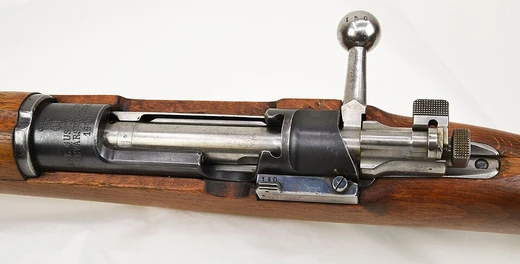
Hanyang 88
Chinese copy of the Gewehr 88, used for over 50 years.

fading · CC BY-SA 3.0
The Hanyang 88, also known as the Type 88 or Hanyang Type 88, is a Chinese-made bolt-action rifle based on the German Gewehr 88. Adopted by the Qing dynasty near the end of the 19th century, it was produced at the Hanyang Arsenal and served as a standard battle rifle for multiple Chinese factions until the end of the Chinese Civil War.
Quick Facts
- Origin
- Qing dynasty
- Is Ranged
- yes
- Service
- 1895 — Present
- Manufacturer
- Hanyang Arsenal
- Production Date
- 1895–1944
- Variants
- Rifle / Carbine
- Number
- 1,083,480
- Weight
- 4.06 kg
- Length
- 1250 mm
- Part Length
- 740 mm
- Cartridge
- M/88
- Action
- Bolt-action
Facts from the source article.
Lore & Background
The Hanyang 88 was directly patterned on the German Gewehr 88 and initially fielded by the New Armies of the Qing Dynasty. Production began in 1895 at Hanyang Arsenal, and the rifle was modified twice—in 1904 and 1930—to improve performance. It served as one of the standard battle rifles of the National Revolutionary Army from its founding in 1925 until the late 1940s. Japanese forces captured large numbers and issued them to second-line units and collaborationist Chinese troops. The Chinese Communists also used the rifle during the same period and later in the Korean War, and some were reportedly supplied to the Viet Minh. Production ceased in 1944 after 1.1 million rifles had been made; after Wuhan fell in 1938, production moved to the 21st Arsenal in Chongqing. When used by the People's Liberation Army, the rifles were typically issued to militia forces or used as training and drill rifles. During the Sino-Soviet split, China supplied surplus Hanyang 88s to the Afghan Mujahideen in the Soviet-Afghan War.
Reader's Guide
The Hanyang 88 was the most numerous rifle used by the Chinese National Revolutionary Army during the Second Sino-Japanese War, despite its original round-nose 7.92×57mm I ammunition having become obsolete by World War I. Its Mannlicher-style en-bloc clip allowed rapid reloading, but the open bottom of the magazine could admit dirt, potentially causing reliability issues. The rifle was due to be replaced by the Chiang Kai-shek rifle, but production of the new rifle never matched demand, so the Type 88 continued to be manufactured and equipped Chinese forces throughout the war. Its long service life—from the Boxer Rebellion through the Chinese Civil War and into the Korean War—reflects its role as a mainstay of Chinese infantry. The rifle's design was essentially a copy of the Gewehr 88, with minor differences taken from the Mannlicher M1904, including the absence of the barrel shroud and an extended bayonet. A carbine variant was also produced, shorter and lighter but with inferior accuracy and range.
Did You Know?
- The Hanyang 88 was based on the German Gewehr 88.
- Production ran from 1895 to 1944, with 1.1 million rifles made.
- Japanese forces captured Hanyang 88s and issued them to collaborationist Chinese troops.
- China supplied surplus Hanyang 88s to the Afghan Mujahideen during the Soviet-Afghan War.
Origins and the Long Production Run
The Hanyang 88, whose Chinese name translates roughly to "Made in Hanyang," traces its lineage directly to the German Gewehr 88 bolt-action rifle. Production began in 1895 at the Hanyang Arsenal, the very facility that gave the weapon its identity, and the firearm was initially fielded by the New Armies raised under the Qing Dynasty. Over its long manufacturing life, the design received two significant revisions—first in 1904 and again in 1930—to refine its performance. When Japanese forces captured Wuhan in 1938, production was relocated to the 21st Arsenal in Chongqing, where it continued until 1944. By that point, an estimated 1.1 million rifles had rolled off the lines, making the Hanyang 88 one of the most prolific Chinese firearms of the era. Its colloquial name, Hanyang Zao, simply meant "Made in Hanyang," a straightforward reference to its birthplace rather than any technical designation.
Mechanics and Design Choices
At its core, the Hanyang 88 was a bolt-action rifle that cocked the bolt upon opening, feeding five rounds of 7.92×57mm Mauser ammunition through a Mannlicher-style box magazine. The loading system relied on a five-round en-bloc clip: the shooter pushed the clip into the magazine, and once the final round was chambered, the spent clip would drop out through a small hole in the magazine floor. This mechanism offered a notable speed advantage for reloading, yet the same opening created a vulnerability, as dirt and debris could work their way in and compromise reliability. The design borrowed a few elements from the Mannlicher M1904, most visibly the absence of a barrel shroud and a slightly extended bayonet. In the 1904 revision, additional wood was added to the forend to shield the shooter's hands from heat, and the rear sight was updated to a Kar98 pattern. A shorter carbine variant and a short-rifle version also existed, trading some range and accuracy for portability. Though plans existed to convert the rifles to fire a spitzer bullet, that mass retooling never materialized.
A Rifle That Outlived Its Era
From the Boxer Rebellion through the Korean War, the Hanyang 88 appeared on battlefields across East Asia and beyond. It served as a standard issue for the National Revolutionary Army from 1925 until the late 1940s and was, by all accounts, the most numerous rifle in Chinese hands during the Second Sino-Japanese War. Japanese forces captured vast quantities and distributed them to second-line units and collaborationist Chinese formations, while the puppet state of Manchukuo also fielded them in secondary roles. The Chinese Communists used the rifle throughout the Civil War and into the Korean War, and the People's Liberation Army later pressed surplus examples into service as militia weapons or training and drill rifles. The rifle's reach extended even further: some were reportedly passed to the Viet Minh in North Vietnam, and during the Sino-Soviet split, China supplied surplus Hanyang 88s to the Afghan Mujahideen fighting the Soviet intervention. Warlord armies of the Republic of China era also relied on the weapon, underscoring how deeply it was embedded in Chinese military life.
The Rifle That Refused to Be Replaced
The Hanyang 88 was officially slated to be superseded by the Chiang Kai-shek rifle, yet the new weapon's production capacity never caught up with the sheer volume of arms China required. As a result, the Type 88 kept rolling off assembly lines and continued to equip National Revolutionary Army troops well into the Second Sino-Japanese War. The Mauser Model 1907, another Chinese-made candidate, also failed to displace it. It was not until 1944, when Chiang Kai-shek rifle output finally scaled up, that Hanyang 88 manufacture was wound down at the Chongqing facility. In the end, the rifle served for nearly five decades—from 1895 to the late 1940s—outlasting the Qing Dynasty, the Republic, and two world wars. Its longevity was less a testament to cutting-edge engineering than to the practical reality that a proven, mass-producible weapon could hold its place in an army's armory for generations, even as newer designs arrived on the drawing board.
Gallery

Frequently Asked Questions
What is the Hanyang 88?
It is a Chinese bolt-action battle rifle produced at the Hanyang Arsenal, originally derived from the German Gewehr 88 design. The Qing dynasty adopted it near the close of the 19th century, and it went on to serve as a standard infantry rifle across multiple Chinese military factions for decades.
What caliber and action type does the Hanyang 88 use?
The rifle fires the 7.92×57mm Mauser cartridge through a bolt-action mechanism that cocks on opening. This pairing of a rimless bottlenecked round with a simple, reliable bolt made it a dependable workhorse throughout its long service life.
How many Hanyang 88 rifles were built and over what period?
Roughly 1.1 million were manufactured between 1895 and 1944, primarily at the Hanyang Arsenal and later at the 21st Arsenal in Chongqing. That production span made it one of the most numerous rifles in Chinese military history.
What is the German connection behind the Hanyang 88?
The design is a direct Chinese adaptation of the German Gewehr 88, one of the earliest military bolt-actions to use a rimless smokeless-powder cartridge. Chinese engineers at the Hanyang Arsenal localized the platform, giving it a distinct identity despite its Prussian origins.
Why is the Hanyang 88 considered significant in rifle history?
It carried Chinese infantry from the late-Qing era all the way through the end of the Chinese Civil War, spanning more than 50 years of continuous service. Its massive production numbers and long operational life make it a defining symbol of China's transition to modern small-arms warfare.
More in Bolt-Action Rifles 1-24
Spotted an error? Know more?
Reader corrections go straight into our review queue. Suggest an edit · How this site is sourced