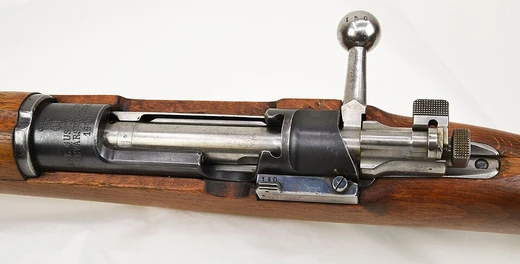
Bolt action
Manual firearm action operated by a turn-bolt handle.

MagHoxpox · CC BY-SA 4.0
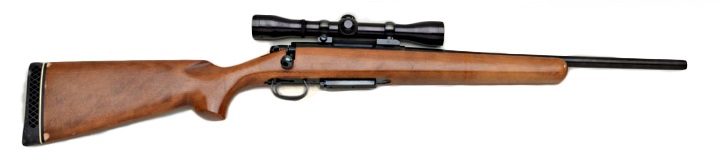
Bolt action is a type of manual firearm action operated by directly manipulating a turn-bolt via a bolt handle, most commonly placed on the right-hand side. The majority of bolt-action firearms are rifles, though some shotguns and handguns also use this mechanism. Bolt action firearms are generally repeating, but many single-shot designs exist, particularly in shooting sports where single-shot firearms are mandated.
- First bolt-action rifle produced
- 1824 by Johann Nikolaus von Dreyse
- First adopted by military
- Prussian Army in 1841
- First u.s. military true bolt-action rif
- Ward-Burton Model 1871
- First u.s. standard-issue bolt-action ri
- Springfield Model 1892
- First bolt-action repeating rifle
- Patented in Britain in 1855
- First bolt-action repeating rifle using
- Designed by Ferdinand Fruwirth in 1871
Lore & Background
The first bolt-action rifle was produced in 1824 by Johann Nikolaus von Dreyse, who perfected his Nadelgewehr (Needle Rifle) by 1836; it was adopted by the Prussian Army in 1841. In 1850 a metallic centerfire bolt-action breechloader was patented by Béatus Beringer, and in 1852 another was patented by Joseph Needham, improved in 1862. The United States purchased 900 Greene rifles in 1857, which saw service at the Battle of Antietam in 1862, but the weapon was considered too complicated. The Palmer carbine, patented in 1863, was purchased by the Union Army but arrived too late for combat; it is not considered a true bolt-action because it used a separate side-mounted hammer. The first true bolt-action rifle used by the U.S. military was the Ward-Burton Model 1871, chambered in .50-70 Government. The first bolt-action rifle adopted as a standard-issue rifle by the United States was the Springfield Model 1892, based on the Norwegian Krag–Jørgensen, used during the Spanish-American War. The French Army adopted its first bolt-action rifle, the Chassepot, in 1866, followed by the Gras in 1874. European armies developed bolt-action rifles through the latter half of the 19th century, first adopting tubular magazines as on the Kropatschek and Lebel rifles. The first bolt-action repeating rifle was patented in Britain in 1855 using a gravity-operated tubular magazine. The Vetterli rifle appeared in 1867, and the first bolt-action repeating rifle to use centerfire cartridges was designed by Ferdinand Fruwirth in 1871. The first box-magazine bolt-action was the M1885 Remington–Lee, but the first generally adopted was the British 1888 Lee–Metford. World War I marked the height of the bolt-action rifle's use. During World War II, the bolt-action rifle began to be superseded by semi-automatic and fully automatic rifles, though it remained the primary weapon of most combatants for the duration; many American units, especially the USMC, used M1903 Springfield rifles until sufficient M1 Garands were available.
Reader's Guide
Bolt-action rifles were the standard infantry service weapons for most of the world's military forces from the late 19th century through both World Wars, except the United States Armed Forces, which used the M1903 Springfield in World War I but adopted the M1 Garand semi-automatic by World War II. After World War II, bolt-action firearms were largely replaced by semi-automatic and selective-fire firearms, remaining only as sniper rifles due to their potential for superior accuracy and precision, as well as ruggedness and reliability compared to self-loading designs. Today, bolt-action rifles are chiefly used as hunting and target rifles, capable of hunting anything from vermin to large game. Target shooters favor single-shot bolt actions for their simplicity, reliability, and accuracy. Since the 2020s, bolt-action AR-15 rifles have become more popular in states with laws restricting semi-automatic rifles with certain cosmetic features as 'assault weapons' or banning the AR-15 and other semi-automatic rifles with detachable magazines. These bolt-action rifles use an AR-15 lower receiver and a special bolt-action upper receiver, retaining the look and versatility of a traditional AR-15 but lacking a gas system and semi-automatic function, thus not meeting state definitions of an assault weapon. They are also becoming popular with competition and sport shooters due to compatibility with a wide range of accessories and no need for special proprietary parts.
Lineage and Design Advantages
Bolt action rifles represent a meaningful step forward in the development of the lever action rifle. Where lever action designs established the foundational principles for modern long guns, the bolt action mechanism refined that concept by addressing key mechanical limitations. Two primary improvements distinguish the bolt action from its lever action predecessor: enhanced accuracy and a more robust receiver structure. The stronger receiver provides a sturdier platform for the action, which in turn supports the precision that makes bolt action rifles particularly valued by shooters. This evolutionary relationship between the two designs illustrates how incremental mechanical innovations can yield substantial performance gains. Rather than representing an entirely new category, the bolt action stands as a direct refinement of the lever action principle, carrying forward its fundamental operating philosophy while upgrading the structural integrity and accuracy characteristics that matter most in practical use.
The Manual Cycling Process
A defining characteristic of the bolt action rifle is the degree of direct physical involvement required from the shooter with every single shot. After each round is fired, the user must manually cycle the bolt to eject the spent casing and chamber a fresh round. This manual operation stands in clear contrast to designs where the cycling action is driven automatically by gas pressure or recoil energy. In the bolt action system, the shooter remains an active participant in every single shot, physically manipulating the bolt handle to complete the loading cycle. This requirement means that the rhythm of fire is entirely governed by the speed, technique, and stamina of the individual operator. The manual nature of the process also means the mechanism relies on fewer automatically driven moving parts, with the bolt serving as the central component the user directly engages with after each trigger pull.
Loading and Feeding Methods
When it comes to getting ammunition into the chamber, bolt action rifles typically rely on two primary feeding methods: stripper clips and magazines. Stripping clips involve pushing a row of cartridges into the magazine or directly into the chamber in a single, quick motion, a method that is straightforward and efficient for the shooter. Magazines, on the other hand, provide a more structured and potentially higher-capacity means of holding rounds ready for the next cycle. The use of these two loading systems reflects the practical balance bolt action designers strike between mechanical simplicity and operational convenience. Because the bolt must be cycled manually after every shot, the loading method plays a meaningful role in the overall speed and flow of the firing sequence. Whether a shooter prefers the rapid bulk loading of a stripper clip or the organized capacity of a magazine, both approaches are well suited to the bolt action's operating cycle.
Place in the Rifle Taxonomy
Within the broader landscape of firearms, the bolt action rifle occupies a specific niche among many distinct operating mechanisms. It sits alongside lever action rifles, pump-action rifles, straight-pull rifles, semi-automatic rifles, and a wide array of other categories ranging from assault rifles to battle rifles, carbines, and sniper rifles. The bolt action's position in this taxonomy is notable because it represents a manual, single-shot-cycling design in a field where many alternatives offer automatic or semi-automatic cycling. Its lineage from the lever action places it in a tradition of manually operated long guns, yet its emphasis on accuracy and receiver strength sets it apart from many of its peers. The existence of so many distinct rifle categories, each with its own operating principle, highlights how the bolt action's particular combination of manual operation, precision, and structural robustness carves out a unique and enduring place in the world of firearms.
Gallery
Frequently Asked Questions
What is a bolt action?
A bolt action is a manual firearm mechanism in which the shooter rotates a bolt via a side handle—usually on the right—to load, lock, and eject a cartridge. It is the most widespread action type on rifles, though a handful of shotguns and handguns also employ it.
Who invented the first bolt-action rifle?
Johann Nikolaus von Dreyse built the earliest known bolt-action rifle in 1824. His design set the stage for the mechanism that would eventually dominate military small arms worldwide.
Which army first adopted a bolt-action rifle?
The Prussian Army was the first military organization to field a bolt-action rifle, adopting it in 1841. This gave Prussia a significant loading-speed advantage over forces still using percussion or caplock systems.
What was the first U.S. military bolt-action rifle?
The Ward-Burton Model 1871 holds the distinction of being the first true bolt-action rifle used by American troops. The Springfield Model 1892 later became the first standard-issue bolt-action rifle in the U.S. arsenal.
Are all bolt-action rifles repeating?
Most bolt-action firearms are repeating, but single-shot bolt-action designs are also well established. They are especially common in competitive shooting events that mandate single-shot platforms.
More in Bolt-Action Rifles 1-24
Spotted an error? Know more?
Reader corrections go straight into our review queue. Suggest an edit · How this site is sourced