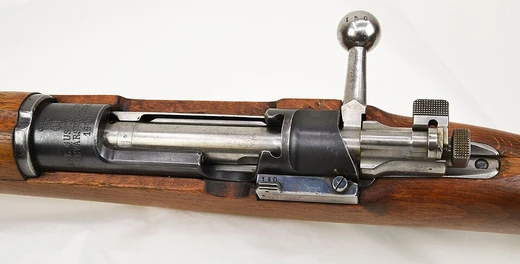
Cadet rifle
A training rifle for military cadets, often in .22 caliber.

Anonymous Unknown author · CC BY-SA 3.0
A cadet rifle is a firearm intended for military cadets and others learning basic firearms handling and marksmanship. These rifles are most often .22 caliber and bolt-action, though semi-automatic versions exist. Many are scaled-down .22 caliber replicas of standard-issue service rifles. In the 19th century, cadet rifles were simply smaller, lighter versions of service rifles, chambered for lower-power cartridges.
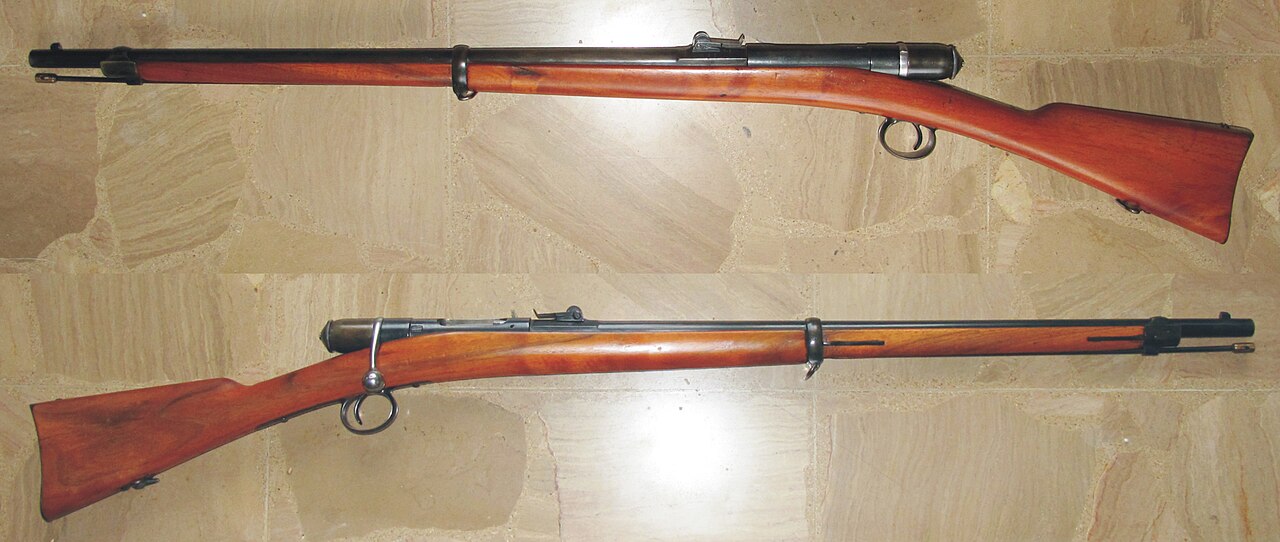
The Martini Cadet is a centerfire, single-shot rifle made in the United Kingdom by BSA and W.W. Greener for Australian military cadets. Though it resembles a miniature Martini–Henry, its internal design differs. It fired the .310 Cadet (or .310 Greener) cartridge and saw service from 1891 to 1955.
The Schmidt-Rubin Model 1897 cadet rifle was meant to replace older Vetterli rifles. It was a single-shot weapon using the bolt from the Schmidt-Rubin Model 89/96. A reduced-power 7.5×55mm Swiss cartridge was used to suit younger, smaller cadets. Its sights were graduated for both light and standard loads. About 7,900 of these rifles were made.
The Springfield Model 1922 is a .22 caliber bolt-action rifle with a 24-inch barrel and a 5-round magazine. Built to mimic the M1903 Springfield for training, it was produced in several versions until World War II, when material shortages halted production.
The No.8 cadet rifle is a bolt-action .22 caliber version of the Lee–Enfield, designed for British Army target shooting. It is a simple, hand-fed single-shot rifle, originally used by military marksmen in civilian competitions before being given to cadet forces. The British cadet services later used it as a basic target rifle. Some examples are now in civilian hands, especially after New Zealand cadet forces auctioned off their No.8 and No.9 rifles.
The TOZ-8 is a single-shot .22 caliber cadet rifle designed in 1932 by D. M. Kochetov and produced at the Tula Arms Plant. Simple, reliable, and trouble-free, it served for decades as the primary cadet rifle for military, paramilitary, and police organizations in the USSR. It is still used for hunting small game.
The Mauser KKW cadet rifle is a single-shot .22 caliber rifle introduced in 1938. It closely resembles the Karabiner 98k and was used by all German military, paramilitary, and police organizations, especially the Hitler Youth.
- Caliber
- .22 Long Rifle (common), also 7.62×51mm, .310 Cadet, 5.56×45mm NATO
- Action
- Bolt-action (common), also semi-automatic, single-shot, blowback-operated
- Notable examples
- Springfield Model 1922, CZ 452, TOZ-17, L81 A2, C12A1, L98A1, Smith & Wesson M&P15-22, SIG 522LR
- Magazine capacity
- 5-round (Springfield Model 1922), 10- or 25-round (M&P15-22), 10- or 25-round (SIG 522LR), 5-round detachable (TOZ-17)
Lore & Background
Cadet rifles have been produced since the 19th century, with early examples such as the Martini Cadet, a centerfire single-shot rifle produced in the United Kingdom by BSA and W.W. Greener for Australian military cadets. Chambered for the .310 Cadet cartridge, it was used from 1891 to 1955. The Schmidt-Rubin Model 1897 cadet rifle was intended as a replacement for earlier Vetterli rifles, using a reduced power 7.5×55mm Swiss cartridge for younger cadets, with sights graduated for both light and standard loads. Approximately 7900 were made.
In the 20th century, many cadet rifles were designed to mimic standard service rifles. The Springfield Model 1922 is a .22 caliber bolt-action rifle with a 24-inch barrel and 5-round magazine, built to mimic the M1903 Springfield. The No.8 cadet rifle is a bolt-action .22 caliber version of the Lee–Enfield, originally designed for British Army target shooting. The TOZ-8, conceived in 1932 by D. M. Kochetov and produced at the Tula Arms Plant, is a single-shot .22 caliber cadet rifle widely used in the USSR. The Mauser KKW cadet rifle, introduced in 1938, is virtually identical to the Karabiner 98k and was used by German military, paramilitary and police organizations, especially the Hitler Youth.
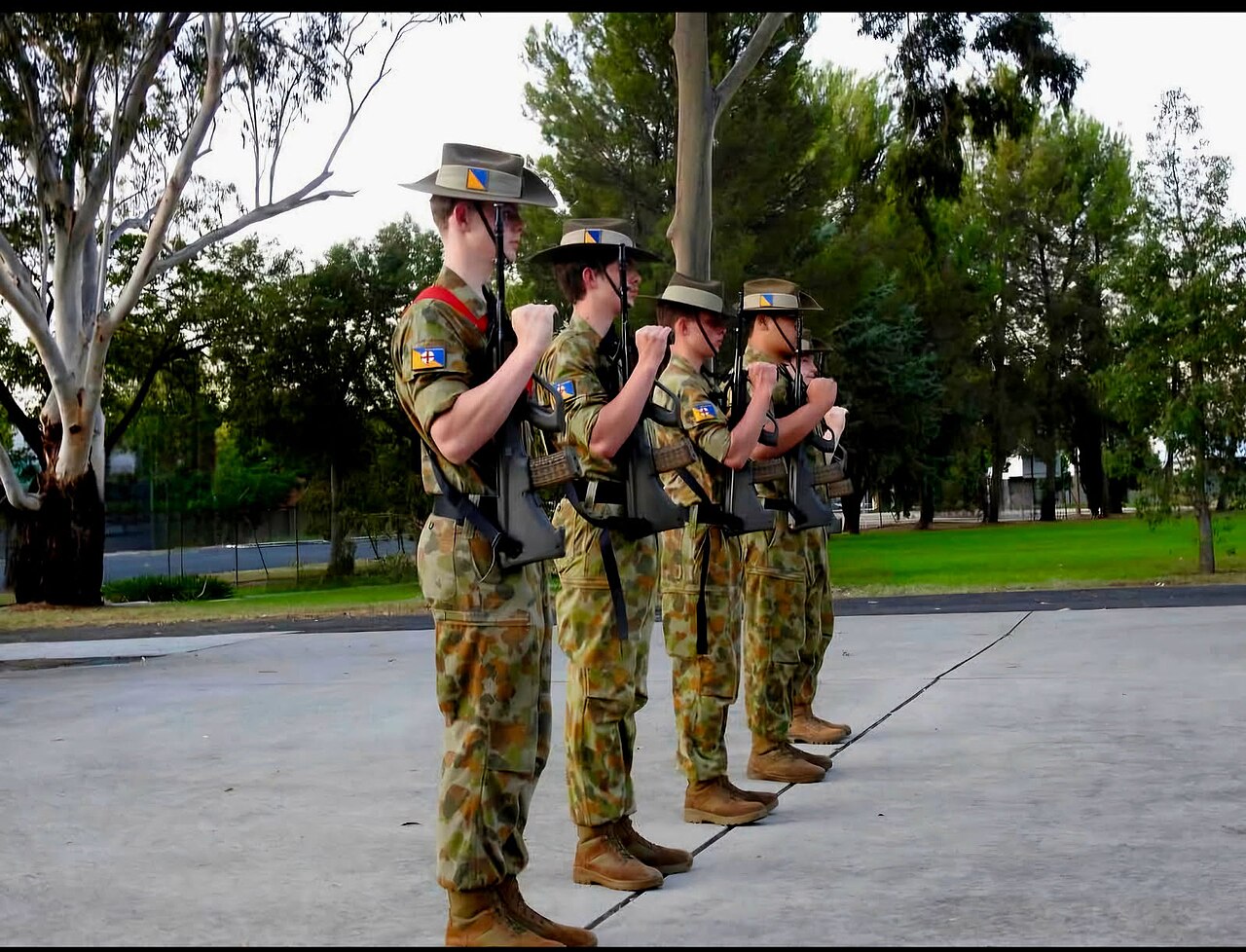
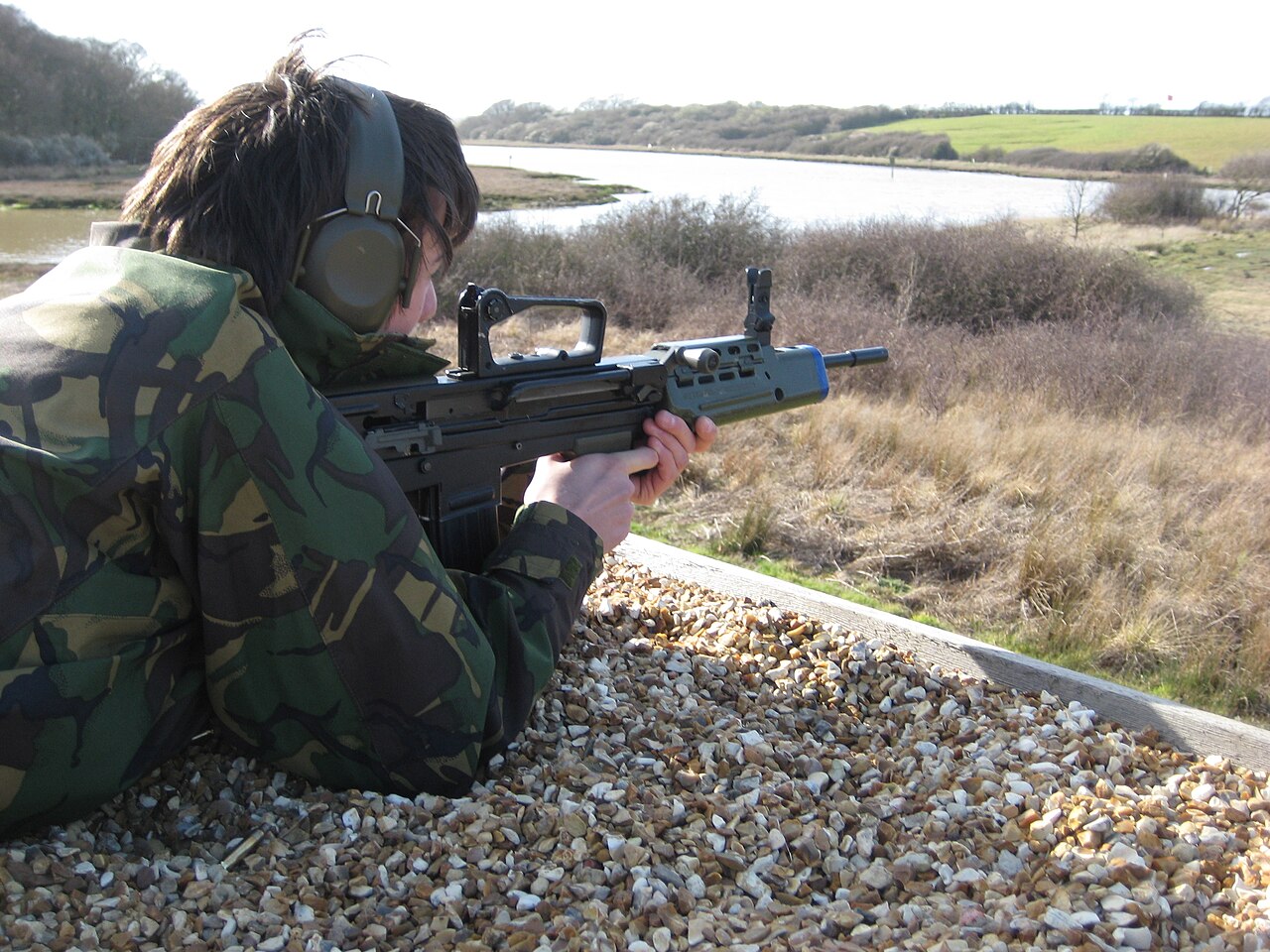
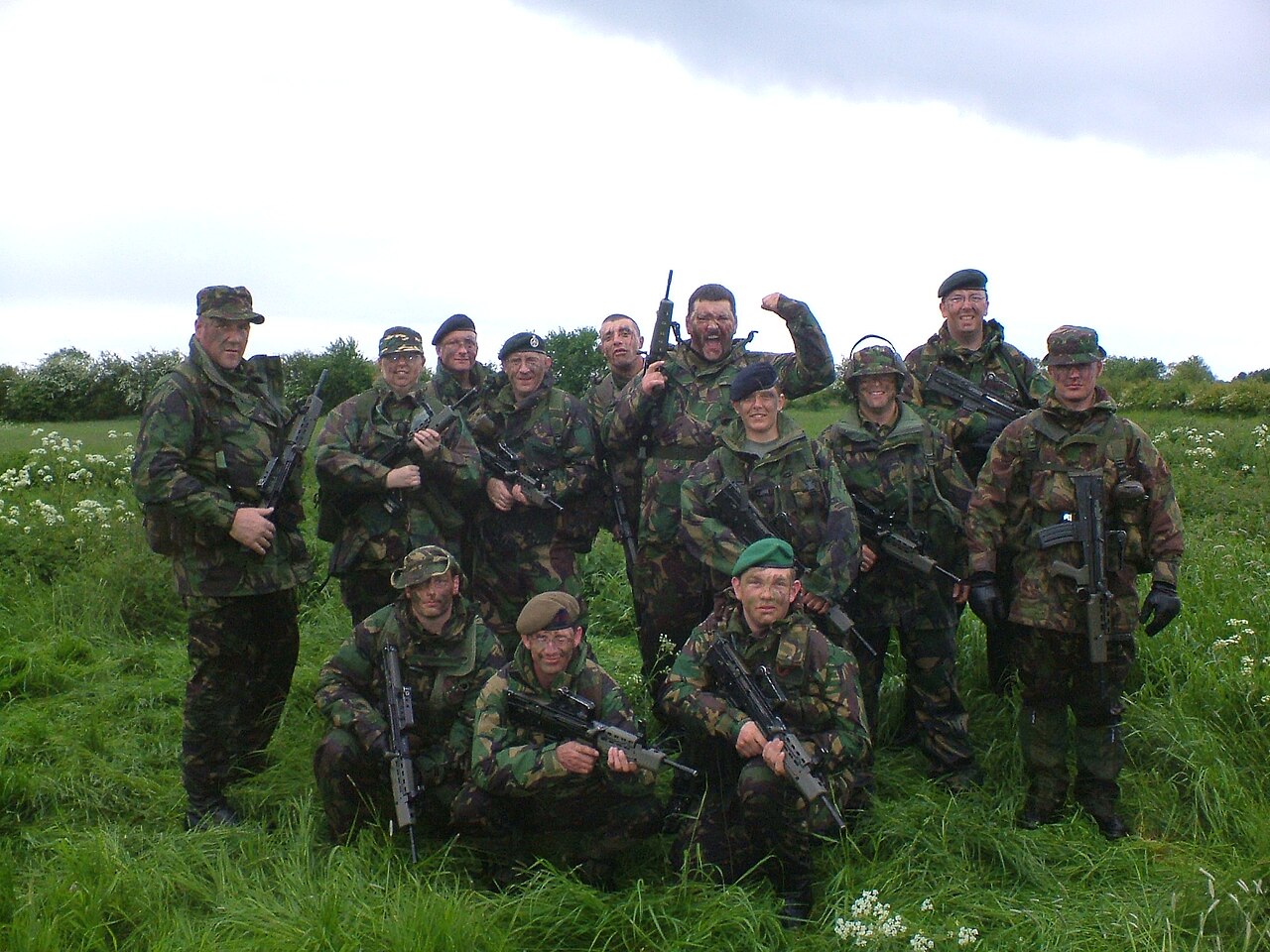
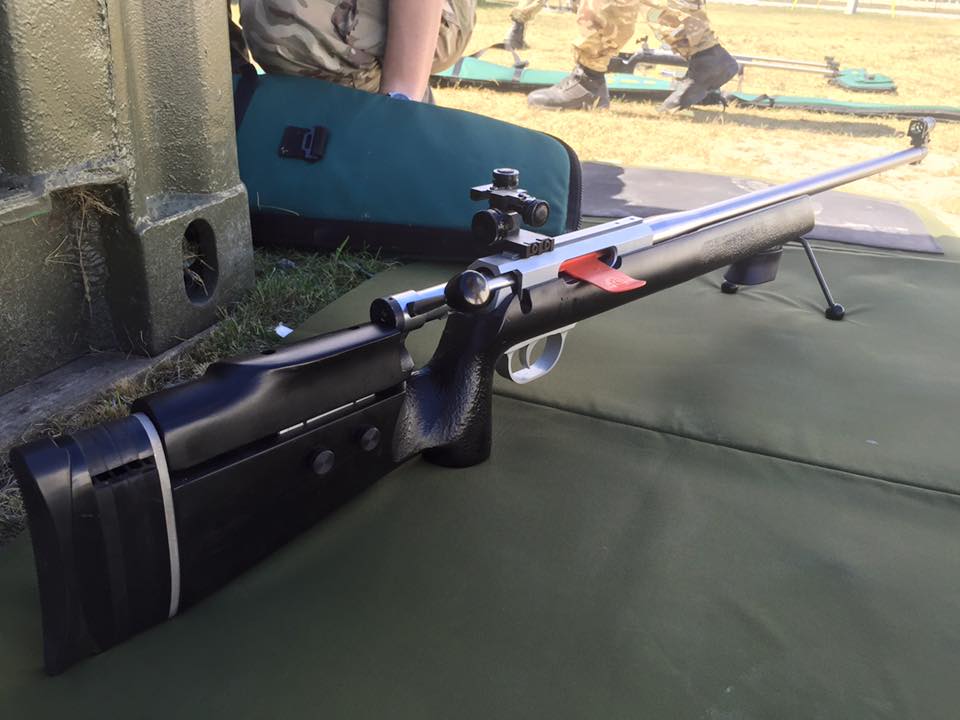
More recent cadet rifles include the Parker Hale L81A2, a 7.62×51mm heavy-barrel, bolt-action, hand-fed single-shot rifle used by UK cadet forces in competitions. The C12A1 is a similar 7.62×51mm competition rifle used by Royal Canadian Army Cadets. The L98A1 Cadet GP Rifle, a 5.56×45mm manually operated single-shot rifle similar to the L85A1, was introduced in 1987 and decommissioned in early 2009, replaced by the L98A2 which can operate in semi-automatic mode. Semi-automatic cadet rifles include the WASR-22, a .22 LR blowback-operated rifle based on the AK-47, and the Smith & Wesson M&P15-22 and SIG 522LR, both .22 LR blowback-operated rifles patterned after larger centerfire counterparts.
Reader's Guide
Cadet rifles serve a critical role in military training by providing a lower-cost, lower-recoil platform for teaching marksmanship fundamentals. Their significance lies in their ability to mimic the handling and controls of full-size service rifles while using inexpensive .22 Long Rifle ammunition, allowing for extensive practice without the expense and recoil of centerfire cartridges. The variety of cadet rifles reflects the training needs of different nations: from the Martini Cadet used by Australian cadets for over six decades, to the Soviet TOZ-8 and TOZ-17 used for decades by military and paramilitary organizations, to modern semi-automatic trainers like the Smith & Wesson M&P15-22 and SIG 522LR that replicate the ergonomics of AR-15 and SIG 55x series rifles. The legacy of cadet rifles extends beyond military use; many have been sold on civilian markets, such as the WASR-22 marketed as a 'starter' or 'trainer AK' in the United States, and the No.8 rifles disposed of by New Zealand cadet forces at auction. Conversion kits also allow standard M16 and M4 rifles to fire .22 LR ammunition for cheaper target practice. The continued use of cadet rifles in competitions like the Ashburton and Inter Service Cadet Rifle Meeting demonstrates their enduring importance in developing shooting skills.
Did You Know?
- The Martini Cadet was produced by BSA and W.W. Greener for Australian military cadets and used from 1891 to 1955.
- The Springfield Model 1922 features a 24-inch barrel and a 5-round magazine, designed to mimic the M1903 Springfield.
- The TOZ-8 was conceived in 1932 by designer-gunsmith D. M. Kochetov and serially produced at the Tula Arms Plant.
- The L98A1 Cadet GP Rifle was introduced in 1987 and began a phased decommission in early 2009.
Origins & Design Philosophy
The TOZ family traces its roots to 1927, when V. G. Selivanov and Ya. I. Kanevsky conceived the TOZ-1, a single-shot .22 Long Rifle bolt-action rifle built at the Tula Arms Plant. Production ran from the late 1920s into the early 1930s before the design was superseded. In 1932, designer-gunsmith D. M. Kochetov introduced the TOZ-8, which became the workhorse of Soviet marksmanship instruction. The design philosophy was deliberately austere: no magazine, no lugs on the bolt. Instead, locking is achieved through the charging handle itself, and a simple guide controls cartridge seating into the chamber. The trigger mechanism releases a striker that strikes the primer, with the trigger resting on receiver ledges and moving forward under spring pressure to drive the firing pin. A protective cover shields the shooter from hot gases in the unlikely event of case head separation. This mechanical simplicity was the rifle's greatest strength—trouble-free, reliable, and easy to maintain in the field.
Training Legacy Across the Soviet Union
From the early 1930s through the late 1950s, approximately one million TOZ-8 rifles rolled off the production lines at the Tula Arms Plant. These single-shot .22LR rifles became the backbone of marksmanship education across the Soviet Union, finding their way into primary schools, gunsmith workshops, and DOSAAF paramilitary organizations. Generations of Russian military, paramilitary, and police cadets first learned to handle a bolt-action rifle through the TOZ-8 and its close relatives. The rifle's open front and rear sights, straightforward bolt operation, and absence of complex mechanisms made it ideal for beginners. Even after institutional use waned, many TOZ-8s transitioned into civilian hands, where they continue to serve for small-game hunting. The rifle's enduring presence in civilian circulation speaks to a design that prioritized function over flourish and rewarded the shooter with dependable performance shot after shot.
The Repeating Rifle Evolution
The TOZ family's most significant leap came in 1956 with the TOZ-17, a .22LR bolt-action repeating rifle featuring a 5-round detachable magazine. Its appearance, sights, and overall function deliberately echoed the Mosin-Nagant, embedding the design firmly in Soviet tradition. Yet under that familiar exterior lay thoughtful engineering: twin extractors on the bolt ensured positive case ejection, while a free-floating barrel and anodized bore improved accuracy and extended barrel life. The bolt itself is notably large for a rimfire action, paired with a substantial firing pin and spring assembly, and a rear safety similar to those found on BSA Sportsman rifles. The TOZ-18 variant added a standard dovetail rail for a 2.5-power fixed-focus scope. In 1986, the TOZ-78 refined this lineage further, offering 5- and 10-round magazines and spawning specialized models: the -04 with a threaded barrel for suppressor attachment, the -05 with a heavy barrel and no iron sights, and the -06 combining a heavy barrel with threading. Still in production, the TOZ-78 line represents the family's ongoing evolution.
Sporting Variants & International Production
Beyond its military training role, the TOZ family spawned a range of sporting and hunting adaptations. The TOZ-9, designed by Kochetov as a sporting version of the TOZ-8, led to the TOZ-11 in 1946—a lightweight rifle crafted specifically for hunters and fishermen by K. I. Shihvatov. Weighing roughly two kilograms less than the TOZ-9, the TOZ-11 earned award recognition and was produced through 1957. The TOZ-16 later applied more modern manufacturing techniques to the TOZ-11's basic concept. On the precision side, the TOZ-12, also by Kochetov, upgraded the postwar TOZ-8M with an adjustable aperture sight for improved accuracy. Production also extended beyond Russia's borders: the Ukrainian firm RPC Fort manufactured the TOZ-8OPF and TOZ-12OPF, bringing these designs to a wider market. Together, these variants illustrate how a single design philosophy—simplicity, reliability, and purposeful function—could be adapted across hunting, sport shooting, and international production without sacrificing the core mechanical character that defined the TOZ family.
Gallery
Frequently Asked Questions
What is a cadet rifle?
A cadet rifle is a training firearm built for military cadets and students learning basic marksmanship and safe firearms handling. They are typically scaled-down replicas of standard-issue service rifles, most commonly chambered in .22 Long Rifle and operated with a bolt-action mechanism.
What calibers do cadet rifles come in?
While .22 Long Rifle is by far the most common choice, cadet rifles are also produced in 7.62×51mm, .310 Cadet, and 5.56×45mm NATO. The .22 LR variant dominates training programs because it cuts recoil and ammunition cost while still teaching proper technique.
How does a bolt-action cadet rifle differ from a full-power service rifle?
A bolt-action cadet rifle is essentially a lighter, lower-powered derivative of its full-service counterpart, designed specifically for instructional use. The reduced cartridge energy makes it safer and cheaper to fire in a classroom or range setting while preserving the same bolt-cycling mechanics cadets must master.
What are some well-known bolt-action cadet rifle models?
Popular examples include the Springfield Model 1922 with its 5-round magazine, the CZ 452, and the TOZ-17 featuring a 5-round detachable box magazine. The L81 A2 and L98A1 also fill this training role for various military academies around the world.
Why are cadet rifles important in military education?
Cadet rifles let trainees practice safe handling, bolt operation, and marksmanship fundamentals without the expense and recoil of full-caliber ammunition. By replicating the feel of a service weapon at reduced power, they build the muscle memory and discipline needed before cadets transition to combat arms.
More in Bolt-Action Rifles 1-24
Spotted an error? Know more?
Reader corrections go straight into our review queue. Suggest an edit · How this site is sourced