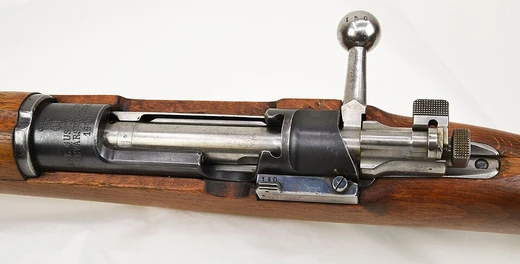
Mauser
German arms manufacturer known for influential bolt-action rifle designs.

Mauser began as the Königlich Württembergische Gewehrfabrik, a German arms maker. Starting in the 1870s, it produced bolt-action rifles and semi-automatic pistols for Germany’s military. Its designs were also exported or licensed to many countries in the late 1800s and early 1900s, where they were used as both military and civilian sporting guns. The Gewehr 98 was especially influential—widely adopted and copied, it became one of the most imitated firearm designs and the basis for many modern sporting bolt-action rifles. Around 10 million Gewehr 98-style rifles were made.
The company was founded by King Frederick I of Württemberg on 31 July 1811 as the Königliche Waffen Schmieden (Royal Weapons Forges). It was initially split between Ludwigsburg and Christophsthal, then moved to a former Augustine monastery in Oberndorf am Neckar. There, master gunsmith Andreas Mauser worked, and seven of his sons joined him. One son, Peter Paul Mauser, stood out for developing faster, more efficient methods. His older brother Wilhelm took over many of their father’s duties when Andreas fell ill.
Paul Mauser was born on 27 June 1838 in Oberndorf, then part of the independent Kingdom of Württemberg. His brother Wilhelm was four years older. Another brother, Franz, went to America in 1853 with their sister and worked at E. Remington and Sons. Paul was drafted in 1859 as an artilleryman at the Ludwigsburg arsenal, where he worked as a gunsmith. By December 1859, he had impressed his superiors enough to be placed on inactive duty and assigned to the royal factory in Oberndorf. After work, Paul and Wilhelm collaborated on a new gun system: Paul designed and engineered, while Wilhelm managed their interests with the factory.
Paul’s first invention was a cannon and its ammunition. Throughout his career, he had a knack for creating both a gun and its ammunition. After the Dreyse needle gun succeeded, Paul focused on improving that design. The brothers briefly split over differences, but when Paul developed a new turning-bolt design, Wilhelm was impressed, rejoined, and secured financing to buy machinery and continue development. The original Dreyse gun used a pin piercing the cartridge base to ignite a primer in the middle; Paul’s design ignited the charge at the base, which was superior.
Quick Facts
- Predecessor
- Königlich Württembergische Gewehrfabrik
- Founded
- 1874-07-31
- Founders
- Wilhelm and Paul Mauser
- Hq Location City
- Isny im Allgäu, Baden-Württemberg
- Hq Location Country
- Germany
- Industry
- Arms industry
- Products
- Firearms
- Defunct
- 2004
Facts from the source article.
Lore & Background
The enterprise was founded by King Frederick I of Württemberg as Königliche Waffen Schmieden on 31 July 1811. Originally located partly at Ludwigsburg and partly at Christophsthal, the factory was transferred to the former Augustine Cloister in Oberndorf am Neckar, where Andreas Mauser worked as the master gunsmith. Of his seven sons who worked with him there, Peter Paul Mauser showed an outstanding ability to develop faster and more efficient methods of operation. His older brother Wilhelm assumed many of his father's duties as he became ill.
Peter Paul Mauser, often called Paul Mauser, was born on 27 June 1838 in Oberndorf am Neckar. He was conscripted in 1859 as an artilleryman at the Ludwigsburg arsenal, where he worked as a gunsmith. By December 1859, he had so impressed his superiors that he was placed on inactive military service and assigned to the royal factory at Oberndorf. Paul engaged his older brother Wilhelm in working on a new gun system during their spare time. Paul was the engineer and designer, while Wilhelm took on the task of manager for their interests with the Oberndorf factory.
Paul's first invention was a cannon and its ammunition. Following the success of the Dreyse needle gun, Paul turned his energies to improving on that design. After Paul developed a new turning-bolt design, Wilhelm was impressed enough to rejoin the business and succeeded in obtaining the financing to purchase machinery and continue development. The Mauser rifle was accepted by the Prussian government on 2 December 1871, and was accepted for service on 14 February 1872. The Königlich Württembergische Gewehrfabrik was acquired on May 23, 1874, after an agreement between the Württemberg government and the Mausers to produce 100,000 Model 71 rifles.
Reader's Guide
Mauser designs were readily adapted as hunting rifles; in Africa, safari rifles were often made from Mausers. These rifles were often rechambered in larger rounds up to and including .50 caliber. The adaptations usually consisted of shortening the foregrip and barrel, rechambering to accommodate popular British rounds, and minor alterations to the action. In the late 19th century and early 20th century, companies that made alterations were generally Commonwealth-based. Several proprietary big-game rounds were specifically for hunting large and dangerous game. Today, large- and small-bore Mauser-derived rifles are made all over the world for the civilian market and are popular with hunters.
Surplus military Mausers, many in mint condition, have also entered the civilian market, to be purchased by collectors and gun owners. A considerable number of surplus Karabiner 98ks were available after World War II, and some were used by Schultz & Larsen in Denmark as the basis for target rifles. Some of these are still in competitive use, although with the benefit of new barrels. The strong following enjoyed by surplus military Mausers is partly a testament to their reliability and quality of manufacture. Additionally, the comparative low cost of surplus military ammunition has served to continue their use by shooting enthusiasts, however, in recent years it is becoming more difficult to obtain as stocks dry up. Vintage surplus ammunition usually requires specialized cleaning regimens to prevent aggressive and rapid metal oxidation caused by corrosive salts contained in their priming compounds.
The first Western-made handguns introduced into South Asia were made by the Mauser company, and the term has entered the lexicon in India and the surrounding regions, to mean any heavy pistol.
More in Bolt-Action Rifles 1-24
Spotted an error? Know more?
Reader corrections go straight into our review queue. Suggest an edit · How this site is sourced