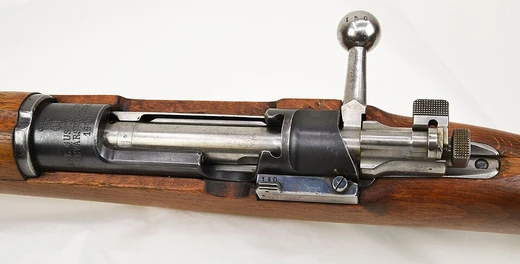
Mauser–Vergueiro
Portuguese service rifle from 1904, used in both World Wars and colonial campaigns.

The Mauser–Vergueiro is a bolt-action rifle whose design was completed in 1904 by José Alberto Vergueiro, a Portuguese Army infantry officer. Production was handled by Deutsche Waffen und Munitionsfabriken (DWM). While it was built on the Mauser 98 platform, its bolt system was taken from the Gewehr 1888 and the Mannlicher–Schönauer. Outside Portugal, it was often called the Portuguese Mauser. The rifle fired a specially developed cartridge, the 6.5×58mm Vergueiro.
In 1904, it became the standard infantry rifle of the Portuguese Army, replacing the Kropatschek m/1886, and remained in service until the Mauser 98k took over in 1939. Its official Portuguese designation was Espingarda 6,5 mm m/1904 ("Rifle 6.5mm m/1904"). A shorter, lighter carbine version was classified as Carabina 6,5 mm m/1904 ("Carbine 6.5mm m/1904"). A total of 100,000 rifles were made for Portugal. In 1906, an additional 5,000 rifles were produced for Brazil’s Federal Police, chambered in 7×57mm Mauser and built from leftover Portuguese-order parts; these were issued in Rio de Janeiro and São Paulo. During 1915, 20,000 of Portugal’s Mauser–Vergueiro rifles were sold to South Africa, which lacked enough Lee–Enfield SMLE rifles for its troops.
The rifle saw combat in World War I and in various colonial campaigns while in Portuguese and South African hands. German colonial troops in East Africa also used captured Mauser–Vergueiro rifles. However, the Portuguese Expeditionary Corps on the Western Front did not use the Vergueiro, relying instead on British weapons and equipment for logistical reasons. Although Portugal remained neutral in World War II, in 1942 Portuguese forces briefly fought Japanese occupiers in Portuguese Timor using Kropatschek rifles.
After the Portuguese Army adopted the 7.92×57mm Mauser 98k as the m/937 in 1939, many surviving Mauser–Vergueiro rifles were converted to fire the new standard cartridge. These modified rifles were designated Espingarda 8 mm m/1904-39. Markings generally stayed the same, except that on some rifles the "6,5" caliber designation was stamped over with two "X" marks—a practice apparently carried out by individual Portuguese armorers rather than as a standard procedure. Visually, the 8mm version can be told apart from the 6.5mm version by its shorter barrel, a distinctive front sight protector, and a ground-down rear sight base.
Quick Facts
- Designer
- José Alberto Vergueiro
- Origin
- Portugal
- Service
- 1904–1960s (Portugal) / 1960s–present (Limited usage)
- Used By
- Portugal / Brazil / Union of South Africa / German East Africa / International Brigades
- Wars
- 5 October 1910 revolution / World War I / Spanish Civil War / Battle of Timor / Portuguese Colonial War / Northern Mali conflict
- Is Ranged
- yes
- Design Date
- 1904
- Manufacturer
- Fábrica de Braço de Prata
- Production Date
- 1904–1945
- Number
- +100,000
- Variants
- Rifle m/1904, Carbine m/1904 and Rifle m/1904-39
- Weight
- 3.92 kg (m/1904) / 3.77 kg (m/1904-39)
Facts from the source article.
Lore & Background
The Mauser–Vergueiro replaced the Kropatschek m/1886 as the standard infantry rifle of the Portuguese Army in 1904, remaining in service until it was replaced by the Mauser 98k in 1939. In Portuguese service the weapon was officially designated Espingarda 6,5 mm m/1904. A lighter and shorter version was classified as a carbine and designated Carabina 6,5 mm m/1904. A total of 100,000 rifles were produced for Portugal. An additional 5,000 Mauser–Vergueiro rifles, chambered in 7×57mm Mauser, were produced in 1906 for Brazil's Federal Police, using leftover components from the Portuguese order and issued in Rio de Janeiro and São Paulo. In 1915, 20,000 of Portugal's Mauser–Vergueiro rifles were sold to South Africa, which had insufficient Lee–Enfield SMLE rifles to supply all of its troops.
In Portuguese and South African service it was used in combat in the First World War and in several colonial campaigns. German colonial troops in East Africa also used Mauser–Vergueiro rifles, captured from allied forces in combat. The Portuguese Expeditionary Corps on the Western Front used British weapons and equipment for logistical reasons, and so did not use the Vergueiro. Although Portugal was neutral in World War II, in 1942 Portuguese forces briefly fought against the Japanese occupation of Portuguese Timor using Kropatschek rifles.
In 1939, after the Portuguese Army had adopted the 7.92×57mm Mauser 98k as the m/937, many of the remaining Mauser–Vergueiro rifles were modified to chamber the new standard cartridge. The modified rifles were called Espingarda 8 mm m/1904-39. Markings on the modified rifles remained unchanged with the exception of the caliber designation '6,5' being stamped over on some rifles with two 'X' marks. This was apparently done by individual Portuguese armorers rather than as standard practice. The 8mm variant can be distinguished visually from the 6.5mm variant with the 1939 modifications including a shorter barrel, distinctive front sight protector and ground down rear sight base.
Reader's Guide
The Mauser–Vergueiro holds significance as Portugal's standard infantry rifle for over three decades, from 1904 until 1939, and as a notable hybrid design combining elements of the Mauser 98, Gewehr 1888, and Mannlicher–Schönauer actions. Its specially developed 6.5×58mm Vergueiro cartridge was unique to the rifle. The weapon saw combat in the First World War and in several colonial campaigns, serving both Portuguese and South African forces. German colonial troops in East Africa also used captured examples. After Portugal adopted the 7.92×57mm Mauser 98k in 1939, many surviving rifles were modified to the new caliber as the m/1904-39, extending their service life. The 7.92×57mm Mauser–Vergueiro rifle was kept in limited use in the Portuguese Army until the middle 1960s, mainly in some Overseas units. These rifles are still used in Africa, for example in the Northern Mali conflict, demonstrating their enduring legacy in regions where they were originally deployed.
Did You Know?
- The Mauser–Vergueiro was designed by Portuguese infantry officer José Alberto Vergueiro in 1904.
- It used a unique 6.5×58mm Vergueiro cartridge developed specially for the rifle.
- In 1915, 20,000 Mauser–Vergueiro rifles were sold to South Africa due to a shortage of Lee–Enfield SMLE rifles.
- Modified 8mm versions (m/1904-39) remained in limited Portuguese service until the mid-1960s.
More in Bolt-Action Rifles 1-24
Spotted an error? Know more?
Reader corrections go straight into our review queue. Suggest an edit · How this site is sourced