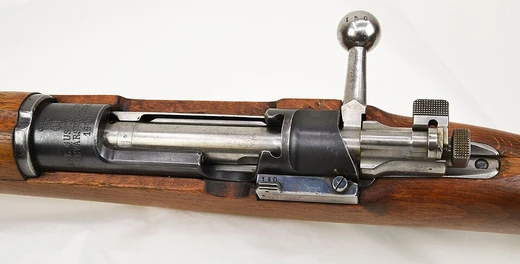
Mannlicher–Schönauer
A rotary-magazine bolt-action rifle adopted by Greece in 1903.

The Mannlicher–Schönauer is a rotary-magazine bolt-action rifle produced by Steyr Mannlicher for the Greek Army in 1903 and later used in small numbers by the Austro-Hungarian Army. Post-war it was sold for civilian use. It is notable for its distinctive rotating spool magazine and conventional turn-bolt action, which set it apart from earlier Mannlicher straight-pull designs.
Quick Facts
- Is Ranged
- yes
- Origin
- Austria-Hungary
- Designer
- Otto Schönauer & / Ferdinand Mannlicher
- Design Date
- 1900
- Manufacturer
- Steyr, Breda
- Service
- 1903–1941
- Wars
- First Balkan War / Second Balkan War / World War I / Greco-Turkish War / World War II / Greco–Italian War / Greek Resistance / Greek Civil War
- Action
- Bolt action
- Velocity
- 2223 ft/s
- Range
- ~600 m
- Weight
- 3.77 kg (1903/14) / 3.58 kg (1903/14 Carbine)
- Length
- 1226 mm (1903/14) / 1025 mm (1903/14 Carbine)
Facts from the source article.
Lore & Background
The Mannlicher–Schönauer originated from late 19th-century Mannlicher designs for the Austro-Hungarian army, which used en-bloc magazines and straight-pull bolts for obsolete large-caliber cartridges. After the introduction of smokeless powder, the Steyr factory developed new designs using modern cartridges. The bolt action was designed by Louis Schlegelmilch, based on the Mauser 71, and the rotary magazine was patented by Otto Schönauer in 1886 and again in 1900 with Ferdinand Mannlicher. The rifle features a split in the rear of the receiver that allows the bolt handle to pass through and doubles as an emergency locking lug.
The original design was introduced at the World Fair as the Model 1900. The Greek Army ordered two versions in 1903: a long rifle of 1230 mm total length and a carbine of 950 mm for cavalry and non-infantry troops. The 6.5×54mm MS cartridge was ballistically efficient, improving accuracy at moderate ranges. The rifle was manufactured to high standards with tight tolerances, raising costs but improving reliability. Iron sights were graduated up to 2000 m.
Greece issued four main contracts: the original Y1903 (supplied 1906–07, about 130,000 rifles and carbines), a 1914 batch of 50,000 Y1903/14 rifles with a full handguard, about 105,000 Breda-marked Y1903/14/27 rifles from 1927, and 25,000 Y1903/14/30 carbines directly from Steyr in 1930. During World War I, Austria sequestered some 1914-contract rifles for its own use. After the dissolution of the Austro-Hungarian Empire, these were passed as war reparations to Greece.
Reader's Guide
The Mannlicher–Schönauer served as the main small arm for the Greek military during some of the most active years of its modern history, including the Balkan Wars, World War I, the Asia Minor Campaign, World War II, and the Greek Civil War. Despite its high quality and durability, it was not a commercial success for export, due to its unusual caliber, cost, and the fact that no major power adopted it. Other foreign Mannlicher clients preferred the M1895 or simpler turn-bolt rifles. The Portuguese military favored it but deemed it too expensive, adopting the locally designed Mauser-Vergueiro instead.
A civilian version introduced in 1903 proved popular with hunters. In Great Britain, the 6.5×54 cartridge fell into disfavor after the 1963 Deer Act because its muzzle energy failed to meet legal minimums. The most significant modification came in 1925 with a lengthened action to accommodate cartridges like .30-06 Springfield, .270 Winchester, and various magnums for the U.S. and world markets. Production continued in various forms until 1972, interrupted by World War II and resuming in 1950 with the MS-1950 model. The rifle also inspired Greek designs such as the Philippidis gun, which was rejected in favor of the Mannlicher–Schönauer after political controversy, and the Rigopoulos rifle, which aimed to convert existing Mannlicher–Schönauer rifles into more modern weapons but was never completed due to war.
Did You Know?
- During World War I, Austria sequestered some Mannlicher–Schönauer rifles manufactured for Greece under the 1914 contract.
- A civilian version introduced in 1903 remained in production until 1972, with a lengthened action introduced in 1925 for larger cartridges.
More in Bolt-Action Rifles 1-24
Spotted an error? Know more?
Reader corrections go straight into our review queue. Suggest an edit · How this site is sourced