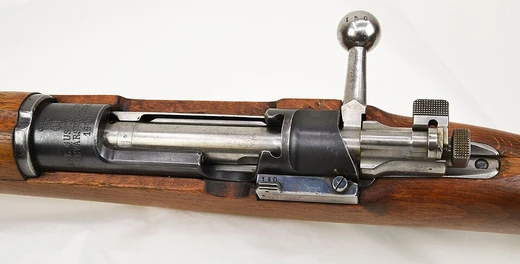
M1871 Beaumont
Dutch service rifle, one of Europe's first metallic-cartridge military arms.

The M1871 Beaumont and its variants served as the standard-issue rifle for the Dutch armed forces from 1871 to 1895, and continued in use with the Royal Netherlands East Indies Army into the early 1900s. It was among the first military rifles adopted by a European power to fire a metallic cartridge. Its bolt featured a split design reminiscent of the French Chassepot, with a distinctive leaf mainspring housed inside the two-piece bolt handle—a mechanism later copied in Japan’s Murata Type 13 and Type 18 rifles.
In the 1860s, as European armies increasingly adopted breechloaders, Dutch officials sought to modernize their own rifle. In 1867, the Dutch army temporarily converted its muzzleloaders using the Snider–Enfield breechloading system while a new rifle was selected. After trials in 1870 of designs from Peabody, Remington, Cooper, Comblain, Jenks, and Benson-Poppenburg, the Dutch chose the Beaumont rifle, designed by Edouard de Beaumont.
The rifle was not adopted for cavalry, as its bolt made it awkward to carry slung across the back; instead, cavalry units received the Remington Rolling block rifle. Several foreign armies showed interest. The French military tested 150 Beaumont rifles between 1872 and 1874, and tests were also conducted in Germany, but neither adopted it. The Royal Danish Army tested the rifle in 1887. During World War I, an unknown number of Beaumont rifles—including shortened and burnished Beaumont-Vitali variants—were used by German second-line troops, likely seized from arms dealers in Liège.
The M1873 Colonial Rifle was developed for deployment to the Dutch East Indies, replacing earlier percussion and centerfire rifles designed by Lieutenant F.W.H. Kuhn. Early shipments were returned to Europe because the rear sights lacked distance markings. In total, 35,000 colonial rifles were produced. To resist tropical humidity, the metal parts—barrel, breech, sights, and bayonet—were browned. Unlike rifles kept in Europe, colonial models were not updated with newer cartridges, upgraded sights, or a magazine.
A cavalry version was used from 1898 to 1914 by units such as the Mangkoe-Nagoro Legion. Between 1899 and 1910, many rifles were shortened for the Corps Armed Police. The Pupil Rifle 1878 and Cadet Rifle 1878 were introduced for training youths.
Quick Facts
- Origin
- Netherlands
- Is Ranged
- yes
- Service
- 1871–1895
- Used By
- Netherlands / Chile / Ethiopia / Kingdom of Bavaria
- Designer
- Edouard de Beaumont
- Design Date
- 1869
- Manufacturer
- Edouard de Beaumont; Simson, Göbel and Bornmüller; P. Stevens; Workshop for Portable Weapons; G. Mordent Company; Manufacture d'Armes
- Production Date
- 1869–1880
- Number
- 138,000
- Weight
- M1871 Rifle: 4.415 kg / M1871/88: 4.55 kg / Colonial Rifle: 4.415 kg
- Length
- M1871, M1873, M1871/88 models: 1320 mm / Cadet: 1150 mm / Navy carbine: 1100 mm / Cavalry carbine: 1030 mm / Pupil: 1020 mm
- Cartridge
- 11.3x50mmR or 11x52mmR
Facts from the source article.
Lore & Background
Following the successful introduction of breechloading rifles in European armies in the 1860s, Dutch officials sought to modernize its service rifle. In 1867, the Dutch army converted its muzzleloader rifles using the Snider–Enfield breechloading system until a new rifle could be chosen. In 1870, after trials of rifles from companies including Peabody, Remington, Cooper, Comblain, Jenks and Benson-Poppenburg, the Dutch army selected the Beaumont rifle designed by Edouard de Beaumont. The rifle was not adopted for cavalry use due to the bolt making it difficult to carry while slung across the back; cavalry troops received the Remington Rolling block rifle.
Several armies expressed interest in the design. There were 150 rifles tested by the French military between 1872 and 1874, and others tested in Germany, but the Beaumont was not adopted by either service. The Royal Danish Army also tested the rifle in 1887. During the First World War, an unknown number of Beaumont rifles were used by German (at least Bavarian) second-line troops, including Beaumont-Vitali rifles that were shortened and burnished. It is likely that the weapons were seized from arms dealers in Liège.
Variants included the M1873 Colonial Rifle for the Dutch East Indies, with browned metal to prevent corrosion; a cavalry version used between 1898 and 1914; the Pupil Rifle 1878 and Cadet Rifle 1878 for training youths; the M1871/79 Rifle with modifications including a new cartridge, modified extractor, removal of the safety, and updated rear sights; Kamerschietoefeningen (KSO) rifles for indoor exercises; fencing models; and the M1871/88 Beaumont-Vitali, which added a 4-round Vitali magazine to around 60,000 existing rifles.
Reader's Guide
The M1871 Beaumont represents a transitional period in military firearms, being one of the first European service rifles to adopt a metallic cartridge. Its split-bolt design, influenced by the Chassepot, and its unique leaf mainspring inside the bolt handle later appeared in Japanese Murata Type 13 and Type 18 rifles, showing its design influence beyond the Netherlands. The rifle's service life extended from 1871 through the early 20th century, with the Beaumont-Vitali magazine variant serving as a stopgap measure until the adoption of the Steyr Geweer M. 95 in 1895. The colonial variant saw extended use in the Dutch East Indies into World War II, and some rifles were used by German second-line troops during World War I. The rifle's legacy includes its role in the War of the Pacific and World War I, and its conversion into smoothbore shotguns for civilian use, as well as the continued use of KSO and fencing rifles until May 1940.
Did You Know?
- The Beaumont's bolt used a unique leaf mainspring inside the two-piece bolt handle, later used by the Murata Type 13 and Type 18 rifles in Japan.
- The M1871/88 Beaumont-Vitali could fire up to 14.5 rounds per minute using a clip-fed 4-round Vitali magazine.
- Colonial rifles for the Dutch East Indies had their metal browned to prevent corrosion in tropical humidity.
Frequently Asked Questions
What is the M1871 Beaumont?
It is a bolt-action military rifle designed by Edouard de Beaumont and adopted as the standard infantry weapon for the Dutch armed forces in 1871. It earned its place in history as one of the earliest European service rifles to chamber a metallic cartridge instead of a paper one.
What makes the M1871 Beaumont's bolt mechanism notable?
The bolt is split into two pieces and houses a leaf mainspring inside the handle, a layout clearly inspired by the French Chassepot system. The design proved so effective that Japan later replicated it in the Murata Type 13 and Type 18 rifles.
What cartridge does the M1871 Beaumont fire, and how fast is it?
The rifle was originally chambered for a metallic cartridge, with later variants using the 1879 cartridge, which was comparable to the French Fusil Gras mle 1874 and the German Mauser Model 1871. The upgraded M1871/88 Beaumont-Vitali pushed muzzle velocity to roughly 1,444 feet per second.
What happened to the M1871 Beaumont after the Netherlands retired it?
The Dutch military phased the rifle out around 1895, but the Royal Netherlands East Indies Army continued fielding it well into the early 1900s. The final evolution, the M1871/88 Beaumont-Vitali, added a four-round Vitali magazine and raised the practical rate of fire to about 14.5 rounds per minute.
Why is the M1871 Beaumont considered important in firearms history?
It placed the Netherlands among the first European powers to standardize a metallic-cartridge military rifle, a key step in the transition away from paper cartridges. Its split-bolt engineering also left a design legacy that outlived the weapon itself, reappearing in Japanese military arms decades later.
More in Bolt-Action Rifles 1-24
Spotted an error? Know more?
Reader corrections go straight into our review queue. Suggest an edit · How this site is sourced