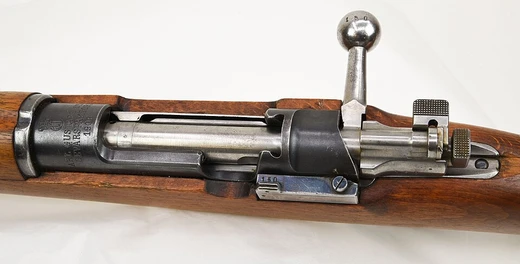
Terry-Norman rifle
A converted muzzleloader bridging Russian military modernization.

The Terry-Norman rifle, a breech-loading firearm from 1865, emerged from a collaboration between an English gunsmith named Terry and a Russian gunsmith from Tula named Norman. Terry originally designed a mechanism with the breech on the side; Norman improved it by placing the breech on top. Their combined work gave the rifle its name. It was created to convert existing muzzle-loading rifled muskets into breech-loaders, a project undertaken by the Imperial Russian Army as part of a broader modernization push following the Crimean War. The rifle was accepted for production by War Minister Dmitry Milyutin in 1866, though he considered it a temporary solution. Around 62,000 were made before it was replaced in 1867 by the more advanced Carle rifle.
The rifle used a simple rotating bolt but kept the percussion cap mechanism from the older M1856 musket. This kept production simple and cheap but slowed the firing rate to 5–6 rounds per minute, compared to 8–12 rounds for rifles like the Chassepot or Dreyse needle gun. In some ways, it resembled early models of the American Sharps rifle. According to Fedorov, the rifle also served as a test to see if Russian arms plants could manufacture breech-loading designs.
Despite its brief adoption, the Terry-Norman saw action. It was issued to frontier districts including Turkestan, West Siberia, East Siberia, Orenburg, and the Caucasus. It was used in several Turkestan campaigns: the 1868 Bukhara campaign, the 1871 Kuldzhin campaign, the 1873 Khivan campaign, the 1875–76 campaign against the Khanate of Kokand, and the 1879 and second battles of Goek Tepe. During the Russo-Turkish War of 1877–1878, most Russian troops carried more modern rifles like the Krnka and Berdan, but the Terry-Norman was still used, especially in the Caucasian theatre. There, its ability to fire up to five rounds per minute gave it an advantage over muzzle-loaders.
Quick Facts
- Origin
- United Kingdom / Russian Empire
- Is Ranged
- Yes
- Service
- 1866–1886
- Used By
- Russian Empire
- Wars
- Russian conquest of Central Asia / Russo-Turkish War
- Designer
- Terry (England) / Norman (Russia)
- Design Date
- 1865
- Developed From
- M1856 six-line rifle musket
- Production Date
- 1866–1867
- Number
- ~ 62 000
- Weight
- 4,4 kg
- Length
- 1340 mm (without bayonet)
Facts from the source article.
Lore & Background
Following the Crimean War, the Imperial Russian Army sought to modernize its weaponry. The Main Artillery Directorate aimed to convert the existing M1856 rifled muskets into breechloading rifles, testing dozens of mechanisms. The Terry-Norman design was one of the more successful. English gunsmith Terry originally designed a breech located on the side of the rifle; Russian gunsmith Norman improved it by placing the breech on top. Their shared contribution gave the rifle its name.
The Terry-Norman rifle used a simple rotating bolt mechanism but retained the percussion cap mechanism from the M1856 rifle. This kept manufacturing simple and cost-efficient, but required the cap to be replaced manually after each shot, limiting the rate of fire to 5–6 rounds per minute—slower than contemporaries like the Chassepot or Dreyse needle gun. In 1866, the rifle was presented to Minister of War Dmitry Milyutin, who accepted it as a temporary measure. Around 62,000 rifles were produced before it was replaced by the Carle rifle in 1867. According to Fedorov, the rifle was also adopted to test the manufacturing capabilities of Russian arms plants.
Reader's Guide
The Terry-Norman rifle holds significance as part of Russia's post-Crimean War military modernization. It represented a pragmatic solution to the challenge of rearming a large army with limited industrial capacity: converting existing muzzleloading muskets rather than manufacturing entirely new breechloaders. Though quickly superseded by the Carle rifle, its production of over 60,000 units demonstrated that Russian arms plants could produce breechloading mechanisms at scale.
The rifle saw limited but real combat use. It was distributed to frontier military districts including Turkestan, West Siberia, East Siberia, Orenburg, and the Caucasus, and was used in several campaigns of the Russian conquest of Central Asia, such as the 1868 Bukhara campaign, the Khivan campaign of 1873, and the battles of Goek Tepe. During the Russo-Turkish War of 1877–1878, it was notably employed in the Caucasian theatre, with around 4,000 rifles in service. After the war, some Terry-Norman rifles were repurposed for big-game hunting. Its legacy lies in bridging the gap between muzzleloading and more advanced breechloading systems in Russian service.
Did You Know?
- The Terry-Norman rifle was developed in 1865 by English gunsmith Terry and improved by Russian gunsmith Norman.
- It retained the percussion cap mechanism from the M1856 rifled musket, requiring manual cap replacement after each shot.
- Approximately 62,000 Terry-Norman rifles were produced before being replaced by the Carle rifle in 1867.
- The rifle saw use in the Russian conquest of Central Asia and the Russo-Turkish War of 1877–1878.
More in Bolt-Action Rifles, Part 4 1-24
Spotted an error? Know more?
Reader corrections go straight into our review queue. Suggest an edit · How this site is sourced