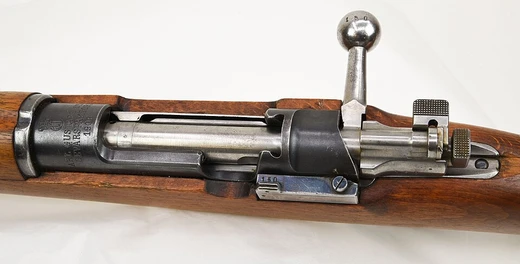
Wz. 35 anti-tank rifle
A secret Polish bolt-action anti-tank rifle used in 1939.

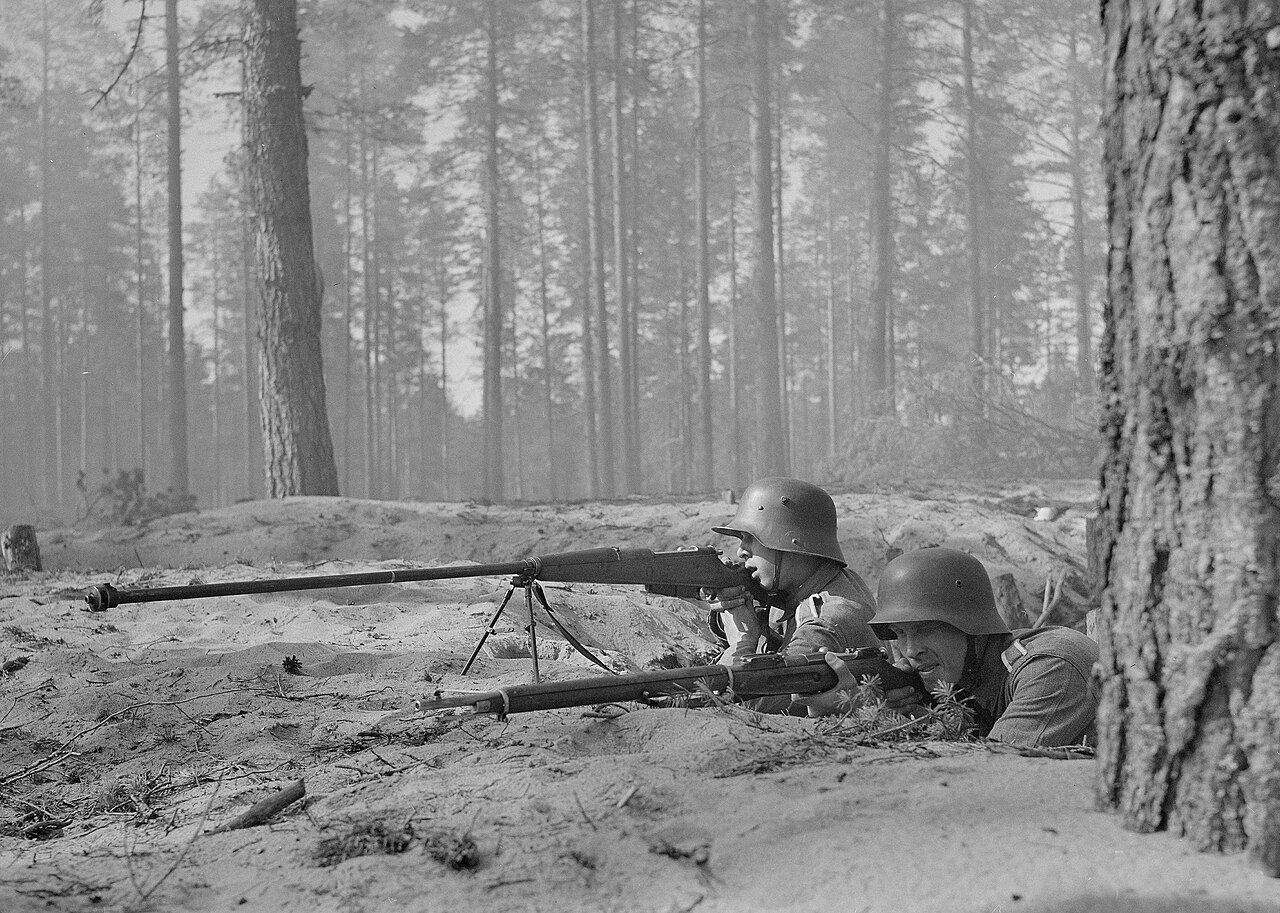
SA-kuva is a photograph archive site storing solely photographs from the 20th-ce · Public domain
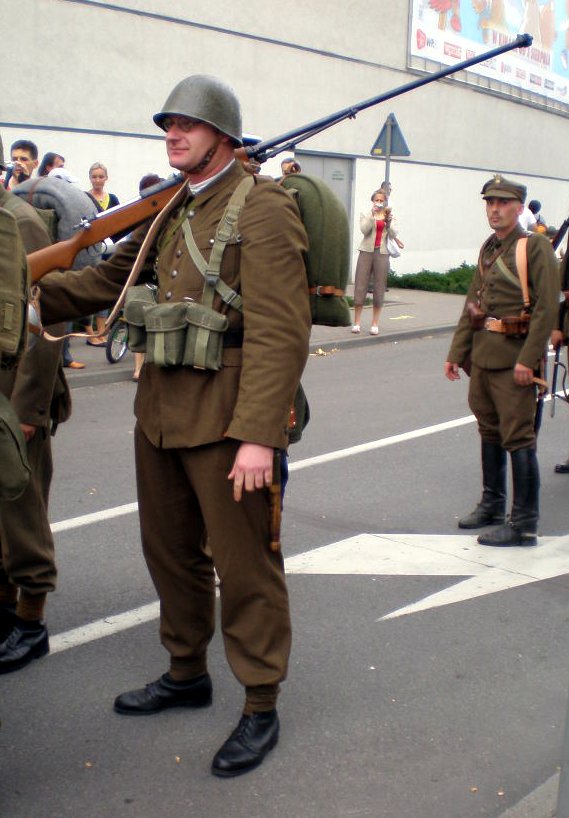
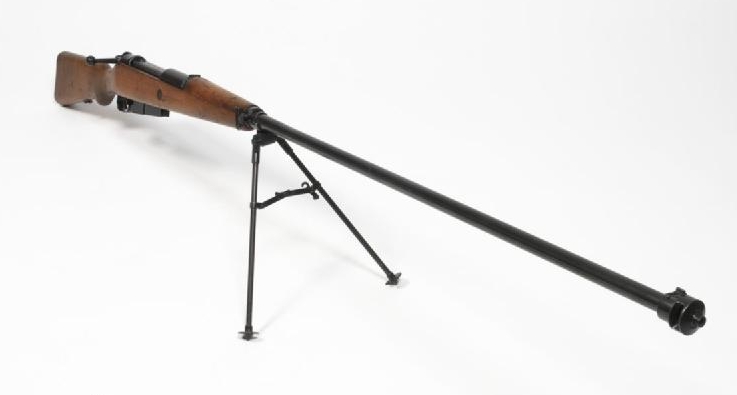
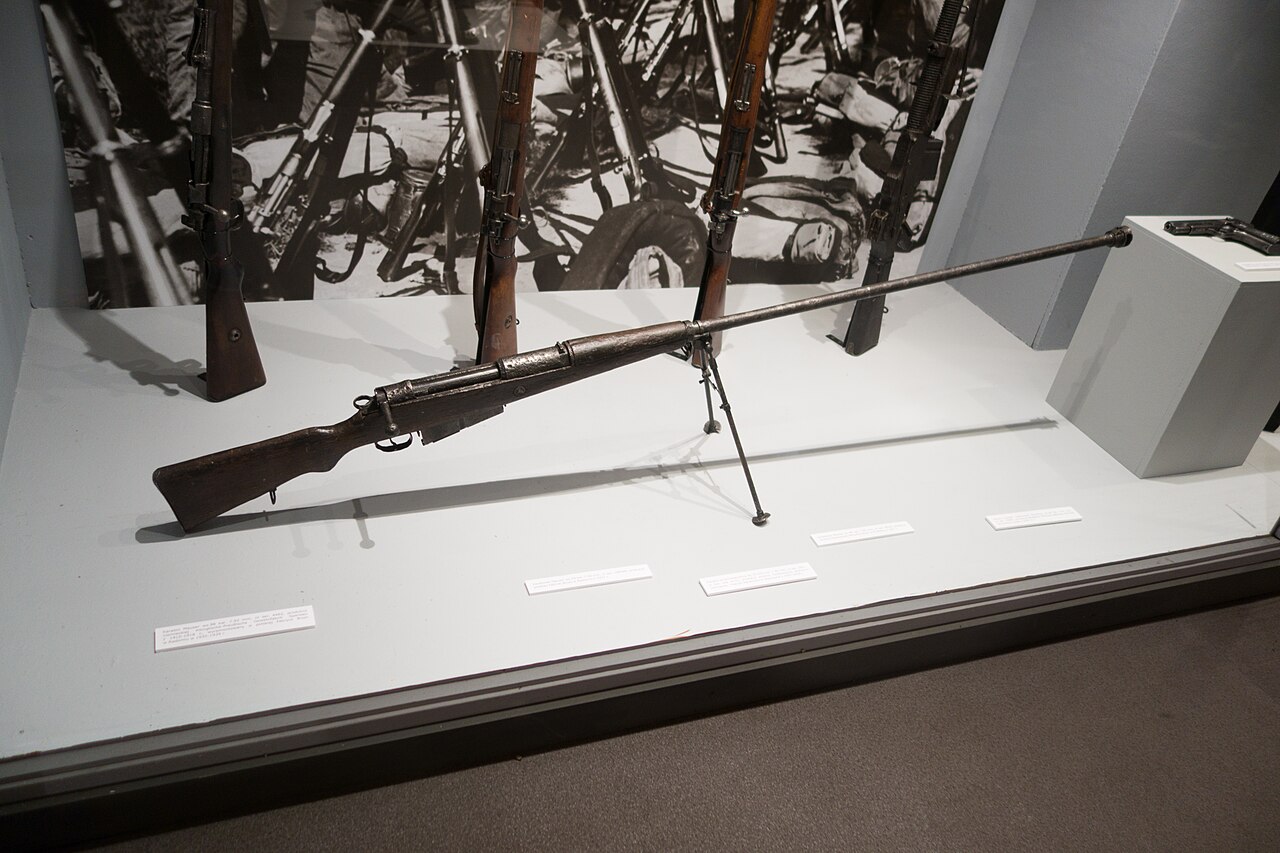
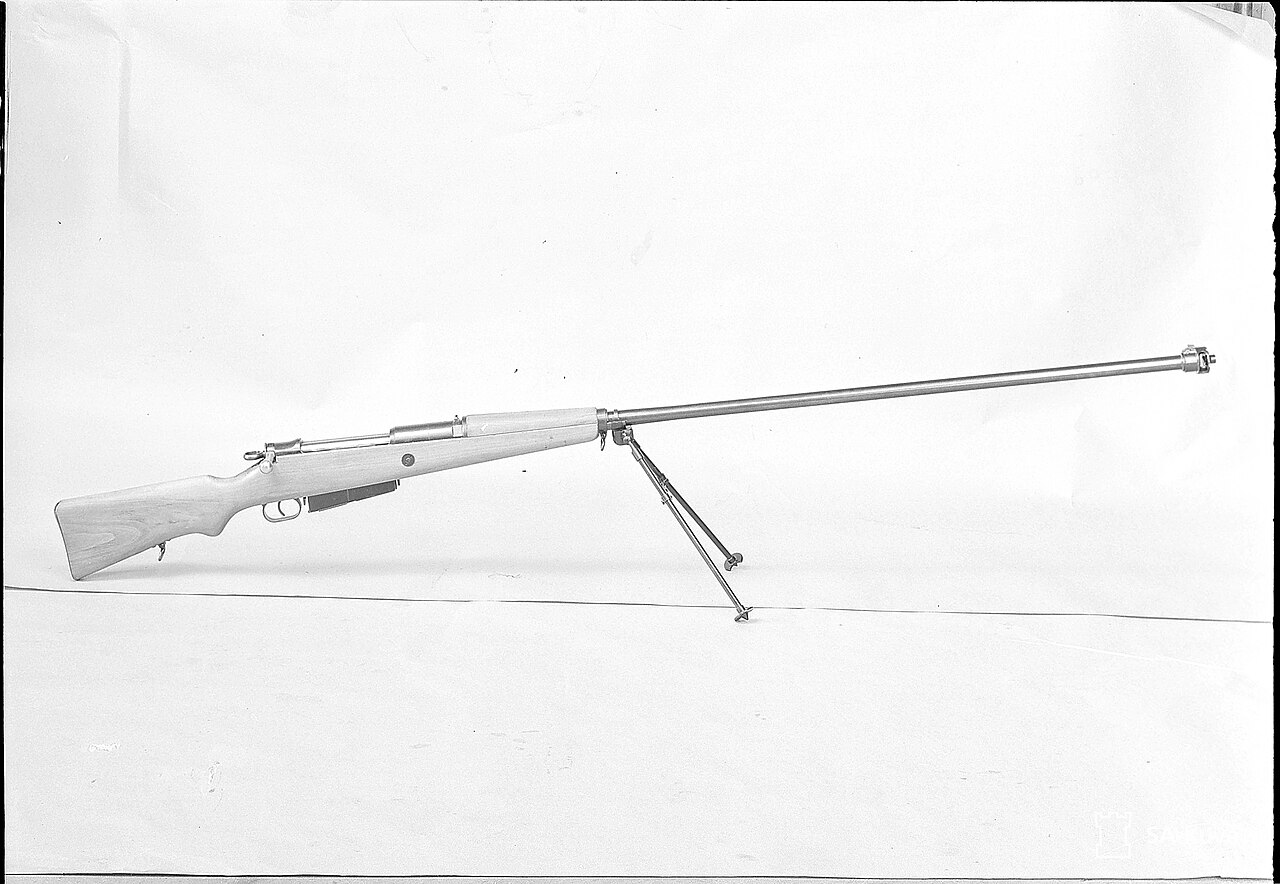
The wz. 35 was a Polish anti-tank rifle chambered in 7.92 mm, used by Polish forces during the 1939 campaign and later adopted by several Axis armies. Its designation came from the design year, 1935, and it was also called "Uruguay" (or kb Ur) after the country, as well as by the name of its designer, Józef Maroszek. The rifle was a top-secret project; neither German nor Soviet intelligence knew of its existence. It operated as a bolt-action rifle fed from a four-round box magazine.
Secrecy was maintained through various codenames. Until mobilization in 1939, combat-ready rifles were stored in sealed crates labeled "Do not open! Surveillance equipment A.R." or "Optical equipment." The codename "Uruguay" suggested the equipment was being exported there, but soldiers never used this name in the field; it became popular only in postwar publications. The secrecy was effective, and postwar literature often claimed it prevented most rifles from being used. Newer research, however, shows that the majority of rifles distributed to units saw combat. On 15 July 1939, an order was issued to present the rifle to selected marksmen from all infantry and cavalry units, with brief training. Estimates suggest about 2,100 marksmen were trained. The rifle was simple to operate, similar to a standard Mauser, and each crate contained a manual.
After Poland fell, the German army captured many wz. 35 rifles, designating them Panzerbüchse 35 (polnisch) (PzB 35(p)). The Italian army later received 800 of these captured weapons, calling them fucile anticarro 35(P). Both names translate roughly to "anti-tank rifle model 1935 (Polish)." In early 1940, Krystyna Skarbek and fellow Polish couriers smuggled one rifle across the Tatra Mountains into Hungary for the Allies, with its stock and barrel sawed off. It never entered Allied service. Polish forces destroyed the drawings and specifications when defeat became certain.
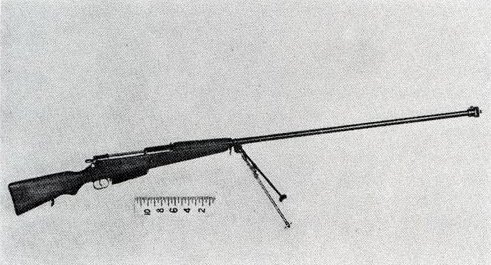
The rifle resembled a standard rifle but had a longer barrel supported by a bipod at the front of the wooden stock. It used a Mauser-style bolt action and a four-round box magazine. A muzzle brake absorbed about 65% of the shot energy, making recoil comparable to a standard Mauser, despite the cartridge carrying more than twice the propellant. Iron sights were fixed for 300 meters.
Quick Facts
- Origin
- Poland
- Is Ranged
- yes
- Service
- 1939 (Polish Military Service) · 1939–1945 (See Users)
- Used By
- Poland / See Users
- Wars
- World War II / Polish Campaign / North African Campaign / Invasion of Soviet Union
- Designer
- Józef Maroszek
- Design Date
- 1935
- Manufacturer
- Państwowa Fabryka Karabinów
- Production Date
- 1938–1939
- Number
- est. 6,500
- Variants
- None. Various redesignations under different armies
- Weight
- 10 kg (loaded) · 9.5 kg (unloaded) · 9.0 kg (unloaded and without bipod)
Facts from the source article.
Lore & Background
The wz. 35 was developed in response to a Polish General Staff search for a light anti-tank weapon in the late 1920s. In 1931, Dr. Tadeusz Felsztyn proposed a high-velocity, low-caliber anti-tank cartridge inspired by German Halger hunting cartridges. After tests of a purchased Halger 7.1 mm rifle in October 1931, work began at the State Armament Factories in Warsaw and a state powder factory at Pionki. A new 7.92×10⁷ DS cartridge was developed, based on the standard 7.92×57mm Mauser round but with an extended case. The rifle itself was designed by Józef Maroszek, based on his thesis project Karabinek KP-32, a reworked and simplified Mauser Gewehr 98 scaled up to handle the new cartridge. First tests in Brześć and Pionki showed it could penetrate a 15 mm steel plate at 300 meters. The committee accepted the design on November 25, 1935, and the Ministry ordered 7,610 rifles; it is estimated more than 6,500 were delivered by September 1939.
The rifle resembled a standard Mauser with a longer barrel supported by a bipod at the front of the wooden stock. It lacked a pistol grip. The barrel had a muzzle brake that absorbed about 65% of shot energy, making recoil comparable to a standard Mauser. It fired a full metal jacket bullet with a lead core weighing 14.579 g. Instead of penetrating by punching through armor, the bullet flattened against the plate, transferring kinetic energy to cause spalling on the interior surface, ejecting a roughly 20 mm diameter fragment. The rifle was kept in sealed crates marked 'Do not open! Surveillance equipment A.R.' or 'Optical equipment' until mobilization in 1939. On 15 July 1939, an order was issued to present the rifle to selected marksmen from all infantry and cavalry units, with an estimated 2,100 marksmen trained.
Reader's Guide
The wz. 35 was the main anti-tank weapon of an infantry platoon, with each infantry company and cavalry squadron equipped with three rifles, each operated by a two-man team. Despite its secrecy, newer research indicates that the majority of rifles distributed to units were used in combat, contrary to postwar beliefs that secrecy prevented their use. After the fall of Poland, the German army captured large numbers and designated it the Panzerbüchse 35 (polnisch); the Italian army later received 800 captured weapons, designating them fucile anticarro 35 (polacco). In early 1940, one rifle with its stock and barrel sawed off was smuggled out of Poland across the Tatra Mountains into Hungary for the Allies by Krystyna Skarbek and fellow Polish couriers, but it never saw service with the Allies. The drawings and specifications had been destroyed by the Poles when defeat became inevitable. The rifle's legacy lies in its innovative use of spalling rather than direct penetration, a concept similar to modern HESH rounds, and in its effective secrecy that kept it unknown to German and Soviet intelligence until its use in combat.
Did You Know?
- The wz. 35 was codenamed 'Uruguay' to disguise it as surveillance equipment being exported.
- Its bullet caused spalling inside armor, ejecting a roughly 20 mm diameter fragment rather than penetrating directly.
- One rifle was smuggled out of Poland into Hungary in early 1940 by Krystyna Skarbek.
Design & Development
Captain Henry C. Boys, a designer at the Royal Small Arms Factory in Enfield and member of the British Small Arms Committee, led the creation of what would bear his name. The project was originally dubbed "Stanchion," but after Boys died in November 1937—just days before the rifle received its service approval—it was renamed in his honour. The finished weapon was a bolt-action, five-round magazine rifle of considerable bulk, fitted with a front bipod and a separate grip beneath a padded butt. To tame the violent kick of its 0.55-inch (14 mm) cartridge, engineers incorporated a muzzle brake, allowed the receiver to slide along the frame, and attached a shock absorber at the rear. The round itself was an adaptation of the .50 BMG, with a belt added and a 47.6-gram (735-grain) projectile. Despite these mitigations, the recoil remained punishing; users reported neck strains and bruised shoulders, and the weapon was almost never fired without being braced on its support. Maintenance was further complicated by numerous small, narrow-slotted soft-steel screws driven tightly into the body.
Early War Effectiveness
The Boys rifle found its most natural role in the opening years of the Second World War, when it could reliably defeat the thinner armour of light tanks and armoured cars. In France, North Africa, and Norway, it proved effective against Panzer I, Panzer II, and early Panzer III models. Britain also shipped large quantities to Finland in 1939 and 1940, where Finnish troops welcomed the weapon because it could punch through Soviet T-26 tanks encountered in numerous engagements during the Winter War. The original W Mark 1 ammunition, a 60-gram (930-grain) armour-piercing projectile launched at 747 metres per second, could penetrate roughly 23.2 millimetres of armour at 100 yards—sufficient for the frontal plate of a half-track or the side and rear of a light tank. Against unarmoured infantry targets the effective range extended considerably further. The rifle's three principal variants reflected different production needs: the Mark I with its circular muzzle brake and T-shaped monopod built at BSA in England, the Mk I* with a rectangular brake and V-shaped bipod manufactured by John Inglis and Company in Toronto, and a shortened 30-inch-barrelled version without a muzzle brake intended for airborne units.
Decline and Replacement
As German and Italian vehicle armour thickened through the mid-war period, the Boys rapidly lost its relevance as a dedicated anti-tank weapon. The shortened airborne variant, deployed in Tunisia in 1942, proved completely ineffective because the reduced barrel length cut projectile velocity below useful levels. The rifle's considerable weight and unwieldy profile further limited its practicality in the field. The weapon's reputation had deteriorated so severely after the Battle of France that the Canadian government commissioned Walt Disney Studios to produce a 1942 training film, Stop That Tank!, specifically to counter what was described as the rifle's "jinx" image among troops. In the European theatre the Boys was formally superseded by the PIAT hollow-charge projector in 1943, which first saw action during the Allied invasion of Sicily. For roles against bunkers, machine-gun nests, and lightly armoured vehicles, the U.S. M2 Browning .50-calibre machine gun quickly displaced the Boys in British and Commonwealth service, offering equal or superior penetration plus the ability to ignite thin-skinned vehicles with incendiary rounds and to engage aircraft. Even the Special Air Service, which had made use of captured and surplus weapons for jeeps and reconnaissance vehicles, discarded their Boys rifles in favour of M2 Brownings or the Italian 20 mm Breda cannon.
Pacific Service and Later Roles
In the Pacific theatre the Boys rifle served as a standard-issue anti-armour weapon for British and Commonwealth forces attempting to halt the Japanese advance. At Milne Bay, at least one of two Type 95 tanks was perforated by multiple Boys rounds. During the Battle of Jitra, a gunner of the 1/14th Punjabi Regiment used the weapon to knock out two light Japanese tanks and block the bridge along which the Japanese were advancing. In the urban combat of the Battle of Singapore, the 1st Battalion Cambridgeshire Regiment reported the rifle was very useful for punching holes through walls during street fighting. The U.S. Marine Corps had purchased Canadian-made Boys rifles before the attack on Pearl Harbor, and Marine Raider battalions employed them with limited success against enemy bunkers. After the Pacific war ended, the Royal Malay Regiment continued to employ the Boys against communist insurgents during the Malayan Emergency, demonstrating that even as it was phased out in European service, the weapon retained a niche in counter-insurgency and close-quarters roles well into the post-war period.
Gallery
Frequently Asked Questions
What is the Wz. 35 anti-tank rifle?
It is a Polish bolt-action anti-tank rifle designed in 1935 by Józef Maroszek, chambered in 7.92 mm, and employed by Polish forces during the 1939 campaign before being adopted by several Axis armies.
Why is the Wz. 35 nicknamed "Uruguay" or "kb Ur"?
The rifle went by the codename "Uruguay" (abbreviated "kb Ur") as part of the secrecy measures surrounding its development, and it was also informally referred to by its designer's surname, Maroszek.
What round does the Wz. 35 fire and at what velocity?
It launches a 7.92 mm cartridge at a muzzle velocity of 1,275 m/s, with a practical effective range of roughly 300 meters when using its fixed iron sights.
How is the Wz. 35 fed and loaded?
The rifle uses a four-round box magazine, consistent with the bolt-action operating system it employs.
Why was the Wz. 35 kept top secret?
The project was classified so heavily that neither German nor Soviet intelligence ever learned of its existence, and combat-ready rifles were stored under codenames until Polish mobilization in 1939.
More in Bolt-Action Rifles, Part 4 1-24
Spotted an error? Know more?
Reader corrections go straight into our review queue. Suggest an edit · How this site is sourced