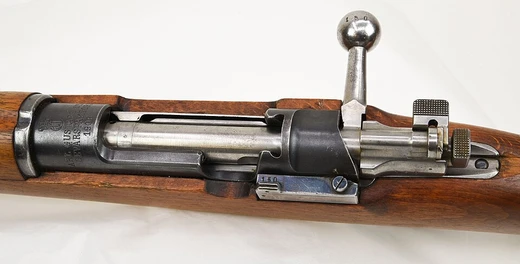
Karabinek wz. 1929
Polish short rifle based on the German Kar98AZ, used by Poland and Germany.

The Karabinek wz. 1929 (kbk wz. 29) was a Polish bolt-action short rifle based on the German Kar98AZ, adopted to standardize the Polish Army's diverse inventory after World War I. It is notable for its Mauser action, distinctive front sight protective ears, and production that continued under German occupation during World War II.
Quick Facts
- Origin
- Poland
- Is Ranged
- yes
- Service
- 1930−1945
- Design Date
- 1929
- Manufacturer
- Państwowa Fabryka Karabinów / Fabryka Broni
- Number
- 634,000
- Mass
- 4.0 kg
- Length
- 1100 mm
- Part Length
- 600 mm
- Cartridge
- 7.92×57mm Mauser
- Caliber
- 7.92 mm
Facts from the source article.
Lore & Background
After regaining independence in 1918, the Polish Army inherited a chaotic mix of rifles from occupying powers, including Russian Mosin–Nagants, Austrian Steyr-Mannlichers, German Gewehr 98s, French Berthiers and Lebels, Japanese Arisakas, and British Lee–Enfields. By the end of the Polish-Soviet War in 1921, the army used approximately 24 types of guns and 22 rifles firing different ammunition. To reduce logistical difficulties, Poland sought a single rifle type. Access to the Danzig Arsenal under the Treaty of Versailles facilitated adoption of the Mauser 98 action, leading to production of the wz. 98 beginning in July 1922. Production stopped two years later as the military sought an intermediate-length rifle based on combat experience. The Karabiner 98a was tested but found unfit for infantry use due to a weak bayonet mount and small-ring action. Following the shift to large-ring carbines with 600 mm barrels and Gewehr 98-style bayonet lugs, the wz. 29 design was finalized in 1929. It used the wz. 98 action with a shortened stock and barrel, stronger alloys, a reinforced chamber, and increased dimensional tolerance for part interchangeability. Infantry models had straight bolt handles; cavalry models had curved handles with a stock cutout. Production began in 1930 at the National Arms Factory in Radom and continued until September 1939, with about 264,000 carbines produced including exports. During the occupation of Poland, production continued under German supervision until 1942, supplying nearly 370,000 rifles to the Wehrmacht as the Gewehr 29(p). The wz. 29 was used by the Polish Army in the September Campaign and later by the Polish Underground and German forces.
Reader's Guide
The Karabinek wz. 1929 represents Poland's effort to modernize and standardize its military small arms after the logistical chaos of the post-independence period. Its design, based on the Mauser 98 action but adapted to an intermediate length, reflected lessons from World War I and the Polish-Soviet War. The rifle's production continued under German occupation, with nearly 370,000 supplied to the Wehrmacht as the Gewehr 29(p), demonstrating its reliability and the value of the Radom factory. The wz. 29 was easier to handle than the earlier wz. 98 and effective at 300–400 m, though it required frequent cleaning to avoid jams. Its export to countries such as China and the Spanish Republic, as well as failed bids like the offer to Persia, show its international reach. The Gewehr 29/40 variant, a clone of the Karabiner 98k built at Radom under Steyr control for the Kriegsmarine and Luftwaffe, further underscores the rifle's adaptability. The wz. 29 remained in Polish service alongside the later wz. 98a and was used by various users including Romania, Spain, and the Palestinian Police, cementing its legacy as a significant Polish military firearm.
Did You Know?
- The wz. 29 was based on the German Kar98AZ but used a large-ring Mauser action.
- Cavalry models had a turned-down bolt handle and a cutout in the stock.
- Production under German occupation continued until 1942, with nearly 370,000 rifles made as the Gewehr 29(p).
Frequently Asked Questions
What is the Karabinek wz. 1929?
It is a Polish bolt-action short rifle adopted in 1929, developed from the German Kar98AZ pattern. Its purpose was to give the Polish Army a single, unified small-arms standard after the patchwork of weapons inherited from World War I.
What are the Karabinek wz. 1929's key specifications?
The kbk wz. 29 chambers 7.92×57mm Mauser in a fixed five-round box magazine, with a 600 mm barrel and a weight of roughly 4 kg. Its tangent rear sight is graduated to 2,000 metres.
What design detail makes the kbk wz. 29 visually distinctive?
Its barleycorn front-sight post is flanked by two protective 'ears' that shield the blade from knocks and brush. This gives the muzzle end a silhouette that immediately sets it apart from other Mauser-action rifles of the period.
What happened to the Karabinek wz. 1929 during World War II?
After the German occupation of Poland, rifle production continued under German direction, and captured service rifles were also incorporated into Wehrmacht stocks. The same pattern therefore saw active use on both sides of the conflict.
Why is the Karabinek wz. 1929 historically significant?
It stands as Poland's interwar attempt to forge a coherent, domestically manufactured small-arms identity in the wake of World War I. Its wartime production under occupation also makes it a concrete bridge between Polish and German military logistics in the 1940s.
More in Bolt-Action Rifles, Part 4 1-24
Spotted an error? Know more?
Reader corrections go straight into our review queue. Suggest an edit · How this site is sourced