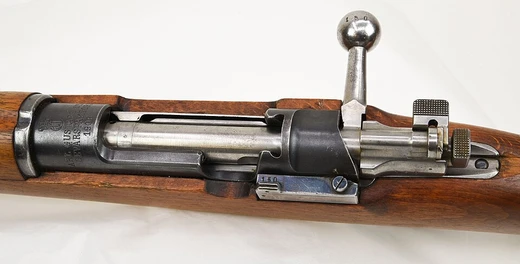
Karabin wz. 98a
Polish improved Mauser 98 rifle, standard issue before World War II.

Czesław Datka · Public domain
The karabin wz. 98a (kb wz. 98a) was a Polish bolt-action rifle developed in the late 1930s as an improved version of the earlier kb wz. 98 rifle, itself a derivative of the German Gewehr 98 Mauser. It was adopted in 1934 and produced from 1936, becoming one of the basic armaments of the Polish army before the outbreak of war in 1939.
Quick Facts
- Is Ranged
- yes
- Origin
- Poland
- Design Date
- 1934
- Production Date
- 1936 to 1939
- Service
- 1936–1940
- Used By
- Poland / Germany as Gewehr 299(p)
- Wars
- World War II
- Caliber
- 7.92 mm
- Part Length
- 740 mm
- Cartridge
- 7.92×57mm Mauser
- Feed
- 5 rounds internal box
- Action
- Bolt-action
Facts from the source article.
Lore & Background
The wz. 98a was developed due to changes in Polish military doctrine in the early 1930s, which rendered the earlier kbk wz. 29 carbine inadequate. In 1934, Poland decided to produce an improved version of the wz. 98 rifle. The new rifle featured a new notch sight and the improved bayonet attachment of the wz. 29. Production began at the National Arms Factory in Radom in 1936; the two-year delay was caused by the need to find an acceptable source of wood for the stocks.
Mechanically identical to the German Gewehr 98, the wz. 98a used a rotating bolt with two front locking lugs and a rear safety lug. It fed from a fixed five-round double-stack box magazine. The safety was mounted on the rear of the bolt assembly. Iron sights consisted of a tapered front blade and a tangent rear sight with a V-shaped notch, graduated from 100 to 2000 meters in 100-meter increments. The rifle could use bayonets wz. 22, wz. 24, wz. 25, wz. 27, wz. 28, or wz. 29.
Before the outbreak of war in 1939, 44,500 wz. 98a rifles had been produced. Captured examples were taken into service by the Wehrmacht as the Gewehr 299(p).
Reader's Guide
The wz. 98a represents Poland's effort to standardize its infantry armament after independence, when the army used a mix of Russian, Austrian, German, and French rifles firing different ammunition. The choice of the Mauser 98 action was facilitated by the transfer of machinery and equipment from the former Prussian Royal Arsenal in Danzig, which had produced the Gewehr 98 during World War I. The wz. 98a improved upon the earlier wz. 98 with updated sights and a better bayonet attachment, addressing doctrinal changes of the early 1930s. Although production was delayed by material sourcing issues, over 44,000 were made by 1939, making it a key rifle for Polish forces. Its capture and reuse by Germany as the Gewehr 299(p) underscores its compatibility with the Mauser system. The wz. 98a thus stands as a significant example of interwar Polish arms development, reflecting both the nation's industrial capabilities and the broader influence of the Mauser design.
Did You Know?
- The wz. 98a was adopted in 1934 but production did not start until 1936 due to the need for acceptable wood for stocks.
- Captured wz. 98a rifles were used by the Wehrmacht under the designation Gewehr 299(p).
- Only 44,500 wz. 98a rifles were produced before the outbreak of war in 1939.
Service Career and Combat Record
The Gewehr 98 entered German military service in 1898, taking over from the Gewehr 1888 as the principal infantry weapon. Its first taste of combat came during the Boxer Rebellion in China, where in 1901 it was issued to the East Asian Expeditionary Force, the Imperial German Navy, and three premier Prussian army corps. It then served as the primary German infantry rifle throughout World War I, and saw further military use by the Ottoman Empire and Nationalist Spain. By 1935, it was superseded by the Karabiner 98k carbine for the Wehrmacht under Nazi Germany. Production was on an industrial scale: 1904 contracts alone covered 290,000 rifles from Waffenfabrik Mauser and 210,000 from Deutsche Waffen und Munitionsfabriken. At the outbreak of WWI in 1914, the German Army held 2,273,080 Mauser 98 rifles of all types, and a further seven million were manufactured during the war itself.
The Controlled-Feed Bolt-Action System
The M98 controlled-feed bolt-action is widely regarded as one of the major bolt-action system designs in rifle history. The bolt body carries three locking lugs: two large main lugs at the head, the left one slotted, and a distinctive third safety lug at the rear that serves as a backup should the primary lugs fail. The two main lugs present a combined locking surface of 56 square millimetres. The receiver ring was enlarged to 35.8 mm in diameter compared to earlier Mauser small-ring designs at 33 mm, and the barrel shank grew to 28 mm with 15.88 mm of threaded area at 12 threads per inch. The controlled-feed mechanism employs a large, non-rotating claw extractor that grips the cartridge rim the instant it leaves the magazine, holding the case firmly until the ejector releases it. A cammed surface on the rear receiver bridge causes a slight bolt retraction at the first stage of the opening cycle, ensuring positive extraction regardless of how the rifle is positioned. The bolt handle is permanently attached and straight, protruding for optimal leverage.
Global Influence and the Path to Adoption
Paul Mauser patented the bolt-action design on 9 September 1895, and was already marketing the similar Mauser Model 1895 to numerous foreign governments before Germany itself adopted it. The German Army had relied on Mauser rifles from 1871 to 1888, but the 1888 replacement was an internal army design that proved impractical. During that intervening decade, Mauser rifles became recognized as the world standard, leaving the German Army effectively outclassed by a German-made product in the hands of other nations. The Gewehr-Prüfungskommission, the official rifle testing commission, formally adopted the Gewehr 98 on 5 April 1898, deriving the action from the experimental Gewehr 96. The design's engineering success soon led to its concepts being adopted by the United Kingdom, the United States, and Japan. A notable drawback, however, was that the system could not be cheaply mass-produced with ease, a limitation that shaped manufacturing decisions for decades.
Ammunition Evolution and Physical Specifications
The original 8 mm M/88 cartridge, introduced in 1888 and loaded with a 14.6-gram round-nose bullet, was replaced on 3 April 1903 by the 7.92×57mm Mauser S Patrone, which carried a lighter 9.9-gram spitzer bullet. This ammunition conversion was marked by a small letter S stamped above the chamber and on the barrel at the back of the rear sight base, a necessary distinction because the 1888 pattern and 1903 S-bore pattern are two different, non-interchangeable chamberings. The flatter trajectory of the new spitzer bullet also required the Lange Visier tangent rear sight to be modified with an S-adapted version. The rifle itself measured 1,250 mm in overall length, weighed 4.09 kg, and featured a 740 mm rifled barrel with an internal five-round magazine loaded via a stripper clip. It carried two sling swivels, open front sights, and the distinctive curved tangent-type rear sight.
Gallery

Frequently Asked Questions
What is the Karabin wz. 98a?
The Karabin wz. 98a (kb wz. 98a) is a Polish bolt-action repeating rifle that served as an upgraded successor to the earlier kb wz. 98. Its lineage traces back to the German Gewehr 98 Mauser, which Poland had previously adapted for its own service.
When was the kb wz. 98a adopted and who manufactured it?
Poland formally adopted the rifle in 1934, with serial production beginning in 1936 at the National Arms Factory in Radom. It was built specifically to replace the older wz. 98 pattern with improved ergonomics and reliability.
How many Karabin wz. 98a rifles were produced before the war?
Approximately 44,500 units were completed by the time hostilities broke out in 1939. That figure made it one of the most numerous standardized rifles in the Polish inventory at the start of the conflict.
What role did the kb wz. 98a play in Polish military service?
It was designated as a primary infantry armament, meaning it was the standard-issue long gun carried by most line soldiers. In that capacity it filled the same foundational role the Gewehr 98 had played in German and other Central European armies.
Why is the Karabin wz. 98a historically significant?
It represents Poland's final pre-war effort to modernize its small-arms stock before the German and Soviet invasion of September 1939. As the rifle most Polish riflemen actually carried into that war, it has become a symbol of the last peacetime generation of Polish military hardware.
More in Bolt-Action Rifles, Part 4 1-24
Spotted an error? Know more?
Reader corrections go straight into our review queue. Suggest an edit · How this site is sourced