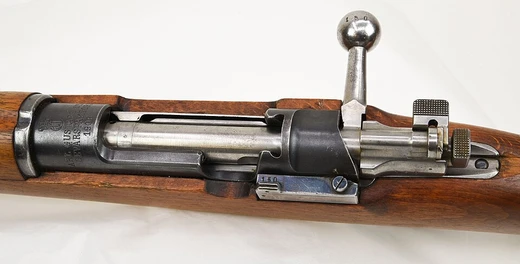
Kbk wz. 91/98/23
Polish Mosin–Nagant carbine converted to 7.92×57mm Mauser.

The Polish kbk wz. 91/98/23 was a carbine conversion of the Mosin–Nagant M1891 rifle, rechambered for the 7.92×57mm Mauser cartridge. Developed as a stopgap in the 1920s, it remained in Polish service until the country’s defeat in World War II, after which German forces also used some examples.
Following the Polish-Soviet War (1919–1921), Poland had captured a large number of Mosin rifles from various sources, including Russian factories (Izhevsk, Tula, Sestroretsk) and American manufacturers (Remington, New England Westinghouse). By January 1919, roughly 20% of Polish Army rifles were Mosins, and despite wartime losses, over 120,000 remained in service by 1922. Although the army adopted the Mauser-based kb wz. 98 as its standard rifle in the early 1920s, initial supplies were scarce. Since both Germany and the Ottoman Empire had successfully rebored captured Mosins to 7.9×57mm during World War I, Poland chose to do the same, shortening the rifles into carbines.
Between 1924 and 1927, about 77,000 Mosin rifles were modified by the Centralna Składnica Broni in Warsaw and ARMA Ltd. in Lwów. Some 3,000 unmodified Mosins were sent to the Spanish Republic during the Spanish Civil War aboard the SS Cieszyn, while the rest were sold on the civilian market, where they appeared alongside a similar Belgian commercial conversion (now known among collectors as "8 mm Blindee" for its Belgian proof marks indicating conversion for 7.9mm full metal jacket bullets).
The modifications included: rechambering for 7.92×57mm Mauser ammunition, with the magazine altered to feed rimless cartridges; overboring or replacing barrels; shortening the barrel by about 20 cm; shortening the barrel mounting; replacing the Russian spike bayonet mount with one compatible with Polish and German bayonets; modifying the lock, bolt group, and firing pin; adjusting sights for the 7.9mm bullet; modifying the ammunition clip; and adding straps to the butt and cradle.
The original wz. 91/98/23 retained the Russian spike bayonet. In 1925, a bayonet mounting bar was added to accept German and Polish knife bayonets (German Model 84/98, Polish wz. 22, wz. 24, and wz. 25), creating the kbk wz. 91/98/25. In 1926, a two-piece ejector/interrupter similar to Mauser mechanisms was introduced, resulting in the kbk wz. 91/98/26.
Quick Facts
- Origin
- Russian Empire · Soviet Union · Poland
- Is Ranged
- yes
- Service
- 1923 – 1945
- Used By
- Second Polish Republic / Nazi Germany (Captured pieces)
- Wars
- Invasion of Poland / World War II
- Design Date
- February 1920
- Manufacturer
- Centralna Składnica Broni / ARMA
- Production Date
- 1924 – 1927
- Number
- ~77,000
- Variants
- see Variants
- Weight
- 3.7 kg
- Length
- 100 cm
Facts from the source article.
Lore & Background
Poland captured large numbers of Mosin rifles of all types during the 1919–1921 Polish-Soviet War, including Russian-made rifles from Izhevsky Zavod, Tula Arms Plant and Sestroretsk Plant, and American-made Mosin–Nagant rifles by Remington and New England Westinghouse. By 20 January 1919 roughly 20% of the rifles used by the Polish Army were Mosins; despite losses during the war there were still over 120,000 Mosin–Nagant rifles in Polish service in 1922. Although in the early 1920s the army decided to adopt the Mauser-based kb wz. 98 rifle as the standard weapon, their supply was initially low, and since both Germany and the Ottoman Empire demonstrated during WWI it was possible to rebore captured Mosins to 7.9×57, it was decided to convert Polish rifles in the same way, shortening them to carbines in the process.
The modifications included rechambering to use 7.92×57mm Mauser ammunition, modifying the magazine to feed the rimless cartridge, overboring the barrels (or replacing them with new ones if needed), shortening the barrel by about 20 cm, shortening the barrel mounting, replacing the Russian spike bayonet mounting with a newly designed mounting compatible with Polish and German bayonets, modifying the lock and bolt group (also shortening the firing pin), modifying the sights to better suit the characteristics of the 7.9 caliber bullets, modifying the ammo clip to accept the new caliber, and adding additional straps to the butt and cradle. The original wz. 91/98/23 utilised the original Russian spike bayonet. In 1925 the design was modified with the addition of a bayonet mounting bar to allow the use of Polish and German knife bayonets used with Mauser rifles: the German Model 84/98, and the Polish wz. 22, wz. 24 and wz. 25 bayonets. It was immediately introduced as the kbk wz. 91/98/25. A year later the design was further modified with the addition of a two-piece ejector/interrupter, similar to mechanisms used in Mauser rifles. The final version was accepted by the Armed Forces as kbk wz. 91/98/26.
Reader's Guide
The kbk wz. 91/98/23 and its variants represent a pragmatic interim solution adopted by Poland in the 1920s to equip its forces while Mauser-based rifles were still scarce. By converting over 77,000 captured Mosin–Nagant rifles to fire the standard 7.92×57mm Mauser cartridge, Poland created a serviceable carbine that could be issued to cavalry, mounted artillery, and military police, as well as the 80th Infantry Regiment of the 20th Infantry Division. The conversion process was thorough, addressing barrel, magazine, bolt, sights, bayonet mounting, and ammunition feed. The subsequent wz. 91/98/25 and wz. 91/98/26 variants refined the design by adding a bayonet mounting bar and a two-piece ejector/interrupter, respectively. By 1929 the carbine was mostly replaced in active units by the new kbk wz. 29 carbine, but remaining guns were supplied to the State Police, Border Guard, and some units of the National Defence. At the outbreak of World War II and the German and Soviet invasion of Poland there were still some 76,400 pieces left in Polish inventory, most of which were destroyed during the war. Some unmodified Mosins were dispatched by SePeWe to the Spanish Republic during the Spanish Civil War aboard SS Cieszyn, and the rest were sold on the civilian market, where they were used alongside a similar Belgian commercial conversion now known as '8 mm Blindee' among modern collectors after their Belgian proof marks denoting conversion for 7.9-mm FMJ bullets. The carbine's legacy is that of a stopgap that served longer than intended, bridging the gap between wartime capture and standardized domestic production.
Did You Know?
- The kbk wz. 91/98/23 was a Polish modification of the Mosin–Nagant M1891 rifle to carbine form, using the 7.92×57mm Mauser cartridge.
- Between 1924 and 1927 roughly 77,000 Mosin rifles were modified at Centralna Składnica Broni of Warsaw and ARMA Ltd. of Lwów.
- The wz. 91/98/25 variant added a bayonet mounting bar for Polish and German knife bayonets, while the wz. 91/98/26 added a two-piece ejector/interrupter.
Italian Military Influence on Albanian Armament
The Kingdom of Albania maintained a modest military force that became deeply intertwined with Italian interests following the April 1939 invasion, which folded the country into the Italian Empire as a protectorate. Albanian units were restructured under Italian command and outfitted predominantly with Italian-manufactured small arms and equipment. During the Greco-Italian War of 1940–1941, Albanian soldiers fought alongside Italian forces against Greece, carrying Carcano rifles, Beretta pistols, and Italian machine guns as their primary armament. The sidearm roster included the Glisenti Model 1910, Beretta Model 1915, and the Beretta M1934 and M1935, the latter two serving as standard Italian service pistols. For close-quarters combat, the Beretta M38 and the earlier Beretta M1918 submachine guns appeared in limited numbers. The rifle line stretched from the Carcano M1891 and M38 down to the older Vetterli M1870, which lingered in limited service from the interwar era. Machine gun support came from the Breda M30 light and M37 medium models, supplemented by the aging Fiat-Revelli Modello 1914.
Shifting Alliances and the Flow of Weapons in Occupied Albania
The Armistice of Cassibile in 1943 triggered a dramatic reshuffling of armaments across Albania. Italian forces pulled out, and German troops moved in to occupy the country. The Wehrmacht began supplying certain Albanian formations with German-made weapons, introducing the Luger P08 in limited quantities, the MP 40 and MP 41 submachine guns, the Karabiner 98k rifle, and the MG 34 general-purpose machine gun. Simultaneously, the National Liberation Movement and Albanian partisan groups assembled their arsenals from a patchwork of sources: Allied airdrops delivered Sten submachine guns and Mosin-Nagant rifles, while captured Italian and German equipment filled the gaps. The result was a battlefield where a single Albanian unit might field a Beretta M38 seized from Italian stocks, an MP 40 taken from a German post, and a Sten received from an Allied drop. This patchwork of Italian, German, and Allied small arms reflected the fluid allegiances of the occupation period and the resourcefulness of resistance fighters operating between competing powers.
Australian Small Arms Across the Mediterranean and Pacific Theatres
The Second Australian Imperial Force deployed across the Mediterranean, Middle East, and Pacific theatres with a distinctive mix of Commonwealth and American small arms. Standard-issue sidearms included the Enfield No.2, the Smith & Wesson Victory, and the Webley Mk.VI in .455 caliber. For submachine gun roles, the Thompson M1928 and M1928A1 saw early service, while the Austen SMG was withdrawn from combat use in August 1944. The Owen gun, adopted in September 1941, became the standard Australian SMG in the Pacific Theatre. The Lee-Enfield No.1 Mk III* served as the backbone rifle, with a heavy-target variant designated for sniper work and the Pattern 1914 Enfield also pressed into that role. Squad and section-level fire came from the Lewis gun, Bren light machine gun, and the Vickers machine gun. Grenade options included the No.36M Mk.I, the No.69 Mk.I concussion grenade manufactured from red bakelite by Australian workshops, and the No.77 white phosphorus round. Heavier support ranged from the 2-inch and 3-inch mortars to the M2 flamethrower, while anti-tank defense relied on the Boys rifle and the PIAT.
Belgian Armament: From National Service to Free Forces
The Belgian Army entered World War II equipped with a blend of domestic and inherited weaponry, using its own stockpiles until the German conquest of 1940. The Browning Hi-Power, adopted as standard sidearm in 1935, joined older FN M1910 and M1922 pistols, the Nagant M1895, and the FN 1900. The Fusil Modèle 1935 was the standard rifle intended to replace the Belgian Mauser Model 1889, though modernized 1889/36 variants and the Mauser 1916 Carbine remained in service. German-supplied Gewehr 98 and Kar98 AZ rifles, received as World War I compensation, also appeared. Light machine gun support came from the Lewis gun, the FN Mle 1930 (a licensed copy of the Colt R75 based on the Browning Automatic Rifle Model 1925), the MG 08/15, and the Fusil-Mitrailleur 1915-27 for rear-line units. After the fall of Belgium, Free Belgian forces were re-equipped by the United Kingdom, adopting the Lee-Enfield No.4 Mk I rifle, the Bren light machine gun, and the Sten submachine gun. Colonial troops of the Force Publique in East Africa were forced to rely on outdated weaponry, including the Stokes Mortar.
Frequently Asked Questions
What is the kbk wz. 91/98/23?
It is a Polish carbine made by taking surplus Mosin–Nagant M1891 rifles and rechambering them to fire the 7.92×57mm Mauser cartridge. The long designation traces the original 1891/1898 Mosin lineage and adds the Polish modification year (1923, with 1925 and 1926 variants also seen).
Why did Poland convert Mosin rifles to Mauser caliber?
After the Polish-Soviet War the Polish Army held a massive stockpile of captured Mosins but wanted to standardize ammunition around the 7.92×57mm Mauser round already used by its other small arms. Rechambering existing rifles was a fast, inexpensive stopgap rather than designing and tooling an entirely new carbine.
How many kbk wz. 91/98/23 carbines were built and where?
Approximately 77,000 rifles were converted between 1924 and 1927. The work was split between the Centralna Składnica Broni arsenal in Warsaw and the ARMA Ltd. plant in Lwów.
What happened to the kbk wz. 91/98/23 in World War II?
The carbine remained in Polish service from the 1920s until the German invasion in 1939 brought the country's independence to an end. German forces captured and fielded a number of the remaining examples after the fall of Poland.
How does the kbk wz. 91/98/23 differ from a standard Mosin carbine?
Beyond the shortened carbine barrel, the critical change is the chamber: a standard Mosin carbine fires the rimmed 7.62×54mmR round, whereas the Polish conversion was reworked for the rimless 7.92×57mm Mauser case. This required altering the bolt face and headspace to suit the different cartridge geometry.
More in Bolt-Action Rifles, Part 4 1-24
Spotted an error? Know more?
Reader corrections go straight into our review queue. Suggest an edit · How this site is sourced