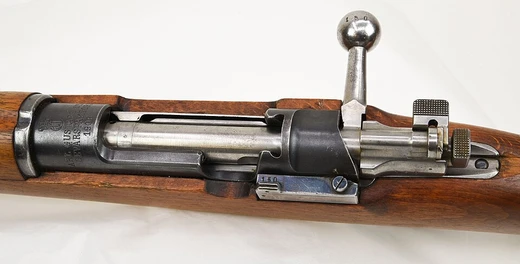
Swing rifle
Purpose-built target rifle with four-lug bolt and sub-1.7ms lock time.

The Swing rifle is a single-shot, bolt-action target rifle chambered in 7.62×51mm, developed by target shooting enthusiasts George Swenson and Laurie Ingram. It was designed to overcome the perceived limitations of military-derived actions like the Lee–Enfield and Mauser 1898, which dominated UK target rifle competition at the time. The rifle is notable for its extremely fast lock time of less than 1.7 milliseconds and its emphasis on trigger quality, incorporating a Mantaari-type match trigger.
Quick Facts
- Origin
- United Kingdom
- Is Ranged
- yes
- Designer
- George Swenson & Laurie Ingram
- Design Date
- 1972
- Manufacturer
- Swing Firearms Ltd
- Production Date
- 1972 – c. 1990
- Variants
- 5
- Cartridge
- 7.62×51mm
- Action
- Bolt-action
- Feed
- Single-shot
Facts from the source article.
Lore & Background
The Swing rifle originated from a collaboration of target shooting enthusiasts who gathered at Bisley in 1970. George Swenson, previously employed by London gunmaker John Wilkes of Beak Street, had commissioned a 'Universal' target sight and a copy of the Finnish Mantari match trigger, and was the UK importer of Schultz & Larsen cut-rifled barrels. These components later appeared in Swing products. Swenson stated his primary aim was to 'concentrate on the importance of the trigger'. The action name SWING is an acronym of SWenson and INGram.
The bolt design uses four locking lugs derived from the Schultz & Larsen Model 54J of 1953 and 62M of 1961, but moved to the front of the bolt. The lugs are positioned at 45 degrees when closed, described as a compromise between the vertical locking of the Mauser and the horizontal locking of the Lee–Enfield. The case recess in the bolt head is deeper (3mm) than the standard 2.5mm set by Mauser, necessitated by the radial sliding extractor. A spring-loaded ejector is fitted.
Development proceeded through several marks. The Mark 2 introduced a radial sliding extractor and improved finish. The Mark 3 featured an investment cast body with integrated recoil lugs, bolt lugs guided full travel length by slot rails, increased bolt lug diameter, and a one-piece bolt. The Mark 4 brought internal body improvements including UN 1040 × 16 tpi barrel threads, a longer barrel shank, ¼ × 28 UNF bedding screws, increased bolt lug diameter, reduced firing pin travel to lighten bolt opening, a new bolt stop, a light metal firing pin with redesigned hard tip, and extractor improvements. A Mark 5 exists but is believed to be only a number change.
Reader's Guide
The Swing rifle's significance lies in its departure from military-action-based target rifles, offering a purpose-built design that prioritized trigger quality and lock time. Its development was driven by the belief that existing designs like the Lee–Enfield and Mauser 1898 had reached their development potential, especially with commercial or hand-loaded ammunition. The rifle adhered to British National Rifle Association requirements for conventional design and safety while meeting competition size and weight constraints.
After George Swenson's death, William Floyd inherited parts and rights to the Swing rifle, and final production rifles were engraved with Swenson's signature, becoming collectable. Though no longer in production, the Swing's design features have been continued in rifles such as the RPA and Paramount. The model name SIN 71 Mk1 commemorated Swenson's disqualification by the NRA for using a diopter visual aid in his backsight, an aid now permitted. Years after his death, the NRA posthumously pardoned Swenson.
Did You Know?
- The Swing action name is an acronym of SWenson and INGram.
- The rifle's lock time was measured at less than 1.7 milliseconds.
- The bolt uses four front locking lugs derived from Schultz & Larsen designs.
More in Bolt-Action Rifles, Part 4 1-24
Spotted an error? Know more?
Reader corrections go straight into our review queue. Suggest an edit · How this site is sourced