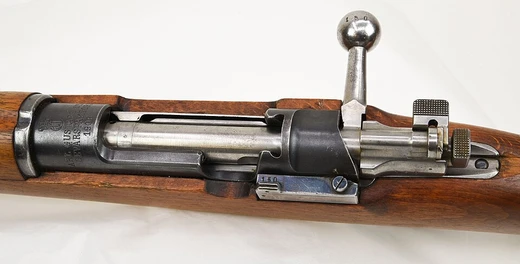
Pattern 1914 Enfield
A British bolt-action rifle produced in the United States during World War I.

The Pattern 1914 Enfield, a bolt-action rifle with a five-round internal magazine, was a British service arm from the First World War era. Though designed in Britain, most were built in the United States under contract. It saw use as a sniper rifle and for second-line or reserve troops, remaining in service until it was officially retired in 1947. This rifle came after the experimental Pattern 1913 Enfield and later led to the American M1917 Enfield.
The design originated from British experiences in the Second Boer War, where Boer Mausers firing a smaller, high-velocity 7mm round proved effective at long range. This prompted the War Office to develop a new "magnum" cartridge, the .276 Enfield, in 1910. A rifle using a modified Mauser action was created for it, the Pattern 1913 Enfield (P13). However, mass production was not underway when World War I began, and the logistical problems of introducing a new cartridge during wartime killed the project.
The primary contractor, Vickers, could only produce a handful of rifles, so the P14 became a secondary project. The Short Magazine Lee–Enfield remained the standard British rifle. Needing more weapons but lacking spare industrial capacity, the British government contracted with American firms—Winchester, Remington, and Eddystone (a Remington subsidiary set up for P14 production)—to manufacture the rifle. This continued until the U.S. entered the war in 1917. Each factory made slightly different parts, causing interchangeability problems. Thus, the rifle’s official designation included a letter for its maker: W for Winchester, R for Remington, or E for Eddystone. Issues with specifications, quality, and shortages of tools and skilled workers meant the first rifles were not accepted by British inspectors until February 1916. In December 1916, the bolt lugs were enlarged, creating the Mark I* variant, still marked by manufacturer letter. The earlier Mk I rifles were soon relegated to training and marked DP (Drill Purpose).
The P14’s main combat role in World War I was as a sniper rifle, as it was more accurate than the Lee–Enfield. Some used modified fine-adjustment aperture sights (designated Pattern 1914 Mk I W (F) or Mk I* W (F)), and from April 1918, Aldis telescopic sights (Pattern 1914 Mk I* W (T)). Winchester rifles were considered superior quality for these modifications.
Quick Facts
- Origin
- United Kingdom
- Is Ranged
- yes
- Service
- 1916–1945 (UK)
- Used By
- World War I · Estonian War of Independence · Spanish Civil War · World War II · Korean War · Annexation of Goa · Portuguese Colonial War · 1958 Lebanon crisis · Lebanese Civil War · Soviet–Afghan War
- Design Date
- 1914–1915
- Production Date
- 1915–1917
- Number
- 1,235,298 total
- Variants
- Sniper (telescopic and unmagnified), grenade launcher, US M1917 rifle
- Mass
- 9 lb unloaded
- Length
- 46.25 in
- Part Length
- 26 in
- Cartridge
- .303 British
Facts from the source article.
Lore & Background
During the Second Boer War, the British faced accurate long-range fire from Mauser rifles, prompting the War Office to develop their own 'magnum' round, the .276 Enfield, in 1910. An advanced new rifle using a modified Mauser M98-pattern action was built to fire it, the Pattern 1913 Enfield; effective mass production was still not in effect when World War I started due to logistical issues. Adapting the design to fire the standard .303 British round led to the Pattern 1914. The primary contractor Vickers was unable to produce more than a handful of rifles, so the British government contracted with U.S. commercial arms manufacturers Winchester, Remington and Eddystone to produce the P14. Each factory produced slightly differing parts, leading to interchangeability issues. The official designation of the rifle was dependent upon its manufacturer: e.g., the Pattern 1914 Mk I W is a Mk I of Winchester manufacture, R for Remington, or E for Eddystone. Problems were encountered with specifications, quality and shortage of machine tools and skilled workers, with the result that the first rifles were not accepted by British inspectors until February 1916. In December 1916, a modification was made to enlarge the bolt lugs and the rifle became the Mark I*.
Reader's Guide
The Pattern 1914 Enfield's principal combat use during World War I was as a sniper rifle, since it was found to be more accurate than the Short Magazine Lee–Enfield. It was used with modified aperture sights or Aldis telescopic sights, mainly on Winchester-manufactured rifles. In 1926, it was re-designated by the British military as the No.3 Mk I. Prior to and during World War II, over 670,000 Pattern 1914 Enfields were used after undergoing modification to the 'Weedon Repair Standard' (Mk II standard), mainly as a rearguard rifle. Post Dunkirk, the stock of No3Mk1 became a valued resource. It was again used as a sniper rifle, and the Australian Army also used some quantities of the sniper variant during World War II. Once sufficient numbers of Lee–Enfield and No.4 rifles were built up, the No.3 Mk I were relegated primarily to equip the British Home Guard or used as sniper rifles. Some sniper rifles were used during the Korean War. The P14/No.3 Mk I was declared obsolete in British service in 1947. Surplus P14s were sold throughout the Commonwealth, where they proved popular for full-bore target shooting and being sporterised for game shooting.
Did You Know?
- The P14 was originally designed for the .276 Enfield experimental cartridge before being adapted to .303 British.
- The rifle's bolt action was said to be the most advanced service rifle of World War I.
- The P14's internal box magazine could hold six rounds of .303 British, though stripper clips held only five.
- The U.S. sent some M1917 Enfield rifles to the UK under Lend-Lease, chambered in .30-06 Springfield.
More in Bolt-Action Rifles, Part 4 1-24
Spotted an error? Know more?
Reader corrections go straight into our review queue. Suggest an edit · How this site is sourced