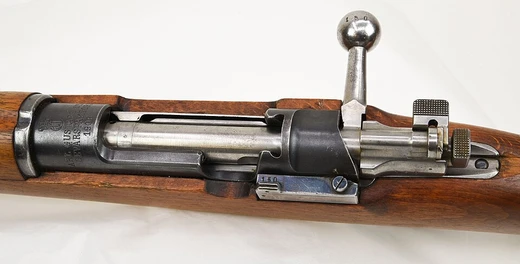
Pattern 1913 Enfield
Experimental British rifle designed for a high-velocity .276 rimless cartridge.

The Pattern 1913 Enfield (P13) was an experimental bolt-action rifle developed by the Royal Small Arms Factory for the British Army, intended as a replacement for the Short Magazine Lee–Enfield. Its design was influenced by combat experience in the Second Boer War, where Boer marksmen using Mauser rifles demonstrated the effectiveness of high-velocity, flat-shooting cartridges at long range. The rifle was chambered for a powerful .276 Enfield rimless round, but its introduction was rendered impractical by the outbreak of the First World War.
Quick Facts
- Is Ranged
- yes
- Origin
- United Kingdom
- Design Date
- 1912
- Production Date
- 1912–1914
- Caliber
- .276 inch (7.0 mm)
- Part Length
- 26 in
- Cartridge
- .276 Enfield
- Feed
- 5-round internal magazine with charger clip loading
- Action
- Modified Mauser bolt action
- Rate
- Manual, as determined by skill of operator
- Velocity
- 2785 ft/s
- Weight
- 8 lb (Empty)
Facts from the source article.
Lore & Background
The Pattern 1913 Enfield originated from British Army experience in the Second Boer War (1899–1902), where Boer marksmen using the Mauser Model 1895 in 7×57mm caliber could engage targets at long range, sometimes up to 2,000 yards. This prompted the War Office to develop a 'magnum' round in 1910, a .276-caliber rimless cartridge. In August 1910, the Small Arms Committee was asked to produce a new service rifle specification, calling for a Mauser-style action and a one-piece stock. Birmingham Small Arms (BSA) submitted a design, and in 1911 the Royal Small Arms Factory produced a modified Mauser-pattern rifle for the .276 cartridge, presented to the Small Arms Committee on 3 April 1911 by Assistant Superintendent Carnegie and Chief Designer Reavill.
Initial experiments ranged from .25 to .28 caliber. The Pattern 1911 variant included .276 and .256 calibers; the .256 was found inaccurate, and the .276 was adopted in mid-1911. Problems with pressure and jacket fouling led to cartridge redesign, and eleven Pattern 1911 and Pattern 1912 rifles were manufactured. In late 1912, limited production for troop trials was ordered: 1,000 rifles from RSAF. By end of 1912, 508 were completed; by end of January 1913, 1,251 had been manufactured. The rifle was distributed as the Rifle, Magazine, Enfield, .276-inch. Trials took place in Britain, Ireland, Egypt and South Africa with battalions from Suffolk and Munster, and the 5th Dragoon Guards. The Chief Inspector of Small Arms recommended changes, leading to six improved Pattern 1913 rifles made between March and April 1914. The outbreak of World War I abandoned the effort to introduce the smaller-caliber rimless cartridge.
The design combined features from the German Gewehr 98, American M1903 Springfield, and the British SMLE. It had a Mauser-type bolt with a low-profile 'dog-leg' bolt handle, an integral safety lug, and a large gas shield. The bolt locking lugs had a 4-degree helical angle with matching receiver seats, creating interrupted threading. The trigger had a mechanical interlock preventing firing unless the bolt was fully locked. The nickel-steel action was large and strong with a long bolt throw. The one-piece wooden stock had a metal butt plate with a bottom-hinged trap for cleaning items. The rifle had no magazine cut-off mechanism. It was distinguished by unusual angled finger grooves on the fore end, not present on later P14 or M1917 rifles.
Reader's Guide
The Pattern 1913 Enfield's significance lies in its role as a transitional design that never saw full adoption due to the First World War. Its development reflected the British Army's desire to match the long-range capabilities demonstrated by Boer marksmen, leading to a high-velocity .276 cartridge and a Mauser-inspired action. Although the P13 itself was not mass-produced, its design was adapted to fire the standard .303 British round as the Pattern 14 Rifle (P14), which was produced in the United States during the war. The P14 was further redesigned for US service as the M1917 Enfield, chambered in .30-06 Springfield. The P13's legacy is thus indirect: it provided the mechanical basis for two widely used military rifles. The few Pattern 1913 examples that exist are collector items, and some were later converted to target rifles in the UK. The rifle's helical locking lugs, cock-on-closing action, and aperture sight influenced later designs, but the SMLE remained the standard British rifle through World War I.
Did You Know?
- The Pattern 1913 Enfield was designed for a .276 Enfield rimless cartridge that was more powerful than the standard .303 British round.
- Only 1,251 Pattern 1913 rifles had been manufactured by the end of January 1913, with six improved versions made in early 1914.
- The rifle's unusual 'dog-leg' bolt handle placed the bolt knob just rearwards of the trigger for rapid cycling.
- The Pattern 1913 Enfield had no magazine cut-off mechanism, unlike the Short Magazine Lee-Enfield.
More in Bolt-Action Rifles, Part 4 1-24
Spotted an error? Know more?
Reader corrections go straight into our review queue. Suggest an edit · How this site is sourced