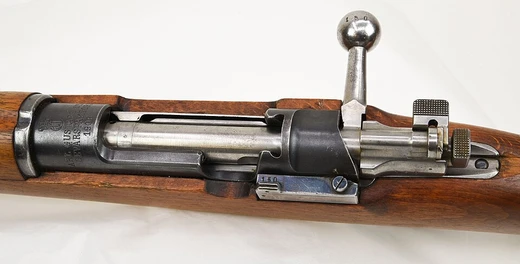
Lloyd rifle
A scope-integrated Mauser-action rifle for flat-shooting magnum cartridges.

The Lloyd Rifle is a bolt-action sporting rifle developed in the 1950s by English deer-stalker, rifleman, metallurgist and engineer David Llewellyn Lloyd. Designed for high accuracy at long ranges with telescopic sights, it was notable for its integral, receiver-enshrouding scope mount that aimed to maintain zero despite rough handling.
Quick Facts
- Origin
- UK
- Is Ranged
- yes
- Designer
- David Llewellyn Lloyd
- Manufacturer
- Lloyd Rifle Company
- Caliber
- .244 H&H Magnum, .264 Winchester Magnum and .25-06 Remington
- Action
- Mauser-type bolt action
- Feed
- Box magazine
- Sights
- Patented system of integral mounts for scopes only
Facts from the source article.
Lore & Background
David Llewellyn Lloyd, an enthusiastic stalker of Highland Red deer who killed more than 5,000 stags over 60 years, sought a rifle capable of flat trajectory and long-range hitting power on mountainous terrain. He selected the Mauser 98 action for its strength and accuracy potential, modifying only the bolt face and back-swept bolt handle. The rifle was designed without iron sights; the telescopic sight was held in a specially designed, integral mount that positioned the scope very low over the action and gripped both scope and action in massive steel rings. Lloyd held UK Patent Number 646419 for this design.
Most barrels were made by Vickers Armstrong Ltd., and Mauser 98 actions were prepared by Holland & Holland. Lloyd personally sourced walnut from European growers, often with assistance from his wife Evadne, and many rifles were stocked by Wisemans. He also worked closely with W. W. Greener, Webley & Scott, W.J. Jeffery, John Rigby and John Wilkes. Externally, the rifle had a streamlined profile with the scope mounted low and a stock of dark French walnut.
Lloyd had a private 400-yard rifle range at Pipewell Hall, Northamptonshire, where he set the zero of all rifles before delivery. The rifle was initially marketed as the 'David Lloyd Telescope Sighted Deer Stalking Rifle'. Most Lloyd rifles were chambered in .244 H&H Magnum, .264 Winchester Magnum and .25-06 Remington.
Reader's Guide
The Lloyd rifle was influential in mid-20th century sporting firearms and cartridge design. It was widely admired by British deer-stalking enthusiasts and international sporting arms experts. Owners included Bill Ruger, Roy Weatherby, Lord 'Skips' Riverdale, the Marquess of Linlithgow, and Mrs Patricia Strutt, who ordered one for her 75th birthday and used it until her death aged 89. Shooting Times magazine ranked it number 8 in its Top 12 Rifles of All Time, and Country Life declared Lloyd a 'National Living Treasure'. The rifles were generally accurate, most shooting to 1.5 MOA or better, but the massive scope mounts could bend and torque the actions, preventing full precision accuracy potential. Within the approximately 300-yard ranges for which they were designed and zeroed, Lloyd rifles in fast magnum calibres performed very well. After David Lloyd's death in 1996, his wife Evadne ran the Lloyd Rifle Company until her death in 2003. The company was then briefly owned by John Shirley, a former Technical Director of James Purdey and Sons, and its name, goodwill and records were offered for sale at auction in London on 14 December 2006.
Did You Know?
- David Lloyd killed more than 5,000 Red deer stags over a career of some 60 years.
- The Lloyd rifle had no iron sights and no provision for fitting them without difficulty.
- Lloyd rifles reportedly survived falls from considerable heights and being run over by vehicles without losing zero.
- The .244 H&H Magnum cartridge was developed by Lloyd himself.
More in Bolt-Action Rifles, Part 4 1-24
Spotted an error? Know more?
Reader corrections go straight into our review queue. Suggest an edit · How this site is sourced