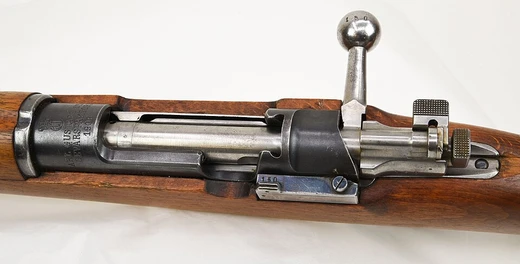
Lee–Metford
First British bolt-action service rifle, combining Lee's action with Metford's rifling.

The Lee–Metford was the first bolt-action rifle adopted by the British military. It paired James Paris Lee’s rear-locking bolt and detachable box magazine with William Ellis Metford’s shallow, seven-groove rifling. Issued to the army in 1888, the Lee–Metford Mk I weighed 9.5 lb, had a 30.2-inch barrel, an overall length of 4.125 ft, and a .303-inch calibre. Its magazine held eight rounds, housed in a sheet-steel box inserted through an opening beneath the trigger guard and held in place by a spring engaging a notch.
The cocking-piece could be set at half-cock for safe carrying. The bolt and bolt head were covered to protect against sand and mud. A safety-catch on the left side of the body, when pulled back with the rifle at full cock, prevented the trigger from being pressed. With the springs eased and the cocking piece forward, the action was locked and the bolt could not be opened accidentally. The stock comprised a fore-end and butt, with a projection under the rear of the butt forming a pistol grip. A stock bolt secured the butt to the body, and the butt plate had a trap for accessing the stock bolt recess, intended to hold an oil bottle and a steel jag (a cleaning implement that screwed onto the cleaning rod).
The nose cap had a bar on top for attaching the bayonet below the barrel. The cleaning rod was threaded at one end for the cleaning tip. A wooden handguard was fixed over the breech end of the barrel to prevent burns when hot, held in place by two steel springs clipped around the barrel. The rifle had two sets of sights: fixed front and rear sights in standard positions, plus extreme range sights. The jag was steel, tapped at one end for the cleaning rod and slotted at the other for cleaning material.
Initially, the Lee–Metford Mk I fired a .303-inch (actually .312-inch) cartridge. The case was solid-drawn brass and fully rimmed. The lead bullet had a nickel jacket, weighed 215 gr, and with 71.5 gr of black powder produced a muzzle velocity of 1,850 ft/s. This black-powder cartridge was already outdated by the rifle’s introduction, as rifle design had shifted to small-calibre smokeless powder cartridges offering higher velocities with less smoke and residue. After successful experiments, a smokeless cartridge was introduced in November 1891. Its case was solid-drawn brass with a formed cap chamber, separate anvil, and one fire-hole.
Quick Facts
- Origin
- United Kingdom
- Is Ranged
- yes
- Service
- 1888–present (ceremonial)
- Wars
- British colonial conflicts / First Sino-Japanese War / First Italo-Ethiopian War / Second Boer War / Boxer Rebellion / Irish War of Independence / Chaco War
- Designer
- James Paris Lee, RSAF Enfield
- Manufacturer
- RSAF Enfield
- Production Date
- 1884–1896
- Variants
- Mk I / Mk II / Mk II / Carbine Mk I
- Cartridge
- Cartridge .303 Mk I
Facts from the source article.
Lore & Background
The Lee-Metford was the very first bolt-action rifle introduced to the British Military. It combined the bolt action breech and box magazine of James Lee and William Metford's shallow segmental rifling. When issued to the Army in 1888 the Lee-Metford Mk I had a weight of 9.5 lb, a barrel length of 30.2 in, an overall length of 4.125 ft, and a calibre of 0.303 in. Its magazine had a capacity of eight rounds. The magazine consists of a sheet-steel box inserted in the body through an opening underneath and directly in front of the trigger-guard, held in position by a spring in the body engaging in a notch on the magazine.
The cocking-piece allows the action to be set at half-cock, enabling the rifle to be carried safely. The bolt and bolt head are covered to protect the action from sand and mud. On the left side of the body is a safety-catch which, when pulled back with the rifle at full cock, prevents the trigger from being pressed. With the springs eased and the cocking piece in the forward position, the action is locked and the bolt is prevented from being opened inadvertently. The stock consists of the fore-end and the butt, with a projection under the rear part of the small of the butt forming a so-called 'pistol grip'. A stock bolt secures the butt to the body of the rifle. The butt plate is fitted with a trap providing access to the empty portion of the stock bolt recess, intended to contain an oil bottle and a jag.
Initially the Lee-Metford Mk I fired a 0.303 in (actually 0.312 in) cartridge with a solid drawn brass fully rimmed case. The lead bullet had a nickel jacket and weighed 215 gr; with 71.5 gr of black powder it had a muzzle velocity of 1,850 ft/s. The cartridge was something of an anachronism due to its use of black powder. After successful experiments a smokeless cartridge was introduced in November 1891, using about 31 gr Cordite, a cupro-nickel jacketed flat-nosed bullet weighing about 215 gr, and giving a muzzle velocity of 1,970 ft/s.
Reader's Guide
The Lee–Metford holds significance as the first bolt-action rifle adopted by the British military, marking a transition from single-shot breechloaders to magazine-fed repeating arms. Its combination of Lee's rear-locking bolt and detachable box magazine with Metford's rifling established a design lineage that would evolve into the Lee–Enfield, which served for decades. The rifle's service life was brief, however, because its black-powder cartridge was already obsolete at introduction; the shift to smokeless powder in 1891 necessitated changes that led to the Lee–Enfield. Variants such as the Mark I*, Mark II, Mark II*, and Carbine Mark I show incremental refinements in sights, safety mechanisms, magazine capacity, and barrel length. The carbine version, with a 20.75 in barrel and 6-round magazine, weighed only 7.43 lb. The Lee–Metford was used by Liberal rebels in 1904 (3,000 brought into the country) and saw service during the Chaco War. Its legacy lies in being the foundational British bolt-action service rifle, demonstrating the viability of the Lee action and box magazine system that would be perfected in later models.
Did You Know?
- Its magazine was a sheet-steel box inserted through an opening underneath and in front of the trigger-guard.
- The initial cartridge used black powder, but a smokeless Cordite cartridge was introduced in November 1891.
More in Bolt-Action Rifles, Part 4 1-24
Spotted an error? Know more?
Reader corrections go straight into our review queue. Suggest an edit · How this site is sourced