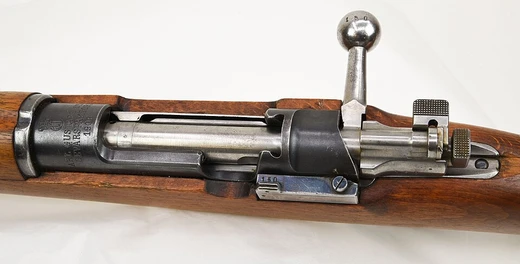
Lee–Enfield
The fastest military bolt-action rifle of its day.

The Lee–Enfield is a bolt-action, magazine-fed repeating rifle that was the primary firearm for the military forces of the British Empire and Commonwealth through the first half of the 20th century. It served as the British Armed Forces' standard service rifle from its official adoption in 1895 until 1957. A redesign of the earlier Lee–Metford (adopted in 1888), the Lee–Enfield replaced both that rifle and the older Martini–Henry and Martini–Enfield models. It used a ten-round box magazine loaded manually from the top with the .303 British cartridge, either one round at a time or via five-round chargers. This rifle was the standard-issue weapon for rifle companies in the British Army, colonial forces (such as those in India and parts of Africa), and other Commonwealth nations—including Australia, New Zealand, South Africa, and Canada—during both World Wars. Although officially replaced in the United Kingdom by the L1A1 SLR in 1957, it remained in widespread British service until the early to mid-1960s, and the 7.62 mm L42A1 sniper variant stayed in use until the 1990s. As a standard-issue infantry rifle, it is still found in service with some Commonwealth armed forces, notably the Bangladesh Police, making it the second longest-serving military bolt-action rifle still officially in use, after the Mosin–Nagant (whose receivers are used in the Finnish 7.62 Tkiv 85). Total production of all Lee–Enfields is estimated at over 17 million rifles.
The rifle takes its name from the designer of its bolt system, James Paris Lee, and the location where its rifling design was created, the Royal Small Arms Factory in Enfield. The Lee–Enfield was derived from the earlier Lee–Metford, a mechanically similar black-powder rifle that combined Lee's rear-locking bolt system with rifling designed by William Ellis Metford. The bolt has a relatively short throw and features rear-mounted lugs, with the bolt handle positioned just behind the trigger in a comfortable ergonomic spot close to the operator's hand. The action uses helical locking surfaces, technically called interrupted threading, meaning the final headspace is achieved only when the bolt handle is fully turned down.
Quick Facts
- Origin
- United Kingdom
- Is Ranged
- YES
- Service
- 1895–1957 (as the standard British service rifle)
- Designer
- James Paris Lee
- Production Date
- MLE: 1895–1904 / SMLE: 1904–1957
- Weight
- 9.24 lb (Mk I) / 8.73 lb (Mk III) / 9.06 lb (No. 4)
- Length
- MLE: 49.6 in / SMLE No. 1 Mk III: 44.57 in / Rifle No. 4 Mk I: 44.45 in / LEC: 40.6 in / Rifle No. 5 Mk I: 39.5 in
- Part Length
- MLE: 30.2 in / SMLE No. 1 Mk III: 25.2 in / Rifle No. 4 Mk I: 25.2 in / LEC: 21.2 in / Rifle No. 5 Mk I: 18.8 in
- Cartridge
- .303 British / 7.92×57mm Mauser (Ottoman Empire conversions) / 7.62×51mm NATO (For L8 rifles, the L42A1 and some No. 4s only)
- Action
- Bolt-action
- Rate
- 20–30 aimed shots per minute
Facts from the source article.
Lore & Background
The Lee–Enfield takes its name from the designer of the rifle's bolt system—James Paris Lee—and the location where its rifling design was created—the Royal Small Arms Factory in Enfield. It was derived from the earlier Lee–Metford, a mechanically similar black-powder rifle, which combined James Paris Lee's rear-locking bolt system with rifling designed by William Ellis Metford. The bolt has a relatively short throw and features rear-mounted lugs, with the bolt knob positioned just rearwards of the trigger. The action uses helical locking surfaces, meaning final headspace is not achieved until the bolt handle is turned down all the way. The rifle was equipped with a detachable sheet-steel, 10-round, double-column magazine. Early models used a short length of chain to secure the magazine to the rifle.
The Lee–Enfield was adapted to fire the .303 British service cartridge, a rimmed, high-powered rifle round. Experiments with smokeless powder in the existing Lee–Metford cartridge wore away the shallow Metford rifling after approximately 6,000 rounds; replacing this with a new square-shaped rifling system designed at RSAF Enfield solved the problem. The best-known model, the Short Magazine Lee–Enfield Mk III, was introduced on 26 January 1907. It featured a simplified rear sight, a fixed charger guide, improved handguards and magazine, and was adapted to fire the new Mk VII high velocity spitzer .303 ammunition. During the First World War, the Mk III* was introduced with several simplifications, including deletion of the magazine cut-off mechanism and long-range volley sights.
Reader's Guide
The Lee–Enfield's design features facilitated rapid cycling and fire compared to other bolt-action designs like the Mauser. The Lee bolt-action and 10-round magazine capacity enabled a well-trained rifleman to perform the 'mad minute', firing 20 to 30 aimed rounds in 60 seconds, making the Lee–Enfield the fastest military bolt-action rifle of the day. The current world record for aimed bolt-action fire was set in 1914 by Sergeant Instructor Snoxall, who placed 38 rounds into a 12-inch target at 300 yards in one minute. Several First World War accounts tell of British troops repelling German attackers who reported encountering machine guns, when in fact it was simply a group of well-trained riflemen armed with SMLE Mk III rifles.
The Lee–Enfield was the standard-issue weapon to rifle companies of the British Army, colonial armies (such as India and parts of Africa), and other Commonwealth nations in both World Wars. Although officially replaced in the United Kingdom with the L1A1 SLR in 1957, it remained in widespread British service until the early/mid-1960s, and the 7.62 mm L42A1 sniper variant remained in service until the 1990s. It is still found in service in the armed forces of some Commonwealth nations, notably with the Bangladesh Police, making it the second longest-serving military bolt-action rifle still in official service, after the Mosin–Nagant.
More in Bolt-Action Rifles, Part 4 1-24
Spotted an error? Know more?
Reader corrections go straight into our review queue. Suggest an edit · How this site is sourced